Try GOLD - Free
Slavery, exploitation and racism. These tragedies have long dominated histories of Africa. But there's another way to tell this story. And it's one that puts Africans right at the centre of their continent's extraordinarily rich and vibrant past
BBC History UK
|February 2025
An 1414, in the Chinese city of Nanjing, a giraffe caused a stir. Amid a crowd of shocked, noble spectators, an official, leading the creature via a rope tied round its face, presented it to China's Yongle emperor. His officials said it was a qilin - an auspicious unicorn - which his sage governance had made appear.
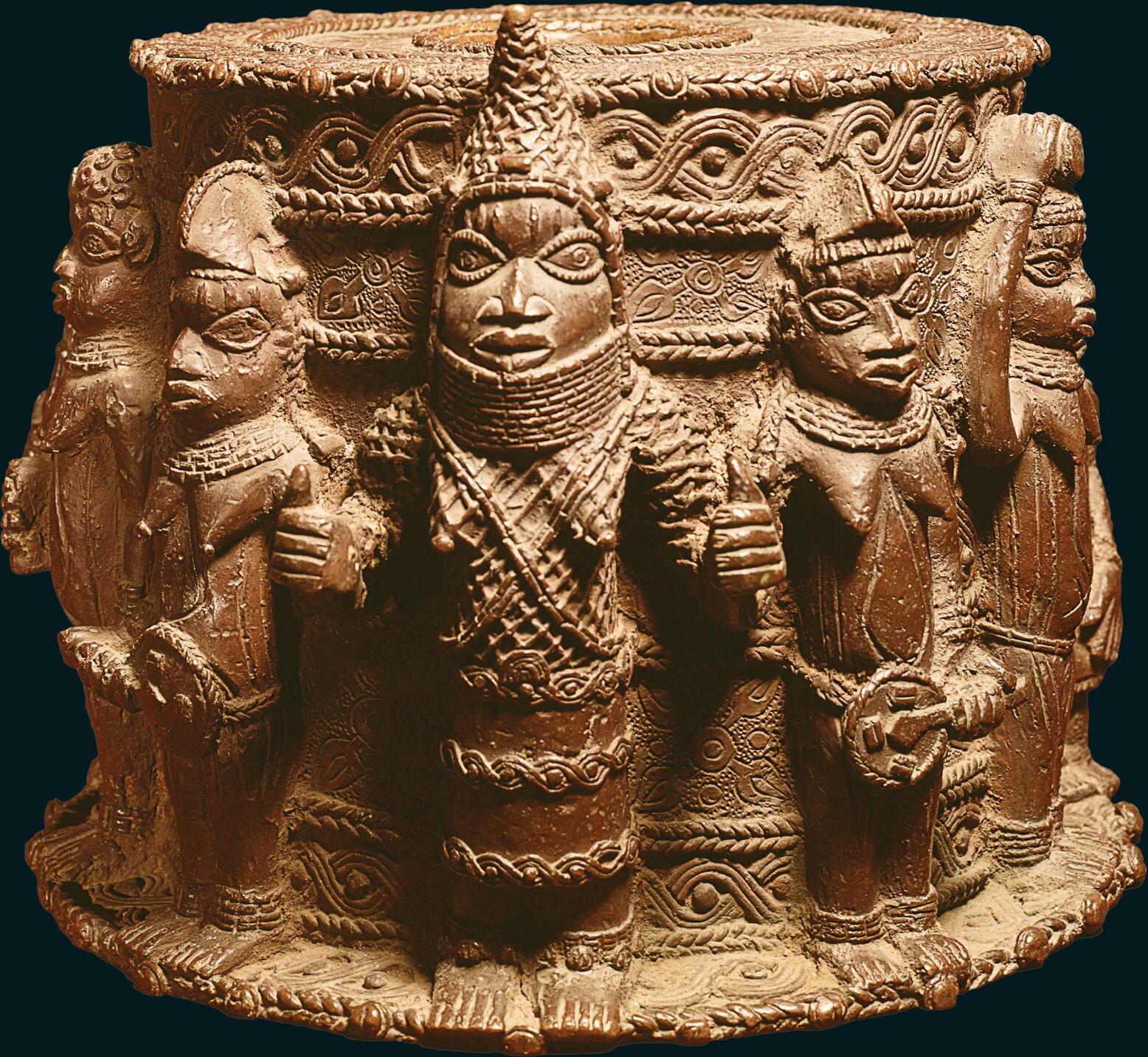
This giraffe was a gift from the sultan of Bengal. But it had originally come from Africa - specifically, the city-state of Malindi in today's Kenya. In 1415, ambassadors from Malindi and Mogadishu sailed to China. In a special ceremony, the Malindi ambassadors gifted the Yongle emperor another giraffe. Delighted at having received his second qilin, the Yongle emperor gave an order. His senior eunuch, Zheng He, whom he'd charged with overseeing the construction of a 200-strong fleet of treasure ships, was to sail to Malindi to obtain more giraffes and other goods.
With the holds of his ships full of treasures, including gold, silver, silk and ceramics, Zheng He set sail for Malindi in 1417. He exchanged what he had for goods including live animals such as leopards and zebras, frankincense and ivory. Sometime between then and 1423, Malindi's king himself sailed to China to meet the Yongle emperor in Nanjing. He made it as far as Fujian, a province in south-eastern China, where he died, seemingly succumbing to illness. He was buried in Fujian, and the Yongle emperor decreed that his grave be given a small sacrifice every year.
This is an intriguing story. But for Africa, it's not extraordinary. For at least 2,000 years, African civilisations have been plugged into international trade networks. Third-century AD Nubia (now northern Sudan and southern Egypt) exported goods including gold, ivory and ostrich feathers to Rome and Yemen. Along Africa's eastern coast, from northern Somalia to southern Tanzania, east African merchants exchanged similar goods for date syrup from Persian traders, swords from Yemenis and carnelian beads from Indians.


This story is from the February 2025 edition of BBC History UK.
Subscribe to Magzter GOLD to access thousands of curated premium stories, and 10,000+ magazines and newspapers.
Already a subscriber? Sign In
MORE STORIES FROM BBC History UK

BBC History UK
On the skids
Richard Rodgers and Oscar Hammerstein II's smash musical Oklahoma! opened on Broadway on 31 March 1943.

1 min
Christmas 2025

BBC History UK
Small pleasures
Memory is imperfect, but what if you could get a professional model maker to recreate a moment from the past?
1 min
Christmas 2025

BBC History UK
Bath in five places
In the Georgian era, Bath became arguably Britain's most fashionable destination. KIRSTEN ELLIOTT promenades five historic highlights
3 mins
Christmas 2025
BBC History UK
End times
Why do civilisations that dominated their epoch fail? In an era of autocracy, climate change, the rise of Al and a first-hand understanding of how deadly pandemics can be, it's a question that seems pertinent.
1 min
Christmas 2025
BBC History UK
What are the origins of the Yule Lads?
To learn about the Jólasveinar (Yule Lads), we must start with their mother, the terrifying ogress Grýla. Her name appeared in Icelandic texts as early as the 13th century, although it wasn’t until later that those 13 mischievous lads became associated with her. Folk tales and poems tell how she descends from the mountains with an empty sack to stuff full of children. Grýla owns the monstrous Jólaköttur (Yule Cat), which roams the countryside on Christmas Eve, searching for children to gobble up if they're not wearing new clothes.
1 mins
Christmas 2025

BBC History UK
Santa Claus v Father Christmas
The true identity of the white-bearded, red-robed figure who fills children's stockings at Christmas has long been debated. Thomas Ruys Smith sizes up the merry contenders
8 mins
Christmas 2025

BBC History UK
Frontier friction
Set in Washington Territory in 1854, The Abandons is a Western that's unusual for having two matriarchs, women whose lives become entangled, at its centre.
1 min
Christmas 2025

BBC History UK
The Last Days of Pompeii: The Immersive Experience
Delve into the culture of daily Roman life, witness the momentous eruption of Mount Vesuvius, and follow its fallout in Immerse LDN's new exhibition. In a blend of cutting-edge technology and vivid storytelling, this exhibition launches visitors into Pompeii's rich history with recreations of the ancient city's beautiful pre-eruption landscape, a 360-degree virtual reality Roman amphitheatre experience, and a digital metaverse recreating Pompeii's 'Villa of Mysteries'.
1 min
Christmas 2025

BBC History UK
Elizabeth Marsh The corsair's captive
Taken hostage by a Barbary ship's captain in the 18th century, a young Englishwoman found herself fighting for her freedom in Marrakech. ADAM NICHOLS introduces a brave captive who later wrote a book about her dramatic experiences
6 mins
Christmas 2025
BBC History UK
29 DECEMBER 1170: Thomas Becket is murdered in Canterbury
Knights loyal to Henry II rid him of the “low-born cleric”
2 mins
Christmas 2025
Listen
Translate
Change font size