
Go Unlimited with Magzter GOLD
Get unlimited access to 10,000+ magazines, newspapers and Premium stories for just
Try GOLD - Free
Breed Focus: Ouessant Sheep
The Country Smallholder
|Spring 2023
Helen Babbs finds out about the world's smallest sheep breed

Island sheep breeds are typically small, and the ultimate example of this is the Ouessant sheep, from the small French island of Ouessant, off the west coast of Brittany. These hold the record for being the smallest sheep breed in the world. "A ram stands 49cm or lower at the shoulder, and a ewe 46cm," explains Adrian Lloyd, who keeps a pedigree flock on his smallholding in Cumbria. This sounds small, but Ouessants start life even smaller! "When the lambs are born, they're about the size of a 6 month old kitten."
SMALL BUT PRODUCTIVE
Unlike many dwarf breeds of livestock, Ouessant sheep are still productive, growing 1-1.5kg fleece each year - comparable to many larger breeds and in fact have more fleece per kg of sheep than most other breeds! "They have big fleeces," says Adrian, "in shades of black, brown and white. The staple, which is the length of the fleece, is 8-10 cms on average and around 25-28 microns." Their fleece covers the whole body and upper legs, and extends to their cheeks and foreheads, although the muzzle and ears are wool-free. Like most other primitive breeds, Ouessants have a well packed double layered fleece, with a longer, coarser outer coat and a shorter, fine undercoat. "It's very popular with hand spinners," Adrian notes, "and I'm currently using some for a peg-loom project too."
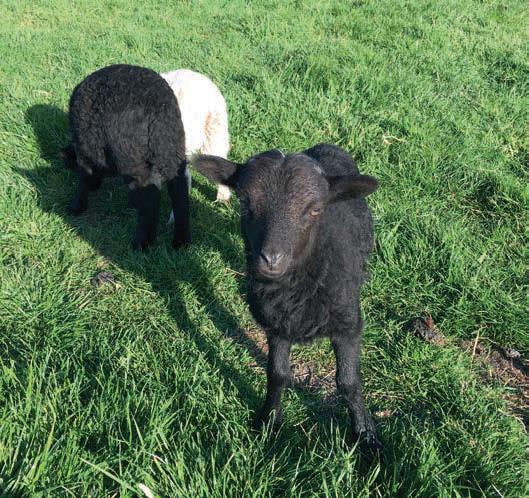
Under their big fleeces, Ouessants are the same mix of colours, with the dark sheep having dark skin, and dark hair on their faces and lower legs, while the white sheep have pink skin and white hair. Although the ewes are naturally polled, the rams have a single pair of large, curved horns, again dark or light to match their fleece.

This story is from the Spring 2023 edition of The Country Smallholder.
Subscribe to Magzter GOLD to access thousands of curated premium stories, and 10,000+ magazines and newspapers.
Already a subscriber? Sign In
MORE STORIES FROM The Country Smallholder
The Country Smallholder
Making sure you put enough nutrition into your dairy goat to support her milk production
Sarah Day, nutritionist for Small Holder Feed offers feeding advice for your dairy goats to help them be happy, healthy and milky animals.

6 mins
March 2026
The Country Smallholder
Welcoming the very start of the spring season
Henrietta Balcon makes the most of the new crop rhubarb
2 mins
March 2026
The Country Smallholder
Starting with Pigs - before you start
Linda Aldous outlines what you need to do before anything porcine arrives on your smallholding
3 mins
March 2026
The Country Smallholder
Insurance to protect livestock - and your peace of mind
Looking ahead to a busy 2026 for Pedigree Sales, farmers and breeders will be preparing their livestock for the upcoming markets
2 mins
March 2026

The Country Smallholder
Getting Your Electric Fence Spring-Ready: Expert Q&A
As Spring arrives, it’s the perfect time to give your electric fence some attention. Based on questions we discuss regularly here at www.electricfencing.co.uk, here’s a list of the checks you should be carrying out now, and why they matter.
2 mins
March 2026

The Country Smallholder
Check your kit for the busy seasons ahead
Agricultural journalist, and machinery writer Jane Brooks, joins us for her regular look at the world.
4 mins
March 2026
The Country Smallholder
Flock together: is now the right time to add more hens?
Andy Hill explains how to integrate birds into a flock without feathers flying
4 mins
March 2026
The Country Smallholder
The secrets behind maximising incubator hatch rates
Buying quality point of lay hens can be an expensive proposition these days (even if you can find a local source of the breed that you want). Incubating fertilised eggs can save a great deal of money and make many more breeds accessible. If you already keep poultry that includes a cockerel, an incubator means that you can hatch their eggs either to increase your flock or to sell. Hugh & Fiona Osborne have been using incubators for many years and have learned that getting a good hatch means attention to detail.
7 mins
March 2026
The Country Smallholder
Making choices for your chicks
Victoria Roberts BVSc MRCVS says Natural and Artifical Incubation are not an either/or choice
5 mins
March 2026

The Country Smallholder
An appetite for asparagus
Our Experts answer your questions
1 mins
March 2026
Translate
Change font size