
Go Unlimited with Magzter GOLD
Get unlimited access to 10,000+ magazines, newspapers and Premium stories for just
CROCODILE ISLAND
BBC Wildlife
|September 2022
Welcome to Lago Enriquillo: the undisputed crocodile capital of the Caribbean

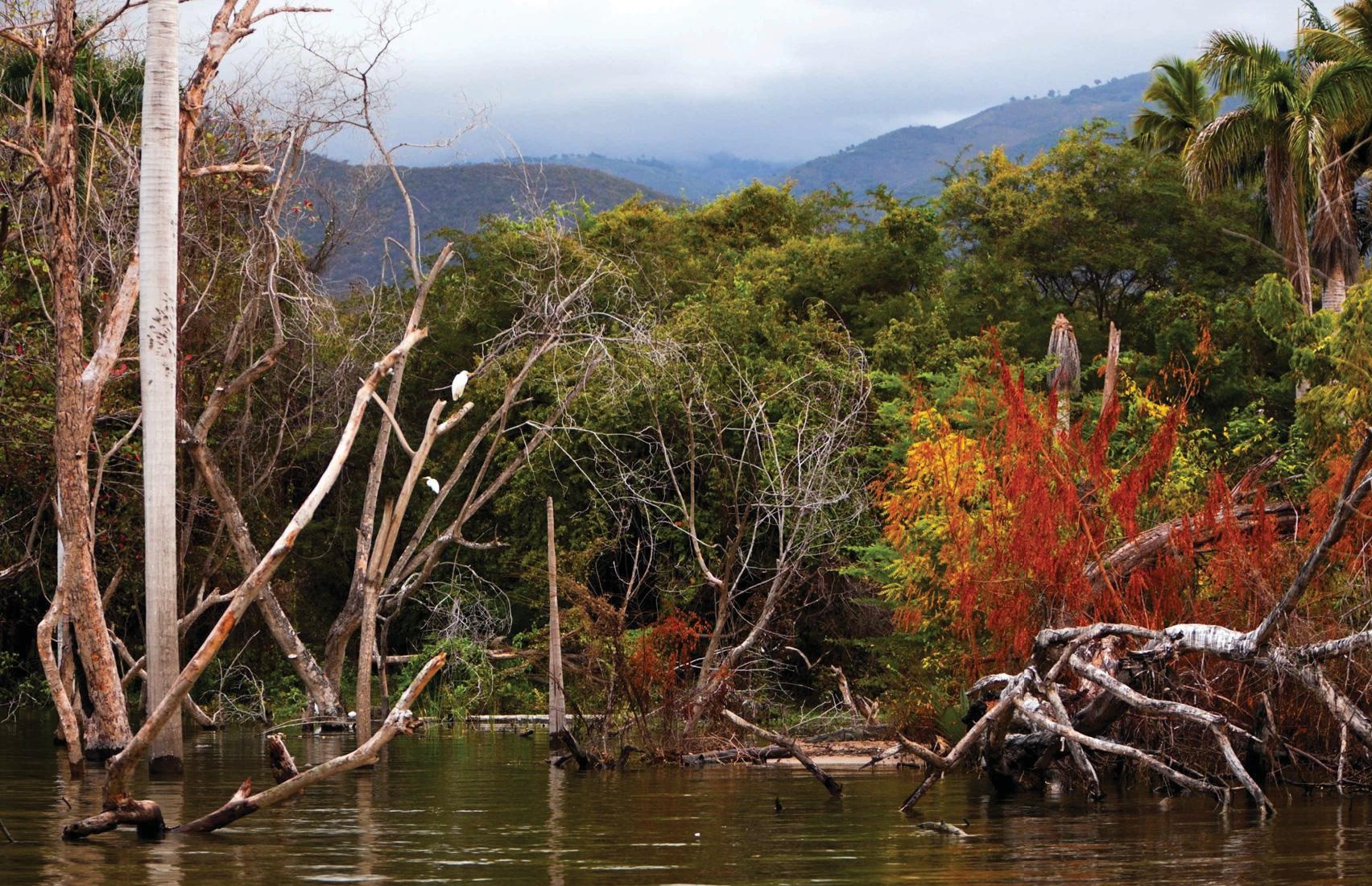
LAGO ENRIQUILLO IS A LAKE THAT DEMANDS description in superlatives. Stretching across an arid valley in the south-west corner of the Dominican Republic, near the country's border with Haiti but far from the holiday hubs of Punta Cana and Puerto Plata, the lake is unique, in the most literal sense of the word. To start with the basics, it is the country's largest lake. In fact, Lago Enriquillo is the largest lake in the entire Caribbean.
The lake's most extraordinary features, however, are found in its exceptional ecology. Among other distinctions, it is home to the world's largest population of American crocodiles, themselves one of the largest crocodilian species in existence. The largest males reach 6m in length. American crocodiles are also one of only two crocodilians to thrive in saltwater, along with Australia's famous 'salties'.
This saltwater tolerance is relevant because, despite being inland and river-fed, Lago Enriquillo is a saltwater lake. Moreover, it is a hypersaline lake, up to three times saltier than the ocean. At 46m below sea level, Lago Enriquillo's shoreline is the lowest elevation found on any ocean island in the world (yet another superlative). To merge with the Caribbean Sea, its waters would have to flow uphill.
The lake's submarine altitude is a result of events that occurred in the area's deep geologic past. Today, Hispaniola (the large island that comprises both the Dominican Republic and Haiti) is a single, relatively large island. Millions of years ago, however, it was two smaller landmasses: one larger island that became the bulk of modern Hispaniola, and a second, smaller island that became the southwestern Dominican Republic and southern Haiti (this geology lesson will be relevant later).

This story is from the September 2022 edition of BBC Wildlife.
Subscribe to Magzter GOLD to access thousands of curated premium stories, and 10,000+ magazines and newspapers.
Already a subscriber? Sign In
MORE STORIES FROM BBC Wildlife
BBC Wildlife
"I was terrified the elephant would ram us"
African elephant in Kenya

2 mins
January 2026
BBC Wildlife
ALL YOU EVER NEEDED TO KNOW ABOUT THE Fennec fox
THE FENNEC FOX IS THE SMALLEST fox in the world, with a body length that can be as little as 24cm.
3 mins
January 2026
BBC Wildlife
INTO THE PLASTISPHERE
A unique synthetic ecosystem is evolving in our oceans – welcome to the plastisphere
7 mins
January 2026
BBC Wildlife
“More than half of all animal life exists in a parasitic relationship, and all life lives in symbiosis”
Our survival depends on species evolving to live together - but some relationships take dark turns
7 mins
January 2026
BBC Wildlife
Are animals able to dream?
SLEEP IS A MYSTERIOUS THING. FOR A long time, we weren't sure why we do it.
1 mins
January 2026
BBC Wildlife
Does a cuckoo know it's a cuckoo?
ABSURD LITTLE BIRDS ACROSS THE world lay their eggs in the nests of other species, leaving the hapless parents to raise a changeling at the expense of their own offspring.
2 mins
January 2026
BBC Wildlife
Orcas killing young sharks
Juvenile great whites are easy prey for orca pod
1 mins
January 2026
BBC Wildlife
Ocean goes on tour
Acclaimed film touring the UK, backed by live orchestra and choir
1 min
January 2026
BBC Wildlife
Feisty bats hunt like lions
Winged mammals use a 'hang and wait' strategy to take down large prey
1 mins
January 2026

BBC Wildlife
SNAP-CHAT
Richard Birchett on magical merlins, wily coyotes and charging deer
2 mins
January 2026
Translate
Change font size