Try GOLD - Free
COWS COME HOME
BBC Wildlife
|December 2023
Tauros are the closest thing to the extinct aurochs. And they are coming to the UK.

IN 2022, A FILM CREW working on the Lika Plains near the Adriatic coast of Croatia picked up some remarkable behaviour. A small herd of aurochs had been released into the area a few years earlier, and thermal-imaging video footage showed the bulls responding to the threat of a pack of wolves by forming a semi-circle and facing outwards with their fearsome horns to the front.
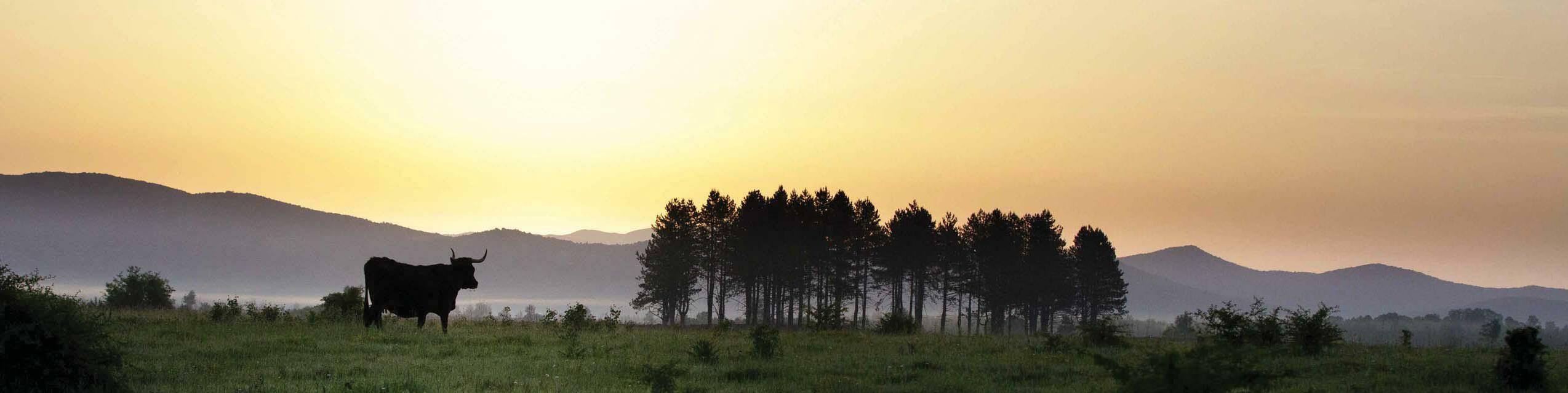
Cows and calves sheltered behind this defensive shield, along with a group of wild horses, including a foal.
Ronald Goderie, a Dutch ecologist who has been closely involved in the European rewilding movement for four decades, says there is historical evidence of aurochs protecting themselves in this way, and of other species taking advantage of it. “That’s what we had heard, but it had never been filmed,” he adds. “It’s a semi-circle with cows and wild horses behind it, and the wolves outside showing a lot of aggression.”
The footage demonstrated how the release of the aurochs into this part of Croatia was beginning to recreate interactions between megafauna that have not been seen in Europe for hundreds, if not thousands, of years. It showed just how far rewilding has come in the past two or three decades. And it revealed that aurochs – a species whose last surviving individual died in 1627 – were playing their part in creating this new, wilder continent.
These same animals could be coming here to the UK – to the Isle of Arran in the Firth of Clyde, to be precise. And while they’re not going to be hunted by wolves, it will be intriguing to see how they behave and what impact they have when they arrive.


This story is from the December 2023 edition of BBC Wildlife.
Subscribe to Magzter GOLD to access thousands of curated premium stories, and 10,000+ magazines and newspapers.
Already a subscriber? Sign In
MORE STORIES FROM BBC Wildlife
BBC Wildlife
"I was terrified the elephant would ram us"
African elephant in Kenya

2 mins
January 2026
BBC Wildlife
ALL YOU EVER NEEDED TO KNOW ABOUT THE Fennec fox
THE FENNEC FOX IS THE SMALLEST fox in the world, with a body length that can be as little as 24cm.
3 mins
January 2026
BBC Wildlife
INTO THE PLASTISPHERE
A unique synthetic ecosystem is evolving in our oceans – welcome to the plastisphere
7 mins
January 2026
BBC Wildlife
“More than half of all animal life exists in a parasitic relationship, and all life lives in symbiosis”
Our survival depends on species evolving to live together - but some relationships take dark turns
7 mins
January 2026
BBC Wildlife
Are animals able to dream?
SLEEP IS A MYSTERIOUS THING. FOR A long time, we weren't sure why we do it.
1 mins
January 2026
BBC Wildlife
Does a cuckoo know it's a cuckoo?
ABSURD LITTLE BIRDS ACROSS THE world lay their eggs in the nests of other species, leaving the hapless parents to raise a changeling at the expense of their own offspring.
2 mins
January 2026
BBC Wildlife
Orcas killing young sharks
Juvenile great whites are easy prey for orca pod
1 mins
January 2026
BBC Wildlife
Ocean goes on tour
Acclaimed film touring the UK, backed by live orchestra and choir
1 min
January 2026
BBC Wildlife
Feisty bats hunt like lions
Winged mammals use a 'hang and wait' strategy to take down large prey
1 mins
January 2026

BBC Wildlife
SNAP-CHAT
Richard Birchett on magical merlins, wily coyotes and charging deer
2 mins
January 2026
Translate
Change font size