
Mit Magzter GOLD unbegrenztes Potenzial nutzen
Erhalten Sie unbegrenzten Zugriff auf über 9.000 Zeitschriften, Zeitungen und Premium-Artikel für nur
German kitchens, Japanese amps, and Afropop gems
Stereophile
|December 2024
BRILLIANT CORNERS - I have a day job at a museum. One of my favorite things about working there is taking the elevator from my office down to one of the floors open to the public; I walk into the galleries through a discreet panel in the wall. This makes me feel like I'm in one of those horror-movie manors with a tunnel concealed behind a bookshelf. Sometimes I startle people, which I kind of enjoy.

Mostly I like spending time looking at art, especially in the early mornings when the galleries are empty. Lately, I've been watching art handlers hanging a roughly 100'-long tapestry depicting some manner of planetary jetsam-or maybe they are aquatic plantsby Nigerian artist Otobong Nkanga. And I make regular trips to a small theater to watch mesmerizing footage of Orchard Street in working-class lower Manhattan, shot in 1955 by veteran filmmaker Ken Jacobs. Captured on warm, saturated 16mm film, the long-gone people on the screen appear as vividly alive as the museumgoers around me.
My favorite-ever thing at the museum, though, is a life-sized kitchen. Austrian architect Grete Lihotzky designed it for a Frankfurt housing complex in 1927, and it became the prototype for the purpose-built, appliance-filled cooking spaces we know today. Aside from its novelty, what set the Frankfurt Kitchen apart is its stated aim: to improve the lives of women working in the home through the application of attention and, in the broadest sense, love.
Lihotzky came by her love through rational means. She used time-motion studies and interviews with housewives and women's groups to create a marvel of efficiency. Just over 6' by 11', her kitchen contains a revolving stool, a gas stove, a foldaway ironing board, an adjustable ceiling light, and a removable garbage drawer, as well as built-in labeled containers for everything from rice to potato starch, each with a spout for easy pouring. The beauty of the design lay in the details: Lihotzky used oak for the flour containers (to repel mealworms) and beech for cutting surfaces (to resist knife gouges and stains). In Weimar Germany, a woman architect was still a rarity, but it is difficult to imagine a man designing a kitchen with such empathy and care. I have often imagined myself preparing food in that little space, with real delight.
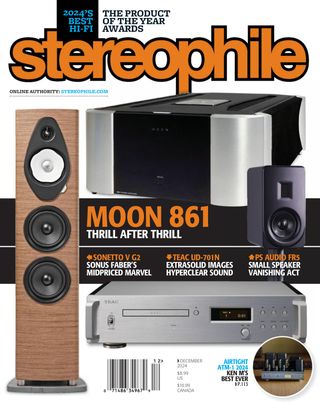

Diese Geschichte stammt aus der December 2024-Ausgabe von Stereophile.
Abonnieren Sie Magzter GOLD, um auf Tausende kuratierter Premium-Geschichten und über 9.000 Zeitschriften und Zeitungen zuzugreifen.
Sie sind bereits Abonnent? Anmelden
WEITERE GESCHICHTEN VON Stereophile

Stereophile
Buzz Me In
If you like 1970s rock music, particularly hard rock music, something you love was recorded or mixed in a Record Plant studio.

3 mins
January 2026

Stereophile
NuPrime MCX-800AD
IMMERSIVE AUDIO PROCESSOR
11 mins
January 2026

Stereophile
Shanachie Records
The term 'sales' is an anachronism. Today, it's about streaming and ancillary income.\"
3 mins
January 2026

Stereophile
Advance Paris X-CD9
CD PLAYER
11 mins
January 2026
Stereophile
T+A Symphonia for phono; a new NAD M10
Out of the box, the T+A Symphonia streaming integrated amplifier Rogier van Bakel reviewed in the November 2025 issue¹ has two pairs of single-ended analog line inputs.
20 mins
January 2026

Stereophile
Why the Music We Love Feels Different Now
There's a scene in the 2002 movie The Pianist in which Adrien Brody's character, the Polish-Jewish pianist Władysław Szpilman, is hiding in the ruins of a Warsaw villa.
3 mins
January 2026

Stereophile
A tale of two Walters
Acommon theme in this space in Stereophile is the need to reach new audiences and generate broader interest in the hi-fi hobby.
3 mins
January 2026

Stereophile
Eversolo Play CD Edition
ALL-IN-ONE STREAMING PLAYER
12 mins
January 2026

Stereophile
Timeless flights
How many adventurous rock’n’roll bands forged in the late-’60s/early-’70s would have been left by the wayside—or relegated to languish in perpetual cutout-bin purgatory—had it not been for the wide-open programming M.O. of stereo-loving FM radio stations? The Moody Blues could very easily have been one of those sidelined, notched-cover footnotes, but they altered their gameplan when guitarist/vocalist Justin Hayward and bassist/vocalist John Lodge joined the fold a few years after the chart success of “Go Now” in 1964.¹
3 mins
January 2026

Stereophile
You still believe in me
One of my foundational memories of becoming an audiophile was waiting to listen to a pair of speakers at Sound by Singer in Manhattan.
12 mins
January 2026
Listen
Translate
Change font size