Versuchen GOLD - Frei
Garbage Collection Strategies: Go vs Java vs Julia
Open Source For You
|June 2025
Explore how three open source languages—Java, Go, and Julia—take different paths to solve the invisible challenge of garbage collection. Whether you're working with enterprise apps, cloud-native systems, or scientific models, knowing how each language manages memory can help you make better technical decisions.
-

What happens to your app’s memory once it’s no longer needed? Most developers don’t think about it until performance drops, latency spikes, or crashes creep in.
That’s where garbage collection strategies come into play. The way a language handles memory cleanup behind the scenes can quietly shape how fast, reliable, and scalable your software becomes.
Garbage collection isn’t about cleaning memory—it’s about keeping your software breathing under load.
What is garbage collection?
Garbage collection (GC) is a form of automatic memory management. It’s a process that runs in the background of many programming languages, finding and cleaning up memory that’s no longer needed so developers don’t have to do it manually.
Without garbage collection, unused memory can pile up, leading to memory leaks, slower performance, and system crashes. GC helps prevent this by making sure memory is freed up when objects or data are no longer in use.
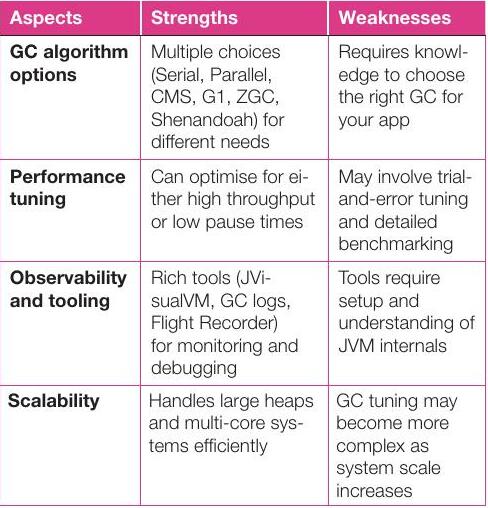 Common garbage collection methods are:
Reference counting: Keeps track of how many parts of the program are using a piece of data. When the count drops to zero, the memory can be freed.
Tracing (mark-and-sweep, generational):
- Mark-and-sweep scans memory to mark active objects and then clears the rest.
- Generational GC splits memory into ‘young’ and ‘old’ objects, optimising how often each part is cleaned.
Stop-the-world vs concurrent GC:
- Stop-the-world pauses the entire program during garbage collection.
- Concurrent GC runs alongside the program to reduce pauses and improve responsiveness.
Java’s garbage collection strategy

Diese Geschichte stammt aus der June 2025-Ausgabe von Open Source For You.
Abonnieren Sie Magzter GOLD, um auf Tausende kuratierter Premium-Geschichten und über 9.000 Zeitschriften und Zeitungen zuzugreifen.
Sie sind bereits Abonnent? Anmelden
WEITERE GESCHICHTEN VON Open Source For You

Open Source For You
Apple acquires open source photonics startup invrs.io and hires its founder
Open source technology sits at the heart of Apple's latest acquisition.

1 min
April 2026
Open Source For You
OpenClaw adoption wave lifts China's tech stocks
OpenClaw, an open source autonomous AI agent, is driving a wave of investor enthusiasm in mainland China's stock markets, lifting shares of companies linked to the technology even as broader market sentiment remains subdued.
1 min
April 2026

Open Source For You
NVIDIA's NemoClaw could power Al-based warfare for India
NVIDIA has introduced NemoClaw, an open source, chip-agnostic AI platform designed to deploy agentic AI systems.
1 min
April 2026

Open Source For You
Microsoft flags fake Next.js repos are embedding staged backdoors inside build scripts
Attackers are seeding the open source ecosystem with malicious yet legitimatelooking Next.js repositories that embed staged backdoors inside build scripts and Microsoft dependencies, according to Microsoft.
1 min
April 2026

Open Source For You
NeoNephos expands its open source cloud ecosystem with new members
NeoNephos Foundation has expanded its pan-European open source cloud coalition with the addition of BWI GmbH as a Premier Member, SUSE LLC as a General Member, and Fraunhofer ISST as an Associate Member.
1 mins
April 2026

Open Source For You
Meta's Manus AI allows users to operate its agents through Telegram
The rise of OpenClaw is reshaping the AI agent market, compelling closed platforms to mirror features first popularised in the open source community. The latest example: Manus AI has introduced Telegrambased mobile control, a capability long central to OpenClaw's messaging-first approach.
1 min
April 2026

Open Source For You
China's DeepSeek has more than 75 million downloads on Hugging Face
Chinese AI lab DeepSeek is turning open source momentum into hardware leverage, with more than 75 million downloads of its models on Hugging Face helping Chinese AI releases surpass every other country on the platform.
1 min
April 2026

Open Source For You
Fractal's LLM Studio will help build domain-specific AI models
Fractal Analytics has launched LLM Studio, an enterprise platform designed to build, evaluate, and operate domain-specific language models using open source foundations, marking a shift away from closed, API-led AI approaches.
1 min
April 2026

Open Source For You
Monitoring Machine Learning in Production
Discover the concepts of drift and data skew, and explore online monitoring techniques that keep your machine learning model relevant.
5 mins
April 2026

Open Source For You
Managing Multi-Cloud Infrastructure: The Way Forward
Kubernetes and open source control planes make multi-cloud operations easier and help organisations build scalable and cloudagnostic infrastructure platforms.
7 mins
April 2026
Listen
Translate
Change font size