Versuchen GOLD - Frei
The Age of Impersonation
Scientific American
|March 2026
Digital forensics pioneer Hany Farid explains why "artificial intelligence" is a misnomer—and what it will take to rebuild trust in the deepfake era
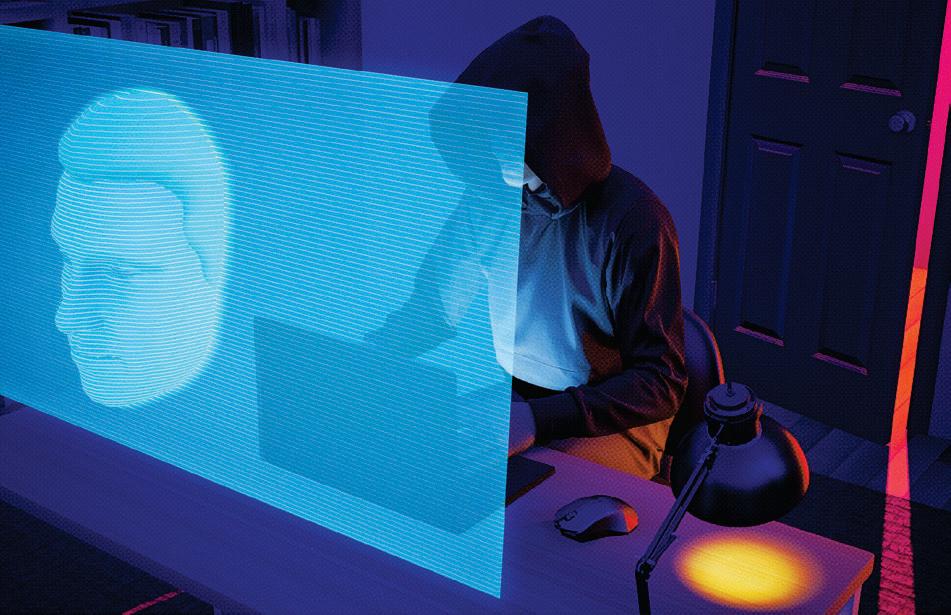
DEEPFAKES FIRST SPREAD as a tool of a specific and devastating kind of abuse: nonconsensual sexual imagery. Early iterations often were technically crude, with obvious doctoring or voices that didn't quite sound real. What's changed is the engine behind them. Generative artificial intelligence has made convincing imitation faster and cheaper to create and vastly easier to scale—turning what once took time, skill and specialized tools into something that can be produced on demand. Today’s deepfakes have seeped into the background of modern life: a scammer's shortcut, a social media weapon, a video-call body double borrowing someone else's authority. Deception has become a consumer feature, capable of mimicking a child's voice on a 2 A.M. phone call before a parent is even fully awake. In this environment, speed is the point: by the time a fake is disproved, the damage is already done.
Hany Farid, a digital forensics researcher at the University of California, Berkeley, has spent years studying the traces these systems leave behind, the tells that give them away and why recognizing them is never the entire solution. He’s skeptical of the AI mystique (he prefers the term “token tumbler”) and even less convinced of the idea that we can simply filter our way back to truth. His argument is plainer and harder: if we want a world where evidence still counts, we must rebuild the rules of liability and go after the choke points that make digital deception cheap and profitable. SCIENTIFIC AMERICAN spoke with Farid about where deepfakes are headed and what works to blunt them.
An edited transcript of the interview follows.When you say “trust infrastructure” in the age of generative AI, what are its core layers right now?

Diese Geschichte stammt aus der March 2026-Ausgabe von Scientific American.
Abonnieren Sie Magzter GOLD, um auf Tausende kuratierter Premium-Geschichten und über 9.000 Zeitschriften und Zeitungen zuzugreifen.
Sie sind bereits Abonnent? Anmelden
WEITERE GESCHICHTEN VON Scientific American
Scientific American
Sailing the Sun
By designing vertical panels that move in a gale, two Swedish inventors are unlocking a solar future for the windswept north

9 mins
March 2026
Scientific American
Covered in Bees
Ancient bees burrowed deep into discarded mammal jawbones
2 mins
March 2026
Scientific American
Fire Starters
Ancient humans were making fire 350,000 years earlier than thought
3 mins
March 2026
Scientific American
Relativity Revealed
Physicists have observed a bizarre prediction of special relativity for the first time
8 mins
March 2026

Scientific American
Everything You Wanted to Know about Polyamory (but Were Afraid to Ask
The practice is not a faddish excuse to sleep around, research shows. And it has deep roots in American culture
14 mins
March 2026

Scientific American
Let the Rivers Run
An investigation into the rights of nature
4 mins
March 2026

Scientific American
Hidden Proof
\"Effective zero knowledge\" beats long-standing cryptographic impossibilities
2 mins
March 2026

Scientific American
The Universe's Weirdest Optical Illusions
Sometimes the farther away an object is, the bigger it seems to be
4 mins
March 2026
Scientific American
Earthquake Life
Yellowstone quakes spark bursts of microbial growth underground
2 mins
March 2026

Scientific American
Living in the COPILOT SOCIETY
The promise and peril of artificial intelligence everywhere
2 mins
March 2026
Listen
Translate
Change font size