Versuchen GOLD - Frei
Path to Excellence
Scientific American
|March 2026
World-class performers are often late bloomers

WHAT DOES IT TAKE to become the best at something? The answer may not lie in early childhood excellence or in lifelong, laser-focused dedication.
Instead the path to becoming exceptional at a skill might involve a lot more meandering.
That's according to recent research published in Science that seeks to untangle what it takes to excel in different performance areas, from sports to chess to classical music. Somewhat counterintuitively, the study authors learned, people who showed the greatest promise in their discipline as children rarely went on to reach the pinnacle of their field as adults.
The findings blow up the "10,000hour rule," the idea that if someone spends 10,000 hours deliberately practicing a skill, they will master it, says Purdue University psychologist Brooke Macnamara, who co-authored the analysis. The rule, which was popularized in Malcolm Gladwell's 2008 book Outliers, is based on a 1993 study of topperforming violin students. These students had each accumulated an average of 10,000 hours of practice by age 20.
Yet they were not world-class performers, Macnamara points out.
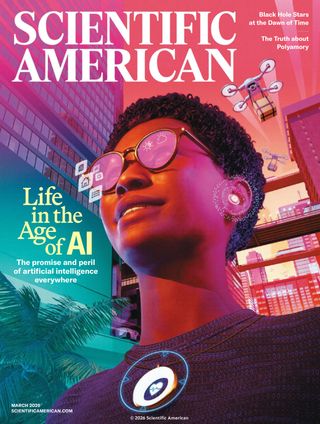

Diese Geschichte stammt aus der March 2026-Ausgabe von Scientific American.
Abonnieren Sie Magzter GOLD, um auf Tausende kuratierter Premium-Geschichten und über 9.000 Zeitschriften und Zeitungen zuzugreifen.
Sie sind bereits Abonnent? Anmelden
WEITERE GESCHICHTEN VON Scientific American

Scientific American
Sailing the Sun
By designing vertical panels that move in a gale, two Swedish inventors are unlocking a solar future for the windswept north

9 mins
March 2026
Scientific American
Covered in Bees
Ancient bees burrowed deep into discarded mammal jawbones
2 mins
March 2026
Scientific American
Fire Starters
Ancient humans were making fire 350,000 years earlier than thought
3 mins
March 2026
Scientific American
Relativity Revealed
Physicists have observed a bizarre prediction of special relativity for the first time
8 mins
March 2026

Scientific American
Everything You Wanted to Know about Polyamory (but Were Afraid to Ask
The practice is not a faddish excuse to sleep around, research shows. And it has deep roots in American culture
14 mins
March 2026
Scientific American
Let the Rivers Run
An investigation into the rights of nature
4 mins
March 2026

Scientific American
Hidden Proof
\"Effective zero knowledge\" beats long-standing cryptographic impossibilities
2 mins
March 2026
Scientific American
The Universe's Weirdest Optical Illusions
Sometimes the farther away an object is, the bigger it seems to be
4 mins
March 2026
Scientific American
Earthquake Life
Yellowstone quakes spark bursts of microbial growth underground
2 mins
March 2026

Scientific American
Living in the COPILOT SOCIETY
The promise and peril of artificial intelligence everywhere
2 mins
March 2026
Listen
Translate
Change font size