Versuchen GOLD - Frei
Navigating Our Social Worlds
Scientific American
|March 2026
The same brain areas that help us map physical space help us chart social connections
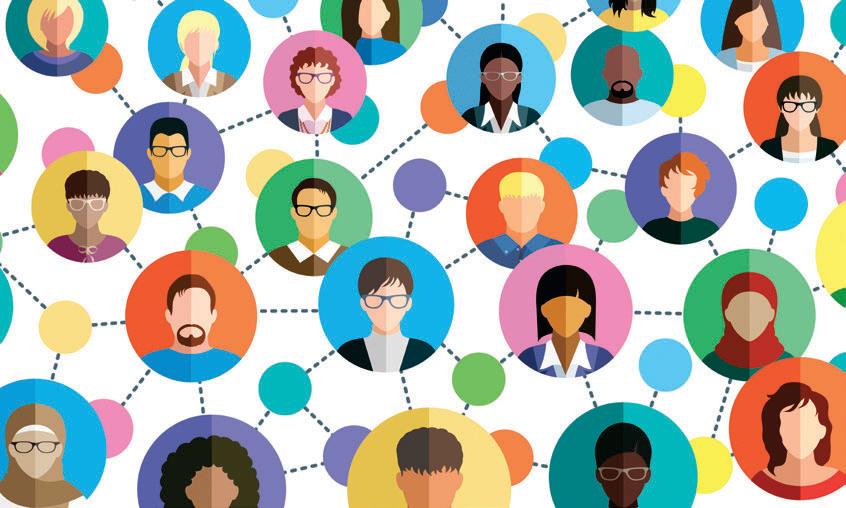
WHAT DO SOCIAL CLIMBERS and gossipmongers have in common? My mother would tell me that both are morally suspect. This moral umbrage is etched into lessons from fairy tales and scripture that we readily pass on to our children: avoid the schemer and the whisperer.
But stories are known to simplify reality. The truth is that the most effective gossipers and social climbers possess a remarkable grasp of social structure, knowledge they use to cleverly navigate their social worlds. This skill isn't a moral failing; it's a cognitive feat. Our minds are sophisticated engines that mentally map our social landscapes. Who's close to whom? Who belongs to which group? Who's popular, and who's just one step away from power?
Recent work from my laboratory has shown that our mind's representations of the social world—what are known as cognitive maps—shape many of our critical social skills. We use these maps to rise in influence, figure out when we should choose to talk about others, and build tighter bonds with those in our inner circle. Social success depends not just on whom you know but also on how well you understand the invisible architecture of your social world.
Mapping this social architecture is no small feat. Consider the magnitude of the challenge. Real-world social networks are large, with hundreds of people and tens of thousands of possible connections. Knowing who is connected to whom is no trivial task. Every time a relationship is forged or destroyed, you need to mentally update that map. My colleagues and I wanted to understand what type of cognitive map would enable you to constantly keep stock of the changing social landscape. And perhaps more important, we wanted to know why someone would take the time and effort to mentally track the web of connections that surrounds them. It turns out that building a cognitive map of your social network affords quite a lot; in fact, it gives you superpowers.


Diese Geschichte stammt aus der March 2026-Ausgabe von Scientific American.
Abonnieren Sie Magzter GOLD, um auf Tausende kuratierter Premium-Geschichten und über 9.000 Zeitschriften und Zeitungen zuzugreifen.
Sie sind bereits Abonnent? Anmelden
WEITERE GESCHICHTEN VON Scientific American

Scientific American
Earthquake Life
Yellowstone quakes spark bursts of microbial growth underground

2 mins
March 2026

Scientific American
Sailing the Sun
By designing vertical panels that move in a gale, two Swedish inventors are unlocking a solar future for the windswept north
9 mins
March 2026

Scientific American
Covered in Bees
Ancient bees burrowed deep into discarded mammal jawbones
2 mins
March 2026
Scientific American
Fire Starters
Ancient humans were making fire 350,000 years earlier than thought
3 mins
March 2026

Scientific American
Relativity Revealed
Physicists have observed a bizarre prediction of special relativity for the first time
8 mins
March 2026

Scientific American
Everything You Wanted to Know about Polyamory (but Were Afraid to Ask
The practice is not a faddish excuse to sleep around, research shows. And it has deep roots in American culture
14 mins
March 2026

Scientific American
Let the Rivers Run
An investigation into the rights of nature
4 mins
March 2026

Scientific American
Hidden Proof
\"Effective zero knowledge\" beats long-standing cryptographic impossibilities
2 mins
March 2026

Scientific American
The Universe's Weirdest Optical Illusions
Sometimes the farther away an object is, the bigger it seems to be
4 mins
March 2026

Scientific American
Living in the COPILOT SOCIETY
The promise and peril of artificial intelligence everywhere
2 mins
March 2026
Listen
Translate
Change font size