Versuchen GOLD - Frei
BLACK HOLE BURPS
Scientific American
|July/August 2025
After black holes devour stars, sometimes the feast comes back up
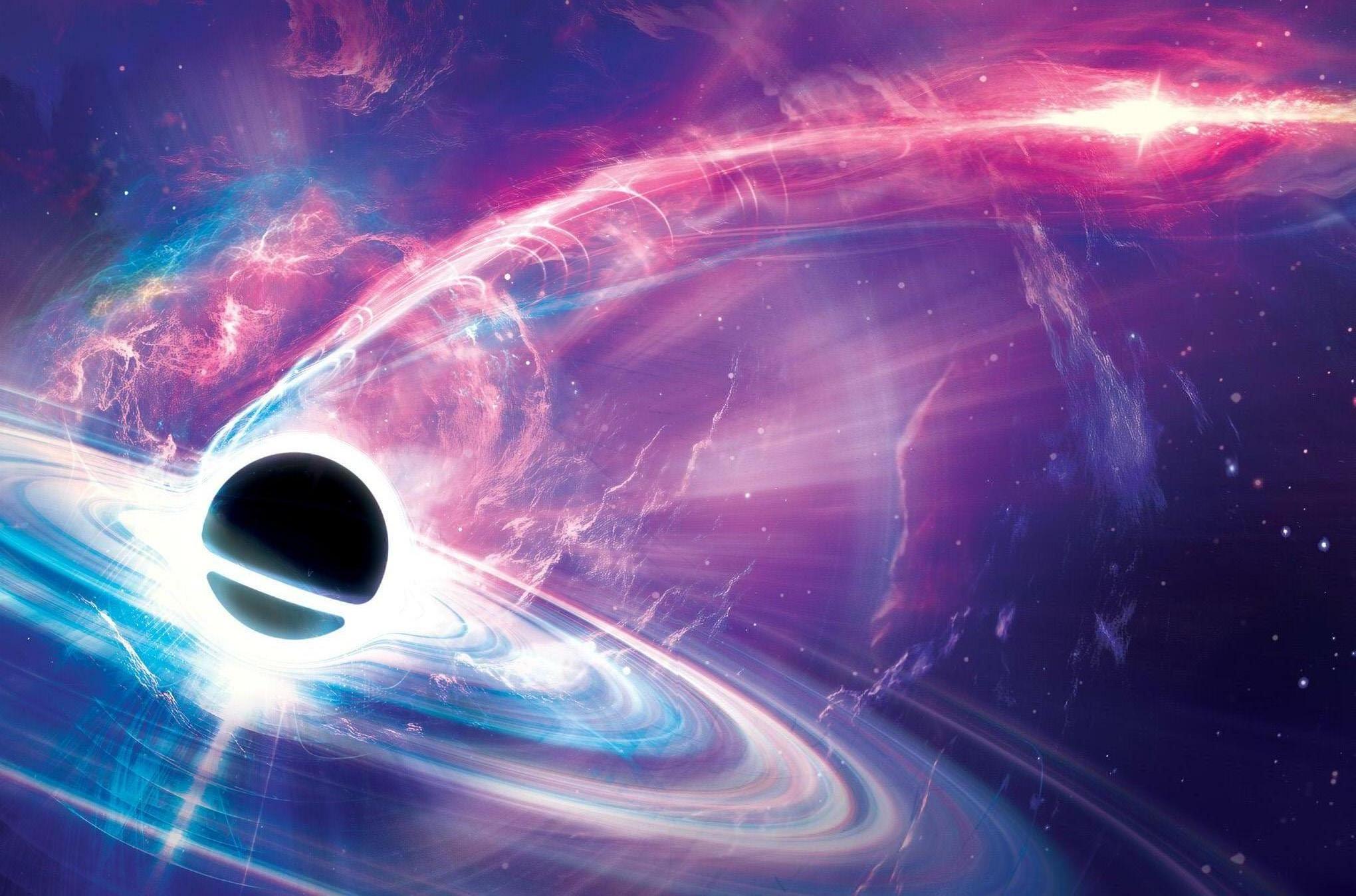
BLACK HOLES ARE INVISIBLE, yet they are among the brightest things in the universe. If a star wanders too close to a black hole, it gets torn apart in a fireworks show called a tidal disruption event. As the star approaches, it gets twisted and pulled, and about half of it ends up flung outward. The other half forms a Frisbee-shaped accretion disk around the black hole itself. This newly formed disk is not stable: material sloshes around and smashes into itself, creating a light show detectable in radio wavelengths.
These are rare occurrences—scientists estimate that the giant black hole at the center of our Milky Way galaxy gobbles a star about every million years or so. But when it happens, it releases a tremendous amount of light and energy visible millions or even billions of light-years away.
Until recently, astronomers had thought that after the initial feast, the swallowed star was never to be seen again. Observations in the past five years, however, suggest otherwise. In a surprising turn unpredicted by theory, it appears that black holes can suffer from indigestion, spewing out material years after the initial stars were shredded. In fact, scientists are now finding that up to half of black holes that devour stars start shining again in radio light years after they had gone quiet—the equivalent of a cosmic burp. We know this material isn’t coming back from beyond the event horizon—that’s impossible. It’s most likely sloshing about in an accretion disk outside that boundary. But explaining how these black hole burps can occur so late is challenging. What’s going on? Solving the mystery of these regurgitations may reveal new secrets about the physics of the most extreme environments in the universe.

Diese Geschichte stammt aus der July/August 2025-Ausgabe von Scientific American.
Abonnieren Sie Magzter GOLD, um auf Tausende kuratierter Premium-Geschichten und über 9.000 Zeitschriften und Zeitungen zuzugreifen.
Sie sind bereits Abonnent? Anmelden
WEITERE GESCHICHTEN VON Scientific American

Scientific American
Dirty Little Secrets
Extremophile molds are invading art museums and devouring their collections. Stigma and climate change have fueled their spread

16 mins
February 2026
Scientific American
Archaeology Is Reviving the Smell of History
How reconstructing long-lost smells connects us to the past
6 mins
February 2026

Scientific American
Heal Injuries Faster
Toss out the old advice that rest is the best recovery strategy
4 mins
February 2026
Scientific American
Can a Time Capsule Outlast Geology?
A ridiculous but instructive thought experiment involving deep time, plate tectonics, erosion and the slow death of the sun
17 mins
February 2026
Scientific American
Fiery Amoeba
A newfound organism thrives in record-breaking heat
2 mins
February 2026
Scientific American
50, 100 & 150 Years
GIANT ATOMS
3 mins
February 2026
Scientific American
Nature's Tile Shop
Life keeps evolving these geometric patterns
2 mins
February 2026
Scientific American
Battle of the Breeds
A large dataset shows that some dog stereotypes are based in reality, and others might be unfair characterizations
1 min
February 2026
Scientific American
The Milky Way's Disk Keeps Getting Weirder
The disk of our galaxy is not flat but warped and waving
5 mins
February 2026
Scientific American
A Winning Loser
If the cards shown here are rearranged to form four new poker hands of five cards each, what is the low- est possible winning or tying hand?
1 min
February 2026
Listen
Translate
Change font size