
Mit Magzter GOLD unbegrenztes Potenzial nutzen
Erhalten Sie unbegrenzten Zugriff auf über 9.000 Zeitschriften, Zeitungen und Premium-Artikel für nur
Versuchen GOLD - Frei
Who invented the southern constellations?
BBC Sky at Night Magazine
|June 2023
Ian Ridpath uncovers how it took 150 years of exploration to fill the skies of the Southern Hemisphere with 26 new constellations.
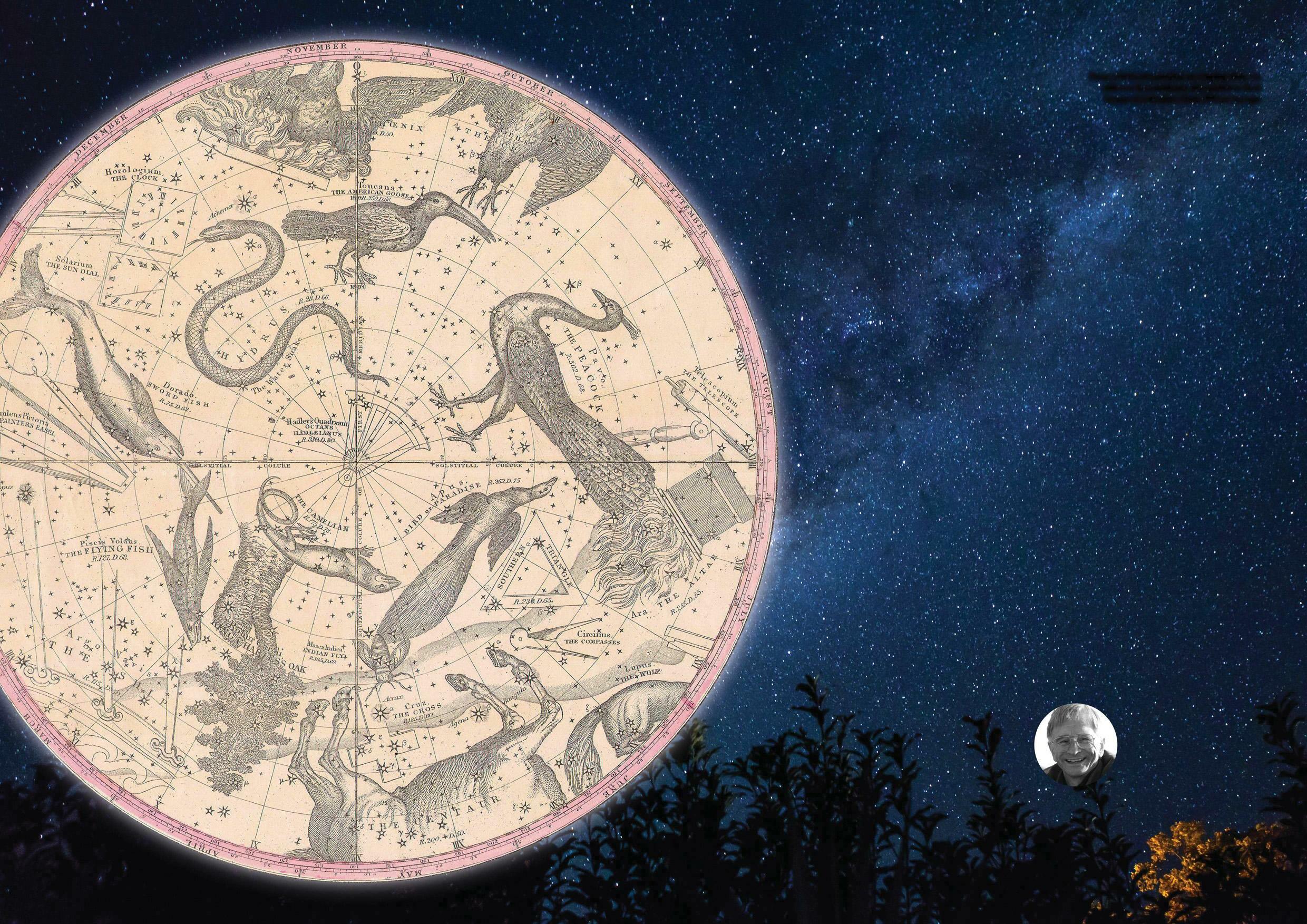
On seeing a chart of the Southern Hemisphere constellations, the Lick Observatory astronomer Heber Doust Curtis is reputed to have declared: "It looks like somebody's attic!".
While it's true that the southern constellations include such technological relics as an air pump, a chemical furnace and a pendulum clock, there are also exotic animals such as a peacock, a bird of paradise and a dorado chasing a flying fish- not to mention the oak tree that was planted by Edmond Halley to commemorate King Charles II, only to be later felled by a Frenchman.
Before the first European seafarers ventured around the tip of Africa to open trade route's to India and the Far East, the sky around the south celestial pole was a blank slate for Western astronomers.
The 48 Greek constellations in Ptolemy's book the Almagest of 150 AD' went only as far south as Centaurus and Argo Navis. Beyond that lay the.. celestial equivalent of terra incognita, beneath the horizon for European observers.
Exploring the southern sky
One man was determined to fill in this blank area of sky: the Dutch cartographer and theologian Petrus Plancius (1552-1622). When the first Dutch trading expedition to the East Indies, the Eerste Schipvaart, set sail in April 1595, Plancius instructed several members of the ships' crews to make positional observations of the southern stars. Foremost among these trusted observers was Pieter Dirkszoon Keyser (c1540-96), chief navigator on the Hollandia, joint largest of the four ships in the fleet.
The Dutch fleet arrived at Madagascar, latitude 23° south, in September 1595 where they remained for several months to resupply and recover from scurvy and malnutrition. It was during this stopover that Keyser made most of his observations, measuring star positions from the crow's nest of his ship, probably using an astrolabe given to him by Plancius.


Diese Geschichte stammt aus der June 2023-Ausgabe von BBC Sky at Night Magazine.
Abonnieren Sie Magzter GOLD, um auf Tausende kuratierter Premium-Geschichten und über 9.000 Zeitschriften und Zeitungen zuzugreifen.
Sie sind bereits Abonnent? Anmelden
WEITERE GESCHICHTEN VON BBC Sky at Night Magazine

BBC Sky at Night Magazine
Crush: Close Encounters with Gravity
Gravity is something that we're all innately familiar with. It keeps our feet on the ground, fights against a rocket trying to leave Earth and governs the movement of the planets and stars.

1 mins
April 2026

BBC Sky at Night Magazine
Exploring the Universe
There's no shortage of children's books about astronomy.
2 mins
April 2026
BBC Sky at Night Magazine
Make your Milky Way images pop
Simple, free processing techniques using FastStone Image Viewer
3 mins
April 2026

BBC Sky at Night Magazine
Nightfaring: In Search of the Disappearing Darkness
This book is a manifesto for dark skies, written as a travel memoir.
1 mins
April 2026
BBC Sky at Night Magazine
Flying saucers- The making of a modern myth
Our obsession with UFOs goes back further than you might think. Robert Pateman traces how early science fiction, dubious sightings and an alien-mad media led to the 1950s saucer fever
9 mins
April 2026
BBC Sky at Night Magazine
STAR OF THE MONTH
Alphecca, the brightest jewel in the Crown
1 min
April 2026

BBC Sky at Night Magazine
How to use a planisphere
Navigate the sky with the original stargazer's tool. No batteries, apps or Wi-Fi required!
3 mins
April 2026
BBC Sky at Night Magazine
Why rockets don't launch straight up
For a rocket to get its payload into space, it has to follow a curved path. But what would happen if it didn't?
2 mins
April 2026

BBC Sky at Night Magazine
Q&A WITH A DARK MATTER SPECIALIST
Dark matter makes up 27 per cent of all matter in the Universe. So why is it so hard to find? Meet one of the people making a map that leads us to it
3 mins
April 2026

BBC Sky at Night Magazine
Why I want to put a hotel on the Moon
Bored of the beach? Sick of city breaks? Step this way. Space entrepreneur Skyler Chan explains how he'll build a holiday destination on the Moon by 2030
2 mins
April 2026
Translate
Change font size