Versuchen GOLD - Frei
Track and measure sunspots
BBC Sky at Night Magazine
|August 2025
How to find, follow and analyse these dynamic features on our ever-changing Sun
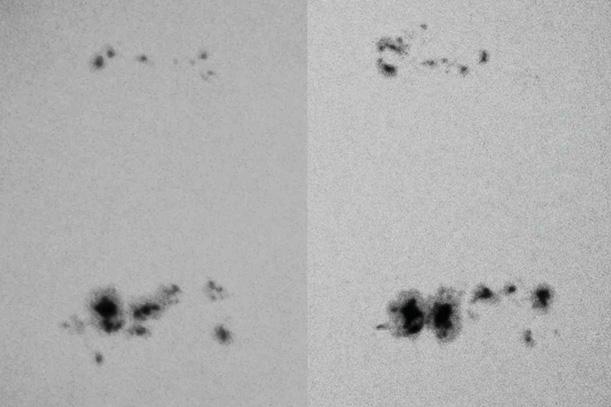
The Sun's surface often looks speckled with darker regions. These are sunspots – cooler patches that form as a result of the Sun's complex magnetic field preventing heat from reaching localised areas of the photosphere. How many you'll see varies during the 11-year solar cycle, with greater numbers during solar maximum – which we're in right now.
Humans have been observing sunspots for centuries, but we have only tracked them in detail since the telescope was invented. Originally, this meant projecting through the telescope onto a piece of white card and sketching the result. These days, observing and photographing the Sun is done either with a certified solar filter on the front of a telescope or a Herschel wedge on the back of a refractor.
Sunspots are related to intense magnetic activity and are often associated with solar flares and coronal mass ejections. These in turn are responsible for geomagnetic storms on Earth. While these produce stunning aurorae, they also impact spacecraft, satellites and infrastructure like the power grid, as well as the health of pilots and astronauts.
Check for spots
This is why solar activity is monitored constantly, not just by ground-based observations here on Earth but also via satellites such as the Solar Dynamics Observatory (SDO). The multi-wavelength images that the SDO creates are freely available to download, so you can measure, track and analyse sunspots even if you don't have a telescope.

Diese Geschichte stammt aus der August 2025-Ausgabe von BBC Sky at Night Magazine.
Abonnieren Sie Magzter GOLD, um auf Tausende kuratierter Premium-Geschichten und über 9.000 Zeitschriften und Zeitungen zuzugreifen.
Sie sind bereits Abonnent? Anmelden
WEITERE GESCHICHTEN VON BBC Sky at Night Magazine
BBC Sky at Night Magazine
The Giant Leap: Why Space is the Next Frontier in the Evolution of Life
“Earth is the cradle of humanity, but one cannot live in the cradle forever,” wrote Konstantin Tsiolkovsky in 1911.

1 mins
February 2026
BBC Sky at Night Magazine
Tele Vue Nagler Type-7 series eyepieces
These premium optics were inspired by Apollo - and deliver a giant leap to your views
4 mins
February 2026
BBC Sky at Night Magazine
Once Upon a Time in Space
While the Space Race of the Cold War years was ultimately a geopolitical contest between the USA and the Soviet Union, the rivalry sparked rapid innovation and inspired multiple generations to look skyward.
1 mins
February 2026
BBC Sky at Night Magazine
The Multiverse: When One Universe Isn't Enough
The concept of a 'multiverse' – the idea that our Universe may be just one of many – is widespread in science fiction and a common thread of online discussions.
1 mins
February 2026
BBC Sky at Night Magazine
Q&A WITH A GAMMA RAY SPECIALIST
In 2025, astronomers detected a blast from space that lasted seven hours. Now they're uncovering the strange processes behind the exceptional outburst
3 mins
February 2026
BBC Sky at Night Magazine
Astronomy Photographer of the Year
The world-leading astrophotography competition returns. Could your image take the top prize of £10,000?
2 mins
February 2026
BBC Sky at Night Magazine
MOONWATCH
February's top lunar feature to observe
2 mins
February 2026
BBC Sky at Night Magazine
NOVAStar Scarlet A62Q 62mm f/8.4 quadruplet achromatic refractor
Well-built and capable, this beginner scope punches well above its bargain price
4 mins
February 2026
BBC Sky at Night Magazine
STAR OF THE MONTH
Rasalas, Leo the Lion's metal-rich crown
1 min
February 2026
BBC Sky at Night Magazine
Comet 24P/Schaumasse
Having reached perihelion on 8 January, comet 24P/ Schaumasse is now fading. Starting the month at a small-telescope-friendly mag. +10.5, it dims throughout February to below 12th magnitude.
1 min
February 2026
Listen
Translate
Change font size