
Mit Magzter GOLD unbegrenztes Potenzial nutzen
Erhalten Sie unbegrenzten Zugriff auf über 9.000 Zeitschriften, Zeitungen und Premium-Artikel für nur
Versuchen GOLD - Frei
SKILLS FOR STARGAZERS
BBC Sky at Night Magazine
|June 2025
Get the best from your astro camera
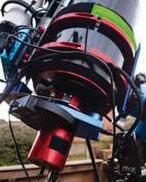
How to optimise your CCD or CMOS settings for great imaging results
CD and CMOS astrophotography cameras have been on the market for many years and allow amateur astrophotographers to produce stunning image results. But to get the best from your astro camera, you need to really understand and master its settings.
If you've just bought one or you've had one for a while but you're not getting the results you hoped for, it's time to learn all about it - and learn from examples of good (and bad!) imaging results. We'll run through how to judge your settings both during and after a 'first light' session. Much can also be learned in post-processing, meaning you can tweak settings on the next clear night.
There are four main settings to focus on: exposure, binning, gain and offset. Exposure is how long (in seconds) each frame is. Finding your camera's ideal exposure length depends upon many factors, including device sensitivity, sky conditions, light pollution and your astronomy target. Longer exposures can lead to more signal and detail, but also introduce noise. This could be system noise (created by the electronics) or shot noise. While system noise is reduced by taking calibration frames, shot noise can be reduced by taking multiple frames to stack together later. A careful examination of the histogram curve in your capture software will show if an exposure is too long or short. If the curve is fully towards the left axis, shadow detail may be lost in post-processing, whereas a curve that extends to the right will clip highlights, leading to blown-out areas.
Binning, gain and offset

Diese Geschichte stammt aus der June 2025-Ausgabe von BBC Sky at Night Magazine.
Abonnieren Sie Magzter GOLD, um auf Tausende kuratierter Premium-Geschichten und über 9.000 Zeitschriften und Zeitungen zuzugreifen.
Sie sind bereits Abonnent? Anmelden
WEITERE GESCHICHTEN VON BBC Sky at Night Magazine
BBC Sky at Night Magazine
Crush: Close Encounters with Gravity
Gravity is something that we're all innately familiar with. It keeps our feet on the ground, fights against a rocket trying to leave Earth and governs the movement of the planets and stars.

1 mins
April 2026

BBC Sky at Night Magazine
Exploring the Universe
There's no shortage of children's books about astronomy.
2 mins
April 2026
BBC Sky at Night Magazine
Make your Milky Way images pop
Simple, free processing techniques using FastStone Image Viewer
3 mins
April 2026
BBC Sky at Night Magazine
Nightfaring: In Search of the Disappearing Darkness
This book is a manifesto for dark skies, written as a travel memoir.
1 mins
April 2026
BBC Sky at Night Magazine
Flying saucers- The making of a modern myth
Our obsession with UFOs goes back further than you might think. Robert Pateman traces how early science fiction, dubious sightings and an alien-mad media led to the 1950s saucer fever
9 mins
April 2026
BBC Sky at Night Magazine
STAR OF THE MONTH
Alphecca, the brightest jewel in the Crown
1 min
April 2026
BBC Sky at Night Magazine
How to use a planisphere
Navigate the sky with the original stargazer's tool. No batteries, apps or Wi-Fi required!
3 mins
April 2026
BBC Sky at Night Magazine
Why rockets don't launch straight up
For a rocket to get its payload into space, it has to follow a curved path. But what would happen if it didn't?
2 mins
April 2026
BBC Sky at Night Magazine
Q&A WITH A DARK MATTER SPECIALIST
Dark matter makes up 27 per cent of all matter in the Universe. So why is it so hard to find? Meet one of the people making a map that leads us to it
3 mins
April 2026

BBC Sky at Night Magazine
Why I want to put a hotel on the Moon
Bored of the beach? Sick of city breaks? Step this way. Space entrepreneur Skyler Chan explains how he'll build a holiday destination on the Moon by 2030
2 mins
April 2026
Listen
Translate
Change font size