Versuchen GOLD - Frei
Prepare for the PLANET PARADE
BBC Sky at Night Magazine
|September 2022
Five planets and an asteroid will be putting on a show this month. Stuart Atkinson shows us where and when to catch the spectacle

While it's been disappointingly quiet for comet observers, aurora hunters and meteor watchers, there's no doubt that 2022 has been a great year for planet spotters. Back in early summer there was a striking and much-hyped 'chain of worlds' spread out across the sky, with half a dozen planets strung out along the ecliptic like beads on a bracelet. Unfortunately, that celestial treat was only visible before dawn, so many people missed it or didn't even know it was happening at all.
But good news: another planetary parade will be on view this month! And even better news: this time it will be in the evening sky, so you won't need to set the alarm really early to see it. Throughout September no less than five planets - Saturn, Jupiter, Mars, Uranus and Neptune - will all be on view at once, if you look at the right time.
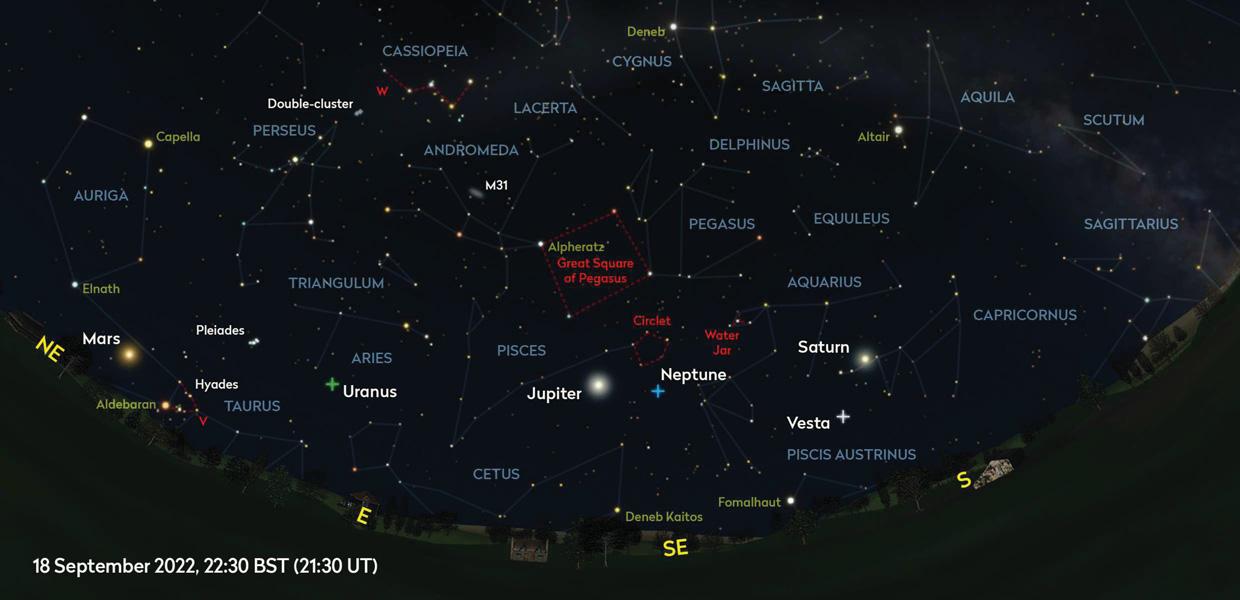
As exciting and rare as it was, summer's planetary line-up wasn't easy to see for many Northern Hemisphere sky-watchers - some of the planets were overwhelmed by the bright summer sky. But this month's gathering will be taking place after dark, so all the planets involved will be either very easy to see with the naked eye or easy to find in binoculars and small telescopes. And as an added bonus, one of the Solar System's most famous minor planets, Vesta, will be in the same region of the sky too.
But when will be the right time'? Although some of these worlds will be on view soon after sunset, you won't be able to see all of them strewn across the sky together until around 10:30pm, so if you want to show them to any space-mad youngsters, they may need to take a nap first and then go out later. We'll look at the view on one particular night mid-month, 18 September, but don't worry if it's cloudy on that night because these planets will be on view throughout September.


Diese Geschichte stammt aus der September 2022-Ausgabe von BBC Sky at Night Magazine.
Abonnieren Sie Magzter GOLD, um auf Tausende kuratierter Premium-Geschichten und über 9.000 Zeitschriften und Zeitungen zuzugreifen.
Sie sind bereits Abonnent? Anmelden
WEITERE GESCHICHTEN VON BBC Sky at Night Magazine
BBC Sky at Night Magazine
The Giant Leap: Why Space is the Next Frontier in the Evolution of Life
“Earth is the cradle of humanity, but one cannot live in the cradle forever,” wrote Konstantin Tsiolkovsky in 1911.

1 mins
February 2026
BBC Sky at Night Magazine
Tele Vue Nagler Type-7 series eyepieces
These premium optics were inspired by Apollo - and deliver a giant leap to your views
4 mins
February 2026
BBC Sky at Night Magazine
Once Upon a Time in Space
While the Space Race of the Cold War years was ultimately a geopolitical contest between the USA and the Soviet Union, the rivalry sparked rapid innovation and inspired multiple generations to look skyward.
1 mins
February 2026
BBC Sky at Night Magazine
The Multiverse: When One Universe Isn't Enough
The concept of a 'multiverse' – the idea that our Universe may be just one of many – is widespread in science fiction and a common thread of online discussions.
1 mins
February 2026
BBC Sky at Night Magazine
Q&A WITH A GAMMA RAY SPECIALIST
In 2025, astronomers detected a blast from space that lasted seven hours. Now they're uncovering the strange processes behind the exceptional outburst
3 mins
February 2026
BBC Sky at Night Magazine
Astronomy Photographer of the Year
The world-leading astrophotography competition returns. Could your image take the top prize of £10,000?
2 mins
February 2026
BBC Sky at Night Magazine
MOONWATCH
February's top lunar feature to observe
2 mins
February 2026
BBC Sky at Night Magazine
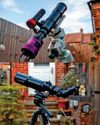
NOVAStar Scarlet A62Q 62mm f/8.4 quadruplet achromatic refractor
Well-built and capable, this beginner scope punches well above its bargain price
4 mins
February 2026
BBC Sky at Night Magazine
STAR OF THE MONTH
Rasalas, Leo the Lion's metal-rich crown
1 min
February 2026
BBC Sky at Night Magazine
Comet 24P/Schaumasse
Having reached perihelion on 8 January, comet 24P/ Schaumasse is now fading. Starting the month at a small-telescope-friendly mag. +10.5, it dims throughout February to below 12th magnitude.
1 min
February 2026
Translate
Change font size