
Mit Magzter GOLD unbegrenztes Potenzial nutzen
Erhalten Sie unbegrenzten Zugriff auf über 9.000 Zeitschriften, Zeitungen und Premium-Artikel für nur
Versuchen GOLD - Frei
Jupiter
BBC Sky at Night Magazine
|February 2023
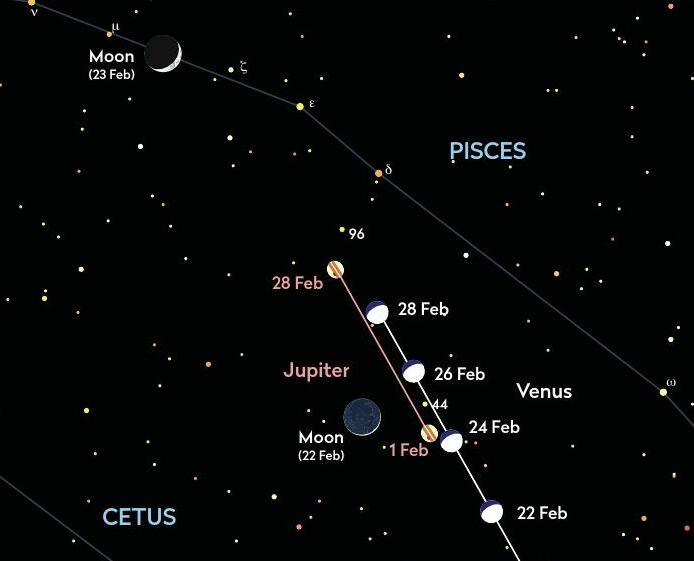
Jupiter is rapidly losing ground to the evening twilight, appearing 29° above the southwest horizon under deep twilight conditions at the start of the month, but reaching only 12° above the western horizon by the time we reach the end of the month.
-
Best time to see: 1 February, from 17:30 UT
Altitude: 34°
Location: Pisces
Direction: South-southwest
Features: Complex atmosphere, Galilean moons
Recommended equipment: 75mm or larger
Through the eyepiece of a telescope, Jupiter's low altitude will mean it will be badly affected by seeing. This causes fine detail to wobble and blur, making such detail difficult to see well. On a more encouraging note, Jupiter's declination is increasing, and when next at opposition in early November, it will be able to reach an altitude of 50° in a dark sky.
A small telescope will currently show the planet's disc, two main belts, and, for apertures above 100mm, the persistent atmospheric feature known as the Great Red Spot. The four Galilean moons are another amazing sight to watch as their starlike dots appear to dance endlessly around the planet.
As the end of February approaches and we move into the start of March, mag. -1.9 Jupiter will appear really close to mag. -3.9 Venus, the two planets forming an impressive pair above the western horizon even despite their low altitude. On 28 February, they will appear 1.5° apart, a prelude to their closest separation of just 0.6° on 1 March. If you have several clear evenings, watching a planetary conjunction involving two bright planets is fascinating. The rapid positional shifts really give you a sense of the three-dimensional nature of our Solar System.
On the evening of 22 February, a thin 8%-lit waxing crescent Moon sits south of the imaginary line joining Venus to Jupiter, a particularly striking display and a great scene to photograph if the conditions are clear.
The planets in February


Diese Geschichte stammt aus der February 2023-Ausgabe von BBC Sky at Night Magazine.
Abonnieren Sie Magzter GOLD, um auf Tausende kuratierter Premium-Geschichten und über 9.000 Zeitschriften und Zeitungen zuzugreifen.
Sie sind bereits Abonnent? Anmelden
WEITERE GESCHICHTEN VON BBC Sky at Night Magazine
BBC Sky at Night Magazine
Capture NLCs with a smartphone
Make this the summer that you nail a shot of beautiful night-shining clouds

3 mins
July 2026
BBC Sky at Night Magazine
ZWO Seestar S30 Pro smart telescope
ZWO Seestar S30 Pro smart telescope
4 mins
July 2026
BBC Sky at Night Magazine
The speed of light
The Universe has a speed limit - and it underpins everything we know about it. We explain the speed of light and its far-reaching implications for astronomy
2 mins
July 2026
BBC Sky at Night Magazine
COMETS AND ASTEROIDS
Can you spot dim, barely moving Pluto?
1 min
July 2026
BBC Sky at Night Magazine
THE SKY GUIDE CHALLENGE
What's the youngest Moon you can photograph? Try our ‘impossible’ challenge
2 mins
July 2026

BBC Sky at Night Magazine
Q&A WITH A SCIENCE COMMUNICATOR
As we find more planets in the habitable zones around other suns, we ask Neil deGrasse Tyson what would happen if we did meet intelligent alien life
3 mins
July 2026
BBC Sky at Night Magazine
Make an all-sky camera
How to set up an always-watching system to catch fleeting sky events
3 mins
July 2026
BBC Sky at Night Magazine
The Universe doesn't need a multiverse
The Universe doesn't need a multiverse The idea that there are many universes seems to solve our most stubborn cosmic mysteries. But, argues Brian Clegg, it's no substitute for hard evidence
2 mins
July 2026
BBC Sky at Night Magazine
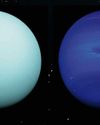
Planets of mystery
Uranus and Neptune – visited just once, 40 years ago – are the least-known planets in our Solar System. Now 21st-century science has revealed they may not even be the ‘ice giants’ we thought. Joseph Phelan investigates
6 mins
July 2026
BBC Sky at Night Magazine
THE BIG THREE
The top sights to observe or image this month
4 mins
July 2026
Translate
Change font size