Versuchen GOLD - Frei
Experiments with Venus
BBC Sky at Night Magazine
|April 2023
Try out these activities while the Evening Star is shining bright in our skies
-
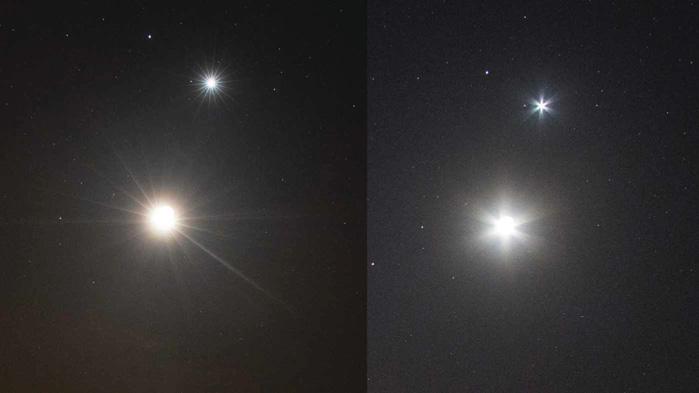
Venus is well-placed in the evening twilight this month, an intense blaze of light, difficult to miss in clear skies. It's an interesting object astronomically, showing subtle atmospheric markings through the eyepiece, as well as displaying striking changes in phase and apparent diameter.
It's interesting for another reason too. Being so intensely bright - the brightest of all the planets - it's essentially a point source at low magnification, and ideal for demonstrating experiments with light. When placed in a dark sky, it's possible to experience its light casting a shadow- okay, it's a dim shadow, but it's one that can be photographed. Being very close to a point light source, the shadow cast is really sharp and well-defined too.
To record this elusive effect, you'll need to be somewhere where there are no other light sources. Even a bright sky can interfere. A west or northwest-facing window is ideal, as long as you can turn all of the lights off. If you can't do this, use a large cardboard box with the opening pointed at Venus. Either way, you'll need a screen on which the shadow will be cast. This can be as simple as a light-coloured wall or several large white sheets of paper.
You'll need a shadow-casting subject as well. This can be a shape cut from card pasted on a window or suspended in front of the box. Then it's simply a case of pointing a camera at the screen, focusing and taking your shot. A high ISO is recommended to keep the exposure times short; take too long and the razor-sharp edge of the shadow will blur as Venus moves relative to the horizon.
Make a rainbow

Diese Geschichte stammt aus der April 2023-Ausgabe von BBC Sky at Night Magazine.
Abonnieren Sie Magzter GOLD, um auf Tausende kuratierter Premium-Geschichten und über 9.000 Zeitschriften und Zeitungen zuzugreifen.
Sie sind bereits Abonnent? Anmelden
WEITERE GESCHICHTEN VON BBC Sky at Night Magazine
BBC Sky at Night Magazine
The Giant Leap: Why Space is the Next Frontier in the Evolution of Life
“Earth is the cradle of humanity, but one cannot live in the cradle forever,” wrote Konstantin Tsiolkovsky in 1911.

1 mins
February 2026
BBC Sky at Night Magazine
Tele Vue Nagler Type-7 series eyepieces
These premium optics were inspired by Apollo - and deliver a giant leap to your views
4 mins
February 2026
BBC Sky at Night Magazine
Once Upon a Time in Space
While the Space Race of the Cold War years was ultimately a geopolitical contest between the USA and the Soviet Union, the rivalry sparked rapid innovation and inspired multiple generations to look skyward.
1 mins
February 2026
BBC Sky at Night Magazine
The Multiverse: When One Universe Isn't Enough
The concept of a 'multiverse' – the idea that our Universe may be just one of many – is widespread in science fiction and a common thread of online discussions.
1 mins
February 2026
BBC Sky at Night Magazine
Q&A WITH A GAMMA RAY SPECIALIST
In 2025, astronomers detected a blast from space that lasted seven hours. Now they're uncovering the strange processes behind the exceptional outburst
3 mins
February 2026
BBC Sky at Night Magazine
Astronomy Photographer of the Year
The world-leading astrophotography competition returns. Could your image take the top prize of £10,000?
2 mins
February 2026
BBC Sky at Night Magazine
MOONWATCH
February's top lunar feature to observe
2 mins
February 2026
BBC Sky at Night Magazine
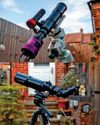
NOVAStar Scarlet A62Q 62mm f/8.4 quadruplet achromatic refractor
Well-built and capable, this beginner scope punches well above its bargain price
4 mins
February 2026
BBC Sky at Night Magazine
STAR OF THE MONTH
Rasalas, Leo the Lion's metal-rich crown
1 min
February 2026
BBC Sky at Night Magazine
Comet 24P/Schaumasse
Having reached perihelion on 8 January, comet 24P/ Schaumasse is now fading. Starting the month at a small-telescope-friendly mag. +10.5, it dims throughout February to below 12th magnitude.
1 min
February 2026
Translate
Change font size