
Mit Magzter GOLD unbegrenztes Potenzial nutzen
Erhalten Sie unbegrenzten Zugriff auf über 9.000 Zeitschriften, Zeitungen und Premium-Artikel für nur
Versuchen GOLD - Frei
Curiosity, 10 years exploring Mars
BBC Sky at Night Magazine
|August 2022
NASA's car-sized Red Planet rover has set new standards in planetary exploration
-

This August marks 10 years since Curiosity, one of the most advanced planetary rovers ever launched, landed on Mars. For a decade the car-sized wheeled robot has been studying the climate and geology of Mars in preparation for human exploration and helping to answer questions about Mars's past suitability for life.
But its launch was repeatedly pushed back as NASA faced many delays. Finally, on 26 November 2011, the mission clock began as an Atlas V launched the rover from Cape Canaveral Air Force Station.
The selection of Curiosity's destination on Mars had begun in June 2006, when an international group started to whittle down 100 potential landing sites to just one. By June 2011 the 154km-diameter Gale Crater had finally been chosen for its exposed layers of sediments, thought to be left by the water of an ancient lake.
Curiosity's landing eventually came on 6 August 2012, and was aimed at the tightest landing ellipse of any mission to date. The Spirit and Opportunity rovers' landings had been within a predicted area of 150 x 20km in 2004; Curiosity was to narrow that down to just 7 x 20km. To achieve this, the craft had to slow down by a factor of around 10,000, from a relative approach velocity of 21,000km/h to a slow walking pace of just 0.75m/sec at touchdown - no easy feat for a rover 3m long by 2.8m wide, with a mass of almost 900kg. Curiosity's mission planners took a novel approach to landing, describing it as either 'the least crazy' solution or the 'seven minutes of terror'.
Feeling supersonic


Diese Geschichte stammt aus der August 2022-Ausgabe von BBC Sky at Night Magazine.
Abonnieren Sie Magzter GOLD, um auf Tausende kuratierter Premium-Geschichten und über 9.000 Zeitschriften und Zeitungen zuzugreifen.
Sie sind bereits Abonnent? Anmelden
WEITERE GESCHICHTEN VON BBC Sky at Night Magazine
BBC Sky at Night Magazine
The Giant Leap: Why Space is the Next Frontier in the Evolution of Life
“Earth is the cradle of humanity, but one cannot live in the cradle forever,” wrote Konstantin Tsiolkovsky in 1911.

1 mins
February 2026
BBC Sky at Night Magazine
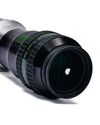
Tele Vue Nagler Type-7 series eyepieces
These premium optics were inspired by Apollo - and deliver a giant leap to your views
4 mins
February 2026
BBC Sky at Night Magazine
Once Upon a Time in Space
While the Space Race of the Cold War years was ultimately a geopolitical contest between the USA and the Soviet Union, the rivalry sparked rapid innovation and inspired multiple generations to look skyward.
1 mins
February 2026
BBC Sky at Night Magazine
The Multiverse: When One Universe Isn't Enough
The concept of a 'multiverse' – the idea that our Universe may be just one of many – is widespread in science fiction and a common thread of online discussions.
1 mins
February 2026
BBC Sky at Night Magazine
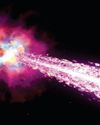
Q&A WITH A GAMMA RAY SPECIALIST
In 2025, astronomers detected a blast from space that lasted seven hours. Now they're uncovering the strange processes behind the exceptional outburst
3 mins
February 2026
BBC Sky at Night Magazine
Astronomy Photographer of the Year
The world-leading astrophotography competition returns. Could your image take the top prize of £10,000?
2 mins
February 2026
BBC Sky at Night Magazine
MOONWATCH
February's top lunar feature to observe
2 mins
February 2026
BBC Sky at Night Magazine
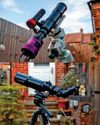
NOVAStar Scarlet A62Q 62mm f/8.4 quadruplet achromatic refractor
Well-built and capable, this beginner scope punches well above its bargain price
4 mins
February 2026
BBC Sky at Night Magazine
STAR OF THE MONTH
Rasalas, Leo the Lion's metal-rich crown
1 min
February 2026
BBC Sky at Night Magazine
Comet 24P/Schaumasse
Having reached perihelion on 8 January, comet 24P/ Schaumasse is now fading. Starting the month at a small-telescope-friendly mag. +10.5, it dims throughout February to below 12th magnitude.
1 min
February 2026
Translate
Change font size