
Mit Magzter GOLD unbegrenztes Potenzial nutzen
Erhalten Sie unbegrenzten Zugriff auf über 9.000 Zeitschriften, Zeitungen und Premium-Artikel für nur
One Hundred Years Of... Resistance
Outlook
|October 21, 2025
Who is afraid of the RSS? No one is today
WHY should anyone be afraid of the Rashtriya Swayamsevak Sangh (RSS) just because it has completed 100 years of its existence? Minus the trappings of a very flabby militia, the organisation looks like any other outfit. Nothing special, nothing different about it.
If at 100, this Nagpur-based body of (mostly) men does not inspire the awe and respect it thinks it once did, it is because it no longer can lay a claim to being the custodian of our collective morals. In its own self-perception, the Sangh arrogates to itself the mantle of a sole overseer of patriotism, nationalism, and idealism in public life. It is a different matter that other than its own functionaries, no one else has ever conceded this claim.
This downward journey can perhaps be traced back to the March 1998 National Executive (Pratinidhi Sabha) of the RSS. Atal Bihari Vajpayee had just been sworn in as the Prime Minister of a coalition government, though he was still to win a vote of confidence—which he did on March 28. This was an expedient and transactional alliance of calculating political parties, but the RSS Chief Rajendra Singh (Rajju Bhaiya) chose to interpret the formation of the Vajpayee government as a rejection of the allegations and biases against ‘the pro-Hindutva forces’.
At the first hint of proximity to power, the moralistic and idealistic Sangh was ready with a convoluted logic to read popular approval and legitimacy into an experiment with opportunism. That experiment flopped within 13 months, but by now the RSS had trapped itself into the role of a godfather of the Bharatiya Janata Party (BJP) and its politics of compromise and convenience.
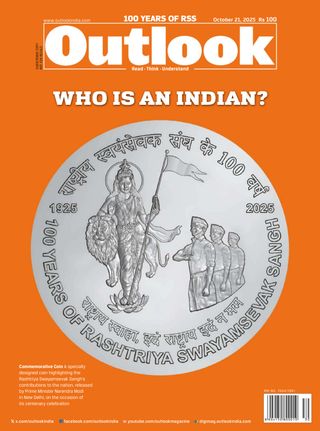

Diese Geschichte stammt aus der October 21, 2025-Ausgabe von Outlook.
Abonnieren Sie Magzter GOLD, um auf Tausende kuratierter Premium-Geschichten und über 9.000 Zeitschriften und Zeitungen zuzugreifen.
Sie sind bereits Abonnent? Anmelden
WEITERE GESCHICHTEN VON Outlook

Outlook
The Big Blind Spot
Caste boundaries still shape social relations in Tamil Nadu-a state long rooted in self-respect politics

8 mins
December 11, 2025

Outlook
Jat Yamla Pagla Deewana
Dharmendra's tenderness revealed itself without any threats to his masculinity. He adapted himself throughout his 65-year-long career as both a product and creature of the times he lived through
5 mins
December 11, 2025

Outlook
Fairytale of a Fallow Land
Hope Bihar can once again be that impossibly noisy village in Phanishwar Nath Renu's Parti Parikatha-divided, yes, but still capable of insisting that rights are not favours and development is more than a slogan shouted from a stage
14 mins
December 11, 2025

Outlook
The Lesser Daughters of the Goddess
The Dravidian movement waged an ideological war against the devadasi system. As former devadasis lead a new wave of resistance, the practice is quietly sustained by caste, poverty, superstition and inherited ritual
2 mins
December 11, 2025

Outlook
The Meaning of Mariadhai
After a hundred years, what has happened to the idea of self-respect in contemporary Tamil society?
5 mins
December 11, 2025

Outlook
When the State is the Killer
The war on drugs continues to be a war on the poor
5 mins
December 11, 2025

Outlook
We Are Intellectuals
A senior law officer argued in the Supreme Court that \"intellectuals\" could be more dangerous than \"ground-level terrorists\"
5 mins
December 11, 2025

Outlook
An Equal Stage
The Dravidian Movement used novels, plays, films and even politics to spread its ideology
12 mins
December 11, 2025
Outlook
The Dignity in Self-Respect
How Periyar and the Self-Respect Movement took shape in Tamil Nadu and why the state has done better than the rest of the country on many social, civil and public parameters
5 mins
December 11, 2025

Outlook
When Sukumaar Met Elakkiya
Self-respect marriage remains a force of socio-political change even a century later
7 mins
December 11, 2025
Listen
Translate
Change font size