Versuchen GOLD - Frei
The Material Creation of Freedom
Philosophy Now
|February/March 2024
Stephen Martin Fritz & Denise Morel contemplate what creates democracy.
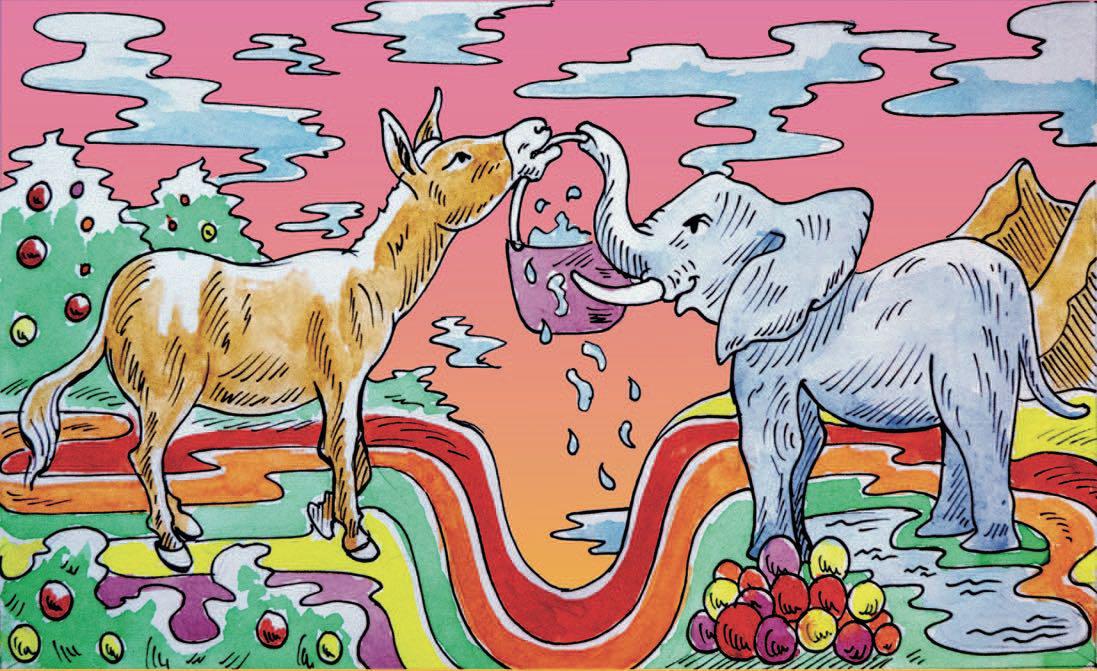
When Biden was President he warned that his political opponents were a threat to democracy itself. Similar accusations were levelled against former Brazilian President Jair Bolsonaro. Indeed, many journalists and pundits claim that a threat to democracy is a global phenomenon. Conservatives have long criticized adversaries for being soft on crime, and liberals have slammed rivals for not caring about the poor; but to accuse the opposition of being 'a threat to democracy' seems to be a new low. But is it? Warnings like "Democracy will come to an end if you don't listen to me!" are almost as old as the idea that the rich are getting richer while the poor are getting poorer.
Since the formation of the earliest democratic republic, in Athens, pundits have been warning citizens of its imminent demise. For instance, in Book VIII of Plato's Republic (c.380 BC), Socrates warns of democracy's soft-on-crime tendencies, infatuation with youth, and excesses of equality extremism: "Have you not observed how, in a democracy, many persons, although sentenced to exile, just stay where they are and walk about the world?... old men condescend to the young ... nor must I forget the equality of the two sexes... the excess of liberty passes to an excess of slavery... and so tyranny naturally arises out of democracy." And in Rome, the demise of the Republic seemed immanent when, after Marcus Livius Drusus was elected tribune in 121 BC, the friends of his rival Caius Gracchus cried foul. They accused Drusus of ballot tampering. In response, the supporters of Drusus chased down Caius and murdered him.
Democracy still had centuries of life in Greece and Rome, and the death predicted for democracy itself has never materialized. Yet democracies are born, and do die. How can we know if our own democracy is threatened?
The Emergence of Democracy

Diese Geschichte stammt aus der February/March 2024-Ausgabe von Philosophy Now.
Abonnieren Sie Magzter GOLD, um auf Tausende kuratierter Premium-Geschichten und über 9.000 Zeitschriften und Zeitungen zuzugreifen.
Sie sind bereits Abonnent? Anmelden
WEITERE GESCHICHTEN VON Philosophy Now
Philosophy Now
Bilbo Theorizes About Wellbeing
Eric Comerford overhears Bilbo and Gandalf discussing happiness.

9 mins
December 2025 / January 2026

Philosophy Now
What Women?
Marcia Yudkin remembers almost choking at Cornell
11 mins
December 2025 / January 2026
Philosophy Now
Islamic Philosophers On Tyranny
Amir Ali Maleki looks at tyranny from an Islamic perspective.
4 mins
December 2025 / January 2026

Philosophy Now
Peter Singer
The controversial Australian philosopher defends the right to choose to die on utilitarian grounds
5 mins
December 2025 / January 2026

Philosophy Now
Another Conversation with Martin Heidegger?
Raymond Tallis talks about communication problems.
7 mins
December 2025 / January 2026

Philosophy Now
Letters
When inspiration strikes, don't bottle it up. Email me at rick.lewis@philosophynow.org Keep them short and keep them coming!
17 mins
December 2025 / January 2026
Philosophy Now
The Philosophy of William Blake
Mark Vernon looks at the imaginative thinking of an imaginative artist.
9 mins
December 2025 / January 2026

Philosophy Now
Philosophical Haiku
Peering through life’s lens God in nature is deduced: The joy of being.
1 mins
December 2025 / January 2026

Philosophy Now
Philosophy Shorts
More songs about Buildings and Food' was the title of a 1978 album by the rock band Talking Heads. It was about all the things rock stars normally don't sing about. Pop songs are usually about variations on the theme of love; tracks like Rose Royce's 1976 hit 'Car Wash' are the exception. Philosophers, likewise, tend to have a narrow focus on epistemology, metaphysics and trifles like the meaning of life. But occasionally great minds stray from their turf and write about other matters, for example buildings (Martin Heidegger), food (Hobbes), tomato juice (Robert Nozick), and the weather (Lucretius and Aristotle). This series of Shorts is about these unfamiliar themes; about the things philosophers also write about.
2 mins
December 2025 / January 2026
Philosophy Now
Hedonic Treadmills in the Vale of Tears
Michael Gracey looks at how philosophers have pursued happiness.
8 mins
December 2025 / January 2026
Listen
Translate
Change font size