Versuchen GOLD - Frei
GUILT
Philosophy Now
|April/May 2025
Michael Breslin considers the place of guilt in a healthy personality.

The goal of this article is to demonstrate the place of guilt in a healthy personality. First what do we mean by a 'healthy personality' and 'guilt'. According to Sydney M. Jourard and Ted Landsman in Healthy Personality (1980), "the term healthy personality is used to describe those ways of being that surpass the average in actualization of self and in compassionate relationships with others." I would add that a healthy personality requires being responsible enough to make decisions about the direction of one's life, and having the courage to live with the consequences of one's choices and actions. Guilt, meanwhile, is "the experience of self-loathing that arises when a person transgresses [their] own moral principles" (Ibid, p.130).
By this definition, the feeling of guilt is unique to human beings, as animals do not have moral principles that they might loath themselves for transgressing. It is an important, if not vital, emotion, and is essential in the formation of ourselves. Willard Gaylin, MD, expresses the importance of guilt in his book, Feelings: Our Vital Signs (1979): He says that guilt "is the emotion that shapes so much of our goodness and generosity. It signals us when we have transgressed from codes of behavior which we personally want to sustain. Feeling guilty informs us that we have failed our own ideals... Guilt is a form of self-disappoint-ment. It is the sense of anguish that we did not achieve our standards of what we could be ” (p.52).
So one experiences the feeling of guilt when one fails to live up to one’s own ideal expectations. In this sense, guilt serves as an indicator of how someone can become more: it helps determine what needs to be corrected in the self so that the person might continue in the process of attaining a healthy personality.
Guilt & Shame
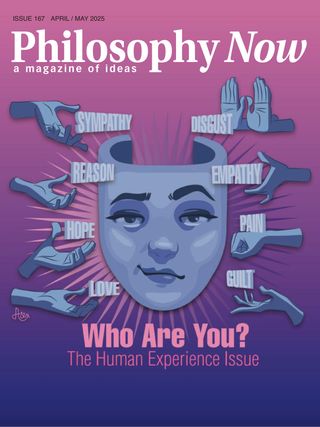

Diese Geschichte stammt aus der April/May 2025-Ausgabe von Philosophy Now.
Abonnieren Sie Magzter GOLD, um auf Tausende kuratierter Premium-Geschichten und über 9.000 Zeitschriften und Zeitungen zuzugreifen.
Sie sind bereits Abonnent? Anmelden
WEITERE GESCHICHTEN VON Philosophy Now

Philosophy Now
The Possibility- Bearing Animal
Raymond Tallis explores a twilight zone.

7 mins
February/March 2026

Philosophy Now
Amazing Times at the Pub Agora
John Douglas Mullen is a philosophical bar fly on the wall.
8 mins
February/March 2026

Philosophy Now
Friedrich Nietzsche (1844-1900)
Hilarius Bogbinder considers the all too human life of the notorious iconoclast.
11 mins
February/March 2026

Philosophy Now
Heisenberg's Philosophy of Quantum Mechanics
Kanan Purkayastha explains how Werner Heisenberg's 1925 paper turned the quantum theory of the early 1900s into the quantum mechanics of today.
10 mins
February/March 2026

Philosophy Now
Cicero & the Ideal of Virtue
Abdullah Shaikh explores Cicero's ideas about the core Roman principle of virtus.
13 mins
February/March 2026

Philosophy Now
ROPE
Les Jones has a Nietzschean take on a Hitchcock thriller.
6 mins
February/March 2026
Philosophy Now
What Have the Romans Ever Done For Us?
Salve! This issue's theme is Roman Philosophy. But as the rebels in Monty Python's Life of Brian asked, what have the Romans ever done for us? The question seems relevant here; we are philosophers, not archaeologists.
2 mins
February/March 2026

Philosophy Now
Paul Guyer
Paul Guyer is an American philosopher and a leading scholar of both Immanuel Kant and aesthetics. AmirAli Maleki interviews him about Kant's political and moral vision.
9 mins
February/March 2026
Philosophy Now
Identity in the Age of Connectivity
Sara Asran explores the dynamics of identity online.
6 mins
February/March 2026

Philosophy Now
A Very Short History of Critical Thinking
Luc de Brabandere summarises a long history through key figures of thought.
7 mins
February/March 2026
Listen
Translate
Change font size