Versuchen GOLD - Frei
Designing Analog Electronics
Circuit Cellar
|January 2026
Part 3: Filters for AC Circuits

So far, the focus of this series has been on DC circuits and measuring DC quantities with some known degree of precision. In Part 1 (Circuit Cellar #424, November 2025), I discussed why error and uncertainty must be managed carefully in circuit design [1]. In Part 2 (Circuit Cellar #425, December 2025), I explored some techniques to extract a small signal of interest riding on a much larger offset [2].
Now it’s time to switch gears and look at AC circuits in more detail. Specifically, this installment will focus of the design of filters that are used to remove unwanted components of AC signals. It’s a big topic, so I am not aiming to be able to provide a comprehensive review; rather, I want to introduce some of the key concepts and leave you with some ideas and inspiration to explore further.
As usual, we will work through a couple of practical examples. But before we do that, we need to get a little theory under our belts.
WHAT IS A FILTER?
A filter is essentially a circuit with a gain that varies with frequency in a controlled manner. The signals with frequencies that we are interested in pass through, whereas the signals we want to reject are attenuated. These frequency ranges are called the “passband” and “stopband,” respectively.
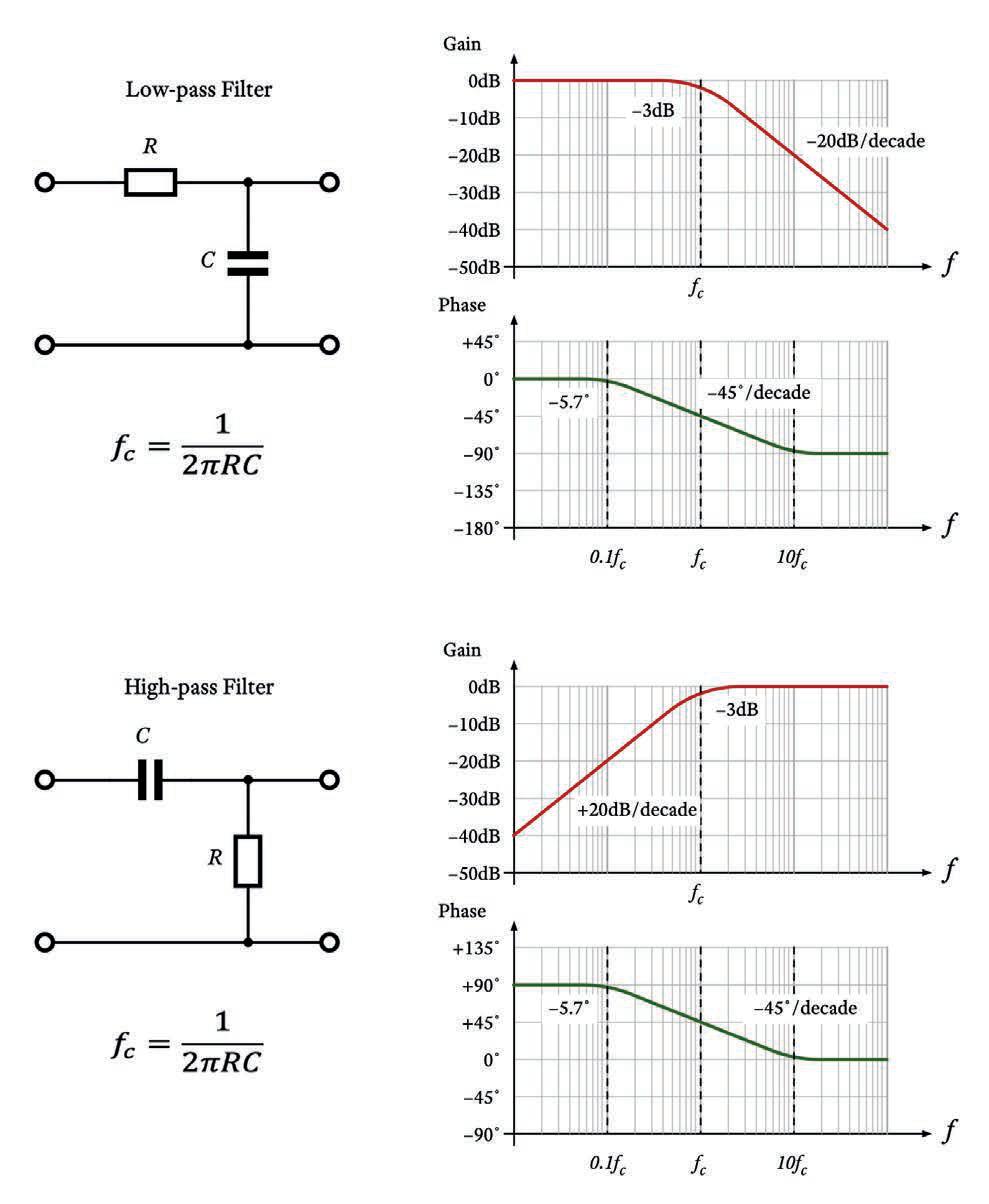 Filters are described by four main characteristics—Shape, Order, Type, and Topology, which I will discuss in sequence.
FILTER SHAPE
The filter’s “shape” describes the relative arrangement of the “passband(s)” and “stopband(s).” These, respectively, are the ranges of frequencies that the filters either allow to pass through with little or no attenuation, or are blocked or heavily attenuated. Figure 1 shows the four main shapes filters can take.


Diese Geschichte stammt aus der January 2026-Ausgabe von Circuit Cellar.
Abonnieren Sie Magzter GOLD, um auf Tausende kuratierter Premium-Geschichten und über 9.000 Zeitschriften und Zeitungen zuzugreifen.
Sie sind bereits Abonnent? Anmelden
WEITERE GESCHICHTEN VON Circuit Cellar

Circuit Cellar
Inside the Tech: E-Bikes Explained
The Future of Product Developement Nature

5 mins
March 2026

Circuit Cellar
Mesh for Embedded Control
Mesh Networks Are Rewiring Embedded Systems
11 mins
March 2026

Circuit Cellar
A System That Detects, Tracks, and Deters Deer
Using Computer Vision, an Arduino, and a Raspberry Pi 5
14 mins
March 2026

Circuit Cellar
Analog Meets Digital
Part 4: Eliminating Mains Interference with an ADC
19 mins
March 2026

Circuit Cellar
Datasheet: Linux-Based SBCs
SBCs Running Linux Bring Enterprise Power to the Network's Edge
8 mins
March 2026
Circuit Cellar
Running Model Trains Without Human Input
A Raspberry Pi Pico Controls Two Trains
9 mins
March 2026

Circuit Cellar
Connector Requirements for High-Voltage Healthcare Applications
Simplifying Safety and Security
9 mins
March 2026
Circuit Cellar
PIC32CM PL10 MCUs Expand Microchip's ARM Cortex-MO+ Portfolio
Building on decades of experience, Microchip Technology has added PIC32CM PL10 MCUs to its PIC32C family of ARM Cortex-M0+ core devices. PL10 MCUs feature a rich set of Core Independent Peripherals (CIPs), 5V operation, touch capabilities, integrated toolsets and safety compliance.
1 mins
March 2026

Circuit Cellar
From Buffer Overflows to Control Flow Attacks
This article extends the January 2026 article by showing a buffer overflow attack that changes a return value. I also discuss the use of the GCC stack protection feature, and demonstrate that it's not always a bulletproof protection method, even if it is better than doing nothing.
7 mins
March 2026
Circuit Cellar
Another Matter-Enabled MCU: the ESP32-C6
The list of MCUs that support the Matter protocol continues to get longer. In this column, Brian goes in-depth on one of the newer Matter-enabled MCUs and shows just how it compares to some of the alternatives now on the market.
21 mins
March 2026
Listen
Translate
Change font size