Versuchen GOLD - Frei
SLEEPER CELLS
The New Yorker
|December 18, 2023
To catch more carcinogens, we need to widen our scope.

In the nineteen-seventies, Bruce Ames, a biochemist at Berkeley, devised a way to test whether a chemical might cause cancer. Various tenets of cancer biology were already well established. Cancer resulted from genetic mutations—changes in a cell’s DNA sequence that typically cause the cell to divide uncontrollably. These mutations could be inherited, induced by viruses, or generated by random copying errors in dividing cells. They could also be produced by physical or chemical agents: radiation, ultraviolet light, benzene. One day, Ames had found himself reading the list of ingredients on a package of potato chips, and wondering how safe the chemicals used as preservatives really were.
But how to catch a carcinogen? You could expose a rodent to a suspect chemical and see if it developed cancer; toxicologists had done so for generations. But that approach was too slow and costly to deploy on a wide enough scale. Ames—a limber fellow who was partial to wide-lapel tweed jackets and unorthodox neckties—had an idea. If an agent caused DNA mutations in human cells, he reasoned, it was likely to cause mutations in bacterial cells. And Ames had a way of measuring the mutation rate in bacteria, using fast-growing, easy-to-culture strains of salmonella, which he had been studying for a couple of decades. With a few colleagues, he established the assay and published a paper outlining the method with a bold title: Carcinogens Are Mutagens.” The socalled Ames test for mutagens remains the standard lab technique for screening substances that may cause cancer.
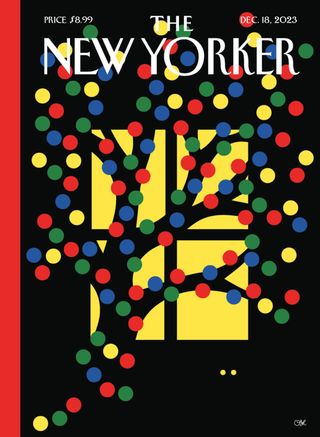

Diese Geschichte stammt aus der December 18, 2023-Ausgabe von The New Yorker.
Abonnieren Sie Magzter GOLD, um auf Tausende kuratierter Premium-Geschichten und über 9.000 Zeitschriften und Zeitungen zuzugreifen.
Sie sind bereits Abonnent? Anmelden
WEITERE GESCHICHTEN VON The New Yorker
The New Yorker
DEPT. OF ETCHING
One recent weekday morning, the British painter Peter Doig arrived at a bonded warehouse—a cavernous brick building—about a mile south of the River Thames, but not subject to the import taxes of the United Kingdom.

3 mins
January 19, 2026

The New Yorker
SUBWAY VIGILANTE
Revisiting the New York shooting that defined an era
17 mins
January 19, 2026

The New Yorker
MOM AND DAD: THE PERFORMANCE REVIEW
Mom, Dad, thanks for being on time this year. Dad, I can see by your T-shirt that it was a challenge. So you've already exceeded expectations.
3 mins
January 19, 2026
The New Yorker
Patrick Radden Keefe on Truman Capote's “In Cold Blood”
In 1972, on “The Tonight Show,” Johnny Carson asked Truman Capote about capital punishment. Capote had written, in unsettling detail, about the hanging of two killers, Dale Hickock and Perry Smith. Carson said, of the death penalty, “As long as the people don't have to see it, they seem to be all for it”; if executions occurred “in the public square,” Americans might stop doing them. Capote wasn't so sure. His hands laced together professorially, he murmured, in his baby-talk drawl, “Human nature is so peculiar that, really, millions of people would watch it and get some sort of vicarious sensation.”
3 mins
January 19, 2026
The New Yorker
BOOTS ON THE GROUND
There aren't many moments in Donald Trump's political career that could be called highlights.
4 mins
January 19, 2026

The New Yorker
CALL OF THE WILD
When calamity strikes in America's busiest national park, who comes to the rescue?
35 mins
January 19, 2026

The New Yorker
UNDER THREAT
The Danes were America's most loyal ally. Now they feel targeted—and terrified.
22 mins
January 19, 2026

The New Yorker
CONTAGION
A Broadway revival of Tracy Letts's “Bug.”
6 mins
January 19, 2026

The New Yorker
ANNALS OF TECHNOLOGY: HEY THERE!
How WhatsApp took over the global conversation.
25 mins
January 19, 2026
The New Yorker
M.I.P. IN CHAINS
Whatever else you think about invading a country and capturing its President, there's no getting around the inconvenience of imprisoning Nicolás Maduro in New York City.
7 mins
January 19, 2026
Translate
Change font size