
Mit Magzter GOLD unbegrenztes Potenzial nutzen
Erhalten Sie unbegrenzten Zugriff auf über 9.000 Zeitschriften, Zeitungen und Premium-Artikel für nur
Versuchen GOLD - Frei
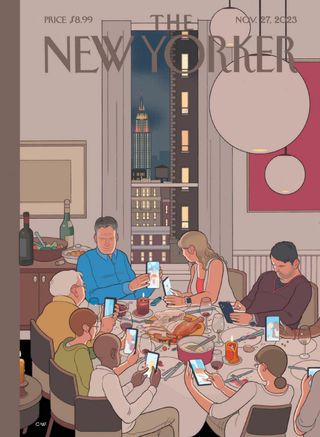
FRATERNAL ECLIPSE
The New Yorker
|December 04, 2023
The strange case of Israel Joshua Singer.

In 1966, the critic Irving Howe published an essay whose title, "The Other Singer," testified to a literary usurpation. For American readers in the nineteen-sixties, the name Singer meant Isaac Bashevis Singer, the only Yiddish writer to have reached the pinnacle of the American literary world. Singer's stories about Jewish life in Poland, where he was born, and New York, where he settled in 1935, appeared in the Forward, the city's leading Yiddish newspaper, before they were published in English in magazines including this one, Harper's, and Playboy.
It was an era when Jewish fiction was in vogue, with writers like Saul Bellow and Philip Roth on the best-seller lists; Singer won the National Book Award twice. In 1978, he became the first (and, to this day, the only) Yiddish writer to win the Nobel Prize in Literature.
In Howe's opinion, however, the ascent of I. B. Singer-known to Yiddish readers by his nom de plume, Bashevis was not a cause for celebration, because it meant the eclipse of a better writer: his older brother, Israel Joshua Singer. In the thirties and forties, it was I. J. Singer who was the star contributor to the Forward, writing both fiction and journalism, and whose books got translated in America and Europe. Maximillian Novak, a Yiddish scholar, writes in his book "The Writer as Exile: Israel Joshua Singer" that when Singer's epic novel "The Brothers Ashkenazi" was published, in 1936, he was compared to Tolstoy and mentioned as a future candidate for the Nobel Prize.
When he died, from a heart attack, in 1944, at the age of fifty, his younger brother Isaac was almost completely unknown.

Diese Geschichte stammt aus der December 04, 2023-Ausgabe von The New Yorker.
Abonnieren Sie Magzter GOLD, um auf Tausende kuratierter Premium-Geschichten und über 9.000 Zeitschriften und Zeitungen zuzugreifen.
Sie sind bereits Abonnent? Anmelden
WEITERE GESCHICHTEN VON The New Yorker

The New Yorker
CONTACT SOLUTIONS
“Disclosure Day.”

6 mins
June 22, 2026

The New Yorker
BAD ROMANCE
When did white-collar work start to look so bleak?
14 mins
June 22, 2026

The New Yorker
MUTTER
I'm waiting for my mother at the airport, holding a strip of cardboard above my head that says \"MUTTER.\"
10 mins
June 22, 2026

The New Yorker
BILLIONS AND BILLIONS
The hedge-fund titan Ken Griffin beats the competition at making money—and spending it.
40 mins
June 22, 2026

The New Yorker
MISERY LOVES COMPANY
The rise of \"Admin Nights\" in pursuit of productivity.
13 mins
June 22, 2026
The New Yorker
MEET RUSS FREUD
It used to be called the Roberts Institute for Living, but everybody knew that it was the insane asylum, and that’s what people called it.
3 mins
June 22, 2026

The New Yorker
UP TO NO GOOD
The hell-raising rocker who conquered country radio.
5 mins
June 22, 2026

The New Yorker
SOUL-SEARCHING
How the American church found its followers.
12 mins
June 22, 2026

The New Yorker
FAREWELL, MY LOVELY
Gustavo Dudamel and James Conlon put down their batons in Los Angeles.
9 mins
June 22, 2026

The New Yorker
ALLIES ON ICE
How the secret plans to take over Greenland have ruptured transatlantic relations.
44 mins
June 22, 2026
Translate
Change font size