
Mit Magzter GOLD unbegrenztes Potenzial nutzen
Erhalten Sie unbegrenzten Zugriff auf über 9.000 Zeitschriften, Zeitungen und Premium-Artikel für nur
Versuchen GOLD - Frei
Literary Legacy
Writer’s Digest
|May/June 2025
The next generation of authors stepping into the worlds of Tom Clancy, Robert Ludlum, and Vince Flynn share what it takes to write estate novels.
Tom Clancy's Jack Ryan. Robert Ludlum's Jason Bourne. Vince Flynn's Mitch Rapp. Once in a magical while, along comes a character who is so larger-than-life, so universally beloved, he outlives the author who created him. For the next generation of authors tapped to tell more of those stories, this isn't merely a career-changing opportunity: It's a dream come true.
Yet authors who write for literary estates are often misunderstood. Skeptics grumble about publishers “cashing in” on big names after they're gone. More awkwardly, some readers don't realize the original author is no longer living. (Brian Andrews, who's co-authored Jack Ryan novels with Jeffrey Wilson, has had multiple readers approach him at events, gushing, “Mr. Clancy, you're my favorite author.” He's not the only estate writer who's had to break it to a reader gently.)
You might be pleasantly surprised to learn estate novels often have much more to do with honoring the original authors’ wishes—and helping their families pay tribute—than with a third party’s payday. Clancy, for instance, had a big hand in what Jack Ryan’s future would look like, greenlighting his first estate writer, Mark Greaney, when he was still alive. Andrews points out that for every legacy series that begins with an author’s death, there are also authors like Lee Child, who recently tapped his brother Andrew to take over writing Jack Reacher.
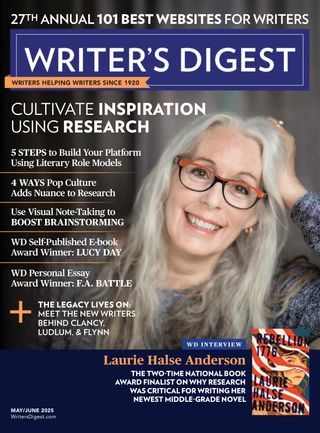

Diese Geschichte stammt aus der May/June 2025-Ausgabe von Writer’s Digest.
Abonnieren Sie Magzter GOLD, um auf Tausende kuratierter Premium-Geschichten und über 9.000 Zeitschriften und Zeitungen zuzugreifen.
Sie sind bereits Abonnent? Anmelden
WEITERE GESCHICHTEN VON Writer’s Digest

Writer’s Digest
Lauren Groff
The three-time National Book Award finalist discusses her new short story collection, Brawler, and the necessity of failure in writing.

14 mins
March / April 2026

Writer’s Digest
Seven
THE CHALLENGE: Write a short story of 650 words or fewer based on the photo below.
2 mins
March / April 2026

Writer’s Digest
Pacing in Nonfiction
It's all about story.
5 mins
March / April 2026
Writer’s Digest
If You're Bored, They're Bored
Five Zero-Draft tricks to ensure tight pacing.
8 mins
March / April 2026

Writer’s Digest
Deities
Gods and goddesses have had power over our imaginations stretching through the ages—whether ancient Norse, Chinese, Mesoamerican, or Greco-Roman, we have a fascination with cosmic beings.
5 mins
March / April 2026
Writer’s Digest
Merging Memory With Imagination
Author Rin-rin Yu's debut middle-grade novel, Goodbye, French Fry, represents a combination of her true childhood experiences and the universal experience of growing into yourself.
5 mins
March / April 2026

Writer’s Digest
Put Yourself in Charge of Your Own Story
Julie Ann Sipos, grand-prize winner of the 33rd annual WD Self-Published Book Awards, on how her career in Hollywood influences her writing style and her business strategy as an indie author.
4 mins
March / April 2026

Writer’s Digest
The Pause Is the Point
How to use stillness to create momentum in your fiction.
10 mins
March / April 2026

Writer’s Digest
Ericka Tiffany Phillips
Ericka Tiffany Phillips is a literary agent at the Stephanie Tade Agency, representing nonfiction authors whose “work have the power to shape culture and catalyze collective transformation,” she says.
2 mins
March / April 2026

Writer’s Digest
Short-Story Dispensers Bring Literature to the Masses
Life is often a wait, whether it's for a commuter train, an appointment with a doctor, or the start of a class.
5 mins
March / April 2026
Listen
Translate
Change font size