Versuchen GOLD - Frei
How to Foster Talent Management Champions
MIT Sloan Management Review
|Fall 2025
Many managers pay insufficient attention to talent strategy. Five interventions can help deepen their commitment to identifying and developing key capabilities.

AS LEADERS JUGGLE INCREASingly complex and demanding responsibilities, they can substantially differ in their commitment and approach to managing talent. While some leaders proactively identify, develop, retain, and deploy talent, others neglect these activities. That can be detrimental for organizations amid ongoing skills shortages and rising employee expectations for career development, continuous learning, and recognition.
A strategic organizational talent management approach, bolstered by leader buy-in, is a powerful mechanism to develop greater operational agility by enabling more fluid and flexible workforces. Deliberate approaches and tools can facilitate talent mobility and enhance strategic deployment by dynamically matching employees' skills with organizational needs.¹ For example, research has found that internal talent markets can increase employee engagement and reduce turnover, but their effectiveness depends on collaboration beyond functional silos - a deep cultural shift for many organizations.2 Leadership commitment to managing talent is paramount.
Here, we will introduce the Talent Leadership Model, developed through our interviews with middle managers, which describes the varying roles and behaviors that leaders exhibit when managing talent.
(See "Four Approaches to Talent Management," p. 31.) Senior executives can use this framework to better understand the talent leadership styles of their organization's team leaders, as well as their own approaches, in order to help managers become more effective contributors to an enterprise-wide talent strategy.
Four Talent Management Approaches Our model describes four different talent management approaches along two key dimensions: leaders’ strategic depth (tactical or strategic) and scope of impact (across their own team or the whole organization).
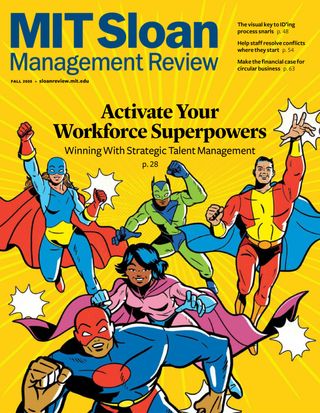

Diese Geschichte stammt aus der Fall 2025-Ausgabe von MIT Sloan Management Review.
Abonnieren Sie Magzter GOLD, um auf Tausende kuratierter Premium-Geschichten und über 9.000 Zeitschriften und Zeitungen zuzugreifen.
Sie sind bereits Abonnent? Anmelden
WEITERE GESCHICHTEN VON MIT Sloan Management Review

MIT Sloan Management Review
Assess What Is Certain in a Sea of Unknowns
Understanding what won't change clarifies what might — and strengthens decision-making in volatile times.

13 mins
winter 2026

MIT Sloan Management Review
Ask Sanyin: Why Is It So Hard to Pull the Plug on a Project?
We're finding it difficult to wind down projects that no longer serve our priorities.
2 mins
winter 2026

MIT Sloan Management Review
Integrate Sustainability and Innovation to Find New Opportunities
Five common innovation practices can help leaders pursue sustainability as a growth strategy.
12 mins
winter 2026

MIT Sloan Management Review
The Case for Quiet Corporate Activism
Leaders concerned that they will be penalized for championing sustainability and diversity can still sustain their commitments.
11 mins
winter 2026

MIT Sloan Management Review
The Perils of Algorithmic Pricing
Some revenue management systems based on algorithms may lead to unintended collusion and antitrust violations.
9 mins
winter 2026

MIT Sloan Management Review
Broadening Future Perspectives at the Bank of England
Leaders at the U.K’s central bank sought to broaden their thinking about future risks and opportunities. Here’s how they built longer-term horizon-scanning capabilities and what they learned along the way.
9 mins
winter 2026

MIT Sloan Management Review
How Nesting Changes Platform Strategy
Should your platform host another platform — or be hosted by one? Here's how to think through the choices.
14 mins
winter 2026
MIT Sloan Management Review
Are You an Authentic Leader or an Authentic Jerk?
Leaders who are true to their values can inspire trust and respect, but not if \"being yourself\" becomes the problem.
13 mins
winter 2026

MIT Sloan Management Review
How to Make Scenario Planning Stick
Developing future scenarios can deepen leaders’ strategic insights. Establishing scenario planning as an ongoing capability and reaping its full benefits require linking it to other processes.
16 mins
winter 2026

MIT Sloan Management Review
A Faster Way to Build Future Scenarios
This streamlined approach to scenario planning incorporates AI and helps managers navigate future uncertainties more efficiently.
13 mins
winter 2026
Listen
Translate
Change font size