Versuchen GOLD - Frei
Dormers: when quality meat really does count
Farmer's Weekly
|August 29 - September 05, 2025
The Kinko Dormers stud near Swellendam in the Western Cape is proving that precision breeding, backed by performance data, can deliver measurable financial advantages. Johan Swart, the owner of the stud, spoke to Glenneis Kriel about his breeding philosophy and the performance-driven approach behind his success.
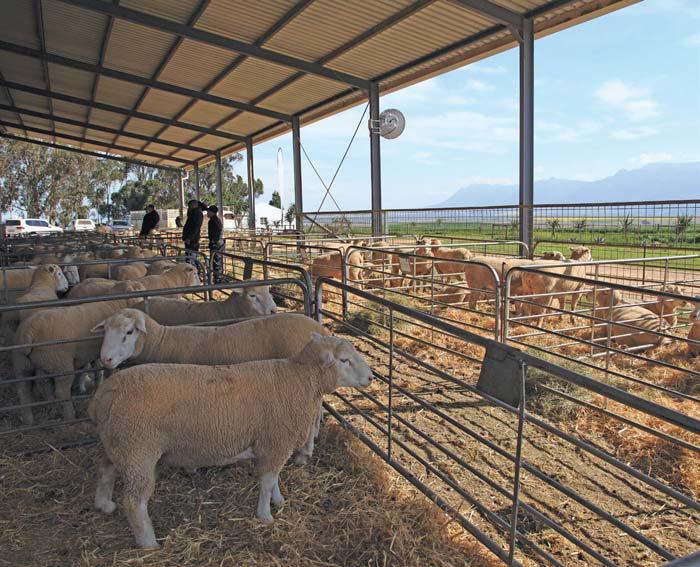
If you are looking for top-class Dormer genetics, the Kinko Dormer stud in Swellendam should be on your radar.
The stud’s story began in 1999, when Johan Swart bought the entire Dormer stud belonging to a family friend, Thys Swart. At the time, the stud had already been running for several decades and was well regarded in Dormer circles.
“We used to buy a lot of Dormer rams in a year from ‘Oom’ Thys, and I always asked if I could buy a few ewes as well. Then one day he agreed to sell me a few of his animals, but when I saw the ewes in the yard, I ended up buying the whole flock at R390 an ewe, and R900 a ram, which was double the price of commercial ewes at the time. ‘Oom’ Thys was already well advanced in his years, so he wanted to scale down,” Swart recalls.
Thys used to be known locally as Thys Kinko, after the Kinko River that flows through what used to be his farm. To honour his legacy, Swart decided to reregister the stud as Kinko Dormers.
“Oom Thys bought his first 10 Dormer ewes back in 1963, and registered the U-Dormer stud in 1974,” he says.
Swart recalls that Thys, back then, used to trade an entry-level ram for three or four slaughter lambs, and his better rams for five.
EFFICIENT SYSTEMS
Like his father, Streicher, Swart invests in Dormer sheep to boost the meat production of his Merino ewes through crossbreeding.
“We predominantly farm with grain, but we keep sheep to add value to lucerne,” he says. “We run a cash crop cycle that includes wheat, canola and barley, followed by a lucerne cycle that lasts about five years.
“The lucerne allows our family business to get grass weeds under control again before the next round of cash crops are planted.”
While Swart initially bred his own Merino ewes, he now buys in Merino ewes at 11 to 14 months of age from nearby producers. The move has improved both efficiencies and flock size.


Diese Geschichte stammt aus der August 29 - September 05, 2025-Ausgabe von Farmer's Weekly.
Abonnieren Sie Magzter GOLD, um auf Tausende kuratierter Premium-Geschichten und über 9.000 Zeitschriften und Zeitungen zuzugreifen.
Sie sind bereits Abonnent? Anmelden
WEITERE GESCHICHTEN VON Farmer's Weekly

Farmer's Weekly
More about growing vegetable seedlings in trays
By considering various factors and tailoring care to specific vegetable needs, you can produce healthy, robust seedlings ready for transplanting into the garden, writes Shane Brody.

2 mins
March 27 - April 3, 2026

Farmer's Weekly
Prodigy of agriculture and land is now a presidential envoy
Wandile Sihlobo will be armed by state powers to accelerate any decision-making that the Presidency deems crucial to grow the sectors of agriculture and land
2 mins
March 27 - April 3, 2026

Farmer's Weekly
Notes from the Western Cape agricultural roadshow
We spent time last week engaging with agribusinesses and farmers in the Western Cape. The primary agricultural focus of the province is various fruits, citrus, table grapes, wine, wheat, barley, livestock, and aquaculture, among many value chains.
3 mins
March 27 - April 3, 2026

Farmer's Weekly
AGOA's promise fades under new US tariffs
Although the African Growth and Opportunity Act has been extended for another year, new US reciprocal tariffs have largely erased its duty-free benefits. Recent modelling shows sharp declines in African exports to the US, particularly in apparel-dependent economies such as Lesotho and Madagascar.
4 mins
March 27 - April 3, 2026

Farmer's Weekly
Egon Zunckel: a lifetime of learning from the soil
The Zunckel name is synonymous with no-till farming in South Africa. Egon Zunckel, a pioneer in the field and a passionate advocate for soil health, shared with Lindi Botha the lessons he has learnt over the years about building resilient soils and sustainable farming systems.
10 mins
March 27 - April 3, 2026
Farmer's Weekly
Researchers explore new tools to combat herbicide resistance
Research by students from Stellenbosch University aimed at combatting herbicide resistance was highlighted during a recent technical trial information day hosted by the Western Cape Department of Agriculture.
6 mins
March 27 - April 3, 2026

Farmer's Weekly
Lepas leaps into South Africa as the latest Chery-owned brand
Lepas has become Chinese carmaker Chery's latest local subbrand with the introduction of the L4 compact SUV. The Citizen's Charl Bosch reports.
2 mins
March 27 - April 3, 2026
Farmer's Weekly
La Rhone Limousins: a small mixed herd turned renowned stud
The Western Cape is not typically known for cattle farming, particularly in its fruit-growing regions. Yet nestled among the orchards below the mountains of Tulbagh is a Limousin stud that has made a name for itself. AJ du Toit of La Rhone Limousins spoke to Henning Naudé about producing high-quality genetics now found on farms in all nine provinces.
6 mins
March 27 - April 3, 2026
Farmer's Weekly
Nitrogen: no easy fix
Products that claim to herald a nitrogen revolution that will boost global food production are nothing more than snake oil, say scientists.
4 mins
March 27 - April 3, 2026

Farmer's Weekly
Potato soup
Rich, creamy, and indulgent, this soup is the ultimate in comfort food.
1 mins
March 27 - April 3, 2026
Listen
Translate
Change font size