Versuchen GOLD - Frei
A breed driven by data and production value
Farmer's Weekly
|August 15-22, 2025
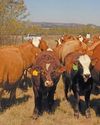
The Brahman is a significant player in the beef industry. Sabrina Dean found out more about its data-driven improvement focus from Sytze Smit, breed director at the Brahman Cattle Breeders' Society of South Africa.
Tell us more about the history of the breed in South Africa.
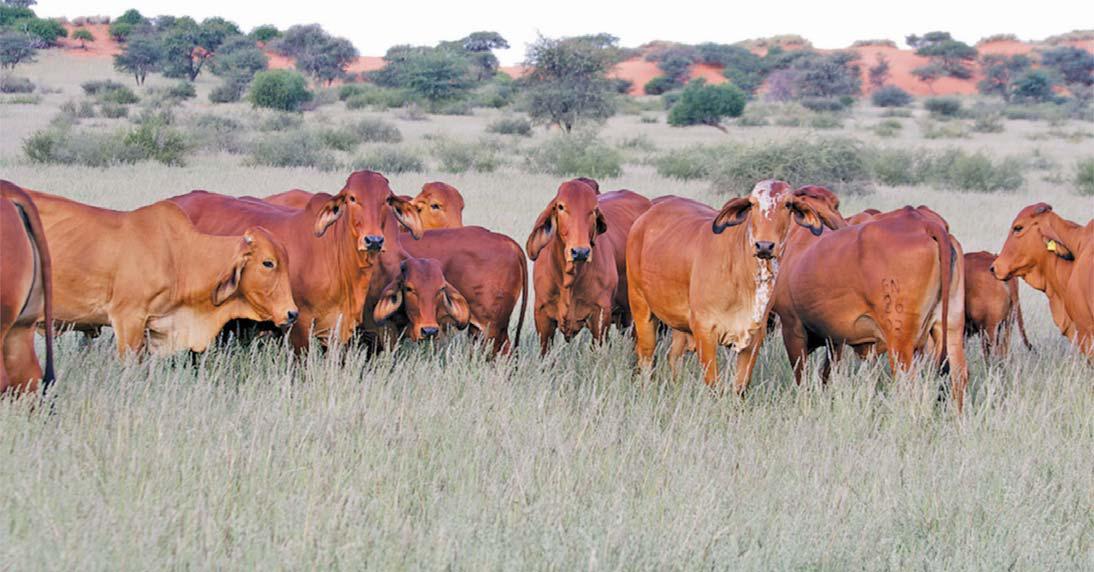
The Brahman breed was first formally adopted in the US when the American Brahman Breeders Association was established in 1924. The breed first made its way to Southern Africa in 1954 when a farmer in Windhoek in what was then South West Africa (Namibia today) imported the first male and female lines via Cape Town Harbour - 18 animals in total. In 1957, the Brahman Cattle Breeders' Society of South Africa (BCBSSA) was founded in Kroonstad in the Free State. By 1960, there were just over 40 registered breeders and membership grew astronomically in the ensuing decades. Today, there are more than 360 members and over 54 000 registered cattle in South Africa.
How would you describe a Brahman in terms of the breed standard?
The Brahman has developed over a long time into a breed that is known for its beef production attributes. They have a typical zebu look and this has been maintained to ensure the breed retains its inherent adaptability to a variety of regions. This makes it suitable for all the different climatic zones occurring in South Africa.
PERFORMANCE EVALUATION HAS BECOME AN IMPORTANT TOOL IN SELECTING BETTER PRODUCTION
The modern Brahman is recognised as a beef breed that is capable of producing high-quality beef from natural resources.
This speaks to its economic efficiency as it reduces financial inputs, lengthens the marketing period, and cattle reared on the veld also qualify for A or AB grades for as long as 32 months.
Some of the strong points for which it is prized include longevity, parasite resistance, hardiness, adaptability, mothering ability, calving ability and heterosis (hybrid vigour).
How has the breed evolved over the years?
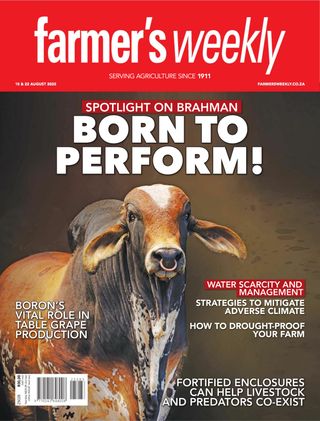

Diese Geschichte stammt aus der August 15-22, 2025-Ausgabe von Farmer's Weekly.
Abonnieren Sie Magzter GOLD, um auf Tausende kuratierter Premium-Geschichten und über 9.000 Zeitschriften und Zeitungen zuzugreifen.
Sie sind bereits Abonnent? Anmelden
WEITERE GESCHICHTEN VON Farmer's Weekly

Farmer's Weekly
Sweet prospects: the current state of litchi production in South Africa
Bram Snijder, agricultural consultant and chairperson of the South African Litchi Growers' Association, spoke to Octavia Avesca Spandiel about the litchi industry embracing new opportunities, tackling challenges, implementing innovation, and reaching markets both locally and internationally.

6 mins
January 16-23, 2026

Farmer's Weekly
How AFGRI uses technology to unlock farm finance from asset to market
As modern farming becomes more capital-intensive and digitally driven, AFGRI is reinventing agricultural finance by linking technology directly to lending decisions.
5 mins
January 16-23, 2026

Farmer's Weekly
Adele's Mohair: a living tapestry of craft, colour and rural heritage
Octavia Avesca Spandiel spoke to Adele Cutten, founder of Adele's Mohair, to explore how a small spinning experiment grew into a thriving rural craft enterprise rooted in South Africa's rich mohair heritage.
6 mins
January 16-23, 2026
Farmer's Weekly
How Merino farmers are battling predation, disease and rising costs
Whether you are a stud breeder or commercial Merino farmer, environmental, operational, and infrastructural challenges have an equal impact on a farming operation. The aim of any livestock farmer, whether stud or commercial, is to keep losses at a minimum, and although farmers are facing many challenges, they implement various strategies to ensure both the survival and financial security or profitability of farming operations.
9 mins
January 16-23, 2026
Farmer's Weekly
The future of SA wool: refined infrastructure and wool traceability
As the agriculture sector starts to adapt to the fast-paced development of technology, producers and processors need to decide what to implement and what to avoid. Henning Naudé spoke to Izak Klopper, manager of shearer training at the National Wool Growers' Association, about how shearing has changed, and what the industry can expect from new research and development from international markets.
5 mins
January 16-23, 2026
Farmer's Weekly
Cannabis and marketing in South Africa
The path from cultivation to commercial success remains complicated by regulatory ambiguity. Cultivators who master compliant marketing while delivering verifiable quality will build sustainable businesses, says Thomas Walker.
2 mins
January 16-23, 2026
Farmer's Weekly
Foot-and-mouth disease project targets waste reduction and regulatory reform
A groundbreaking research collaboration between Red Meat Industry Services, the University of Pretoria, and global animal health leader Zoetis is aiming to transform South Africa's approach to foot-and-mouth disease.
3 mins
January 16-23, 2026
Farmer's Weekly
What to expect in 2026
The world faces a complex interplay of economic, geopolitical, environmental, technological, and social pressures.
3 mins
January 16-23, 2026

Farmer's Weekly
How drones are revolutionising pest and disease detection in agriculture
Drones are reshaping modern crop protection by giving farmers a powerful new vantage point: the sky. With advanced sensors, high-resolution imaging, and artificial intelligence-driven analytics, these unmanned aerial vehicles can detect early signs of disease, water stress, and pest damage long before the human eye can. Jedrie Harmse spoke to agricultural drone specialist Monique Heydenrych.
7 mins
January 16-23, 2026
Farmer's Weekly
Generic advertising in perspective
Dr Koos Coetzee explains how industry organisations and the agriculture sector actually have the ability to prudently manage the negative perceptions surrounding generic advertising campaigns.
2 mins
January 16-23, 2026
Listen
Translate
Change font size