Versuchen GOLD - Frei
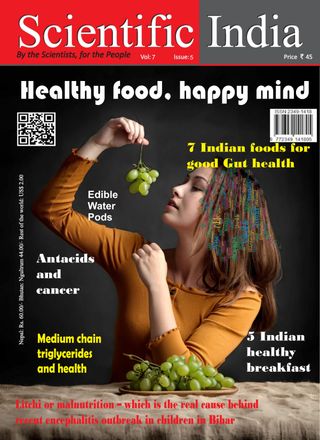
Edible Water Pods
Scientific India
|September - October 2019
With the changing life styles of present civilization, wastage/litter in its various forms has become one of the serious problems for the well being of mother planet earth.
-

Despite the fact that we're all fully aware of the negative impact plastic water bottles have on our Mother Earth, we continue to consume them at the alarming rate of 480 billion per year. Discarded bottles can be seen polluting here and there on roads, buses, trains and at every place used by human beings. Approximately one billion of those plastic bottles pollute the oceans also. Plastic is cheap to make, which is why it's used for bottling drinks and other liquids, but that doesn't mean it's as good for the environment as it is for the manufacturer. Every plastic bottle takes a thousand years to break down, which leads to massive piles of waste that go nowhere fast. Manpower and machinery involved in recycling these discarded water bottles are playing their role but not with the pace with which this trash is being generated by human.
Efforts are also being made to minimize or restrict the use of the plastic bottles but without much fruitful outcomes. Need of drinking water at every time and every place is becoming an essential habit/requirement of present water-bubble human race. Hence, there is a great need to develop water carriers which are more handy and environmental friendly. In this direction, the biodegradable edible water pods created by Skipping Rocks Lab (London, Uk) in an attempt to make a more environmentally friendly alternative to single-serving plastic bottles.
Water carriers can come in different materials with all shapes and sizes, but to replace one of the most simple, ubiquitous water carriers on the planet - in this case, plastic bottles - it really has to be unbelievably brilliant to have any chance at success. In this direction, “Ooho” is an edible bottle created by Skipping Rocks Lab and is a product that's perfectly suited for internet hype.

Diese Geschichte stammt aus der September - October 2019-Ausgabe von Scientific India.
Abonnieren Sie Magzter GOLD, um auf Tausende kuratierter Premium-Geschichten und über 9.000 Zeitschriften und Zeitungen zuzugreifen.
Sie sind bereits Abonnent? Anmelden
WEITERE GESCHICHTEN VON Scientific India
Scientific India
Japanese physicists were the first to measure the most tolerant entanglement state, the W state
There are many unusual things that happen in the world of quantum physics.

3 mins
September - October 2025

Scientific India
The Fifth Force: Could It Unlock the Secret of Dark Matter?
What if the universe is powered by a force we've never seen before? For centuries, science has explained nature with four fundamental forces.
3 mins
September - October 2025

Scientific India
A flu test you can chew
As flu season nears in the northern hemisphere, scientists are exploring a surprising new way to detect infection: through taste.
1 mins
September - October 2025
Scientific India
Lab-Grown Kidney Brings Artificial Organ Dream Closer to Reality
In a major leap toward bioengineered organ replacement, scientists have successfully grown human kidney 'assembloids' in the laboratory that mimic key structural and functional features of natural kidneys.
1 min
September - October 2025
Scientific India
Your pumpkin might be hiding a toxic secret
Pumpkins, squash, zucchini, and other members of the gourd family have a surprising trait: they can take up pollutants from the soil and store them in their edible parts.
1 mins
September - October 2025

Scientific India
2025 Nobel Prize in Physics Reveals Quantum Secrets in Superconducting Circuits
The 2025 Nobel Prize in Physics has been awarded to John Clarke, Michel H. Devoret, and John M. Martinis for their pioneering experiments that brought quantum mechanics from the invisible atomic world to the macroscopic scale a system large enough to hold in your hand.
1 mins
September - October 2025
Scientific India
Genomic Evidence Redefines the Evolutionary Age of Mosquitoes
A new genetic analysis has shaken up what we thought we knew about one of humanity's most notorious pests the mosquito.
1 min
September - October 2025

Scientific India
Nobel Prize in Chemistry 2025: Building Molecular Architectures with Room to Breathe
In a scientific breakthrough that bridges molecular design with planetary-scale problems, the 2025 Nobel Prize in Chemistry has been awarded to Susumu Kitagawa, Richard Robson, and Omar Yaghi.
1 mins
September - October 2025

Scientific India
Guardians of Immunity: Nobel Prize 2025 Honors Discoveries that Keep the Immune System in Check
The 2025 Nobel Prize in Physiology or Medicine has been awarded to Mary E. Brunkow, Fred Ramsdell, and Shimon Sakaguchi for their groundbreaking discoveries in the field of peripheral immune tolerance a crucial mechanism that prevents the body's immune system from turning against itself.
1 mins
September - October 2025
Scientific India
'Is cold nuclear fusion feasible?
In early May 1989, two chemists from the University of Utah, Pons and Fleischmann, arrived in Washington, U.S.A. The aim is to present their findings to members of the US Congress.
3 mins
September - October 2025
Translate
Change font size