
Mit Magzter GOLD unbegrenztes Potenzial nutzen
Erhalten Sie unbegrenzten Zugriff auf über 9.000 Zeitschriften, Zeitungen und Premium-Artikel für nur
Versuchen GOLD - Frei
Dry Run
Down To Earth
|February 01, 2017
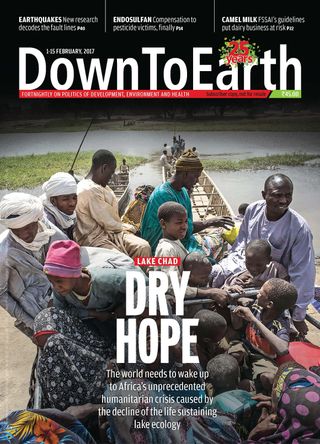
Nutritional standards for the sale of camel milk, issued for the first time by the government, are a huge threat to the nascent dairy industry.

THE FOOD Safety and Standards Authority of India (FSSAI), the country’s apex food regulator, has passed an order that can nip a promising dairy industry in the bud. On November 29 last year, FSSAI issued and enforced, for the first time, interim standards for the sale of camel milk. Scientists say the standards are too stringent to be implemented.
As per the standards, raw, pasteurised, boiled, flavoured and sterilised camel milk should have minimum 3 per cent fat and 6.5 per cent solids-not-fat (SNF). “The minimum 3 per cent standard is not practical,” says Raghvendar Singh, Principal Scientist (Animal Biochemistry) at the National Research Centre on Camel (NRCC). The Bikaner based institution comes under the Indian Council of Agricultural Research.
Since the sale of camel milk has always been part of the informal sector, there are no official figures available, but the business is thriving in states like Rajasthan and Gujarat. “Camel milk is not consumed by the masses, but is in huge demand for its medicinal properties, particularly among people who suffer from diabetes and liver diseases,” says Hitesh Rathi, founder and director, Aadvik Foods and Products Pvt Ltd, the first company trading in camel milk and milk products on a pan-India scale. The Rajasthan-based company procures 3,5004,000 litres of milk a month from pastoralists in Gujarat and Rajasthan. Ramesh Bhatti, programme director and team leader of the Centre for Pastoralism Unit of Sahjeevan, a public charitable trust based in Gujarat, says a pastoralist with 25 camels can earn up to ₹3 lakh a year by selling milk. Bhatti works with the Rabari and Jat pastoral communities engaged in camel breeding in the Kachchh region. Pastoralists in the region sell more than 1,000 litres of camel milk every week, he estimates. Bhatti says the demand for camel milk is on the rise but the regulation can dent the budding market.

Diese Geschichte stammt aus der February 01, 2017-Ausgabe von Down To Earth.
Abonnieren Sie Magzter GOLD, um auf Tausende kuratierter Premium-Geschichten und über 9.000 Zeitschriften und Zeitungen zuzugreifen.
Sie sind bereits Abonnent? Anmelden
WEITERE GESCHICHTEN VON Down To Earth

Down To Earth
THINK TWICE BEFORE FELLING SAL TREES
Many trees considered to be affected by sal borer in the 1990s are still alive today

1 mins
February 16, 2026

Down To Earth
EDGE OF SURVIVAL
Caste divides deny marginalised communities land, resources and essential aid, leaving them more vulnerable to climate disasters
6 mins
February 16, 2026

Down To Earth
A WISH LIST?
Union Budget for 2026-27 conveys the impression of a roll-call of intentions and ambitious proposals, with little detail on their formulation
6 mins
February 16, 2026
Down To Earth
Break down the gender wall
THE RULING National Democratic Alliance (NDA) government has been heavily invested in the goal to make India a developed economy by 2047.
2 mins
February 16, 2026

Down To Earth
MENSTRUAL HEALTH, NOW A FUNDAMENTAL RIGHT
In a landmark judgement, the Supreme Court has recognised menstrual health and hygiene as a fundamental right under Article 21 of the Constitution of India, which guarantees the right to life and dignity.
8 mins
February 16, 2026

Down To Earth
Of devolution and new disasters
The 16th Finance Commission pushes for changes in view of new fiscal and climatic conditions
11 mins
February 16, 2026
Down To Earth
Rising risks of plastics
NEGATIVE IMPACTS on human health due to emissions linked to the plastic lifecycle could double by 2040, according to a study published in The Lancet Planetary Health in January.
1 min
February 16, 2026

Down To Earth
GAP BETWEEN EPIDEMICS NARROWING
A watershed-based and landscape-level approach is needed to address forest degradation
2 mins
February 16, 2026
Down To Earth
WAITING TO STRIKE
Sal heartwood borer is considered the biggest threat to forestry in India, especially to the sal tree, where it lives and breeds.
11 mins
February 16, 2026

Down To Earth
A SPRING DELIGHT
Mustard flowers are not meant only for the eyes. Invite them to your plate once in a while
3 mins
February 16, 2026
Translate
Change font size