Versuchen GOLD - Frei
Why Are We So Angry?
The Atlantic
|January/February 2019
The untold story of how we all got so mad at one another

I. An Angry Little Town
Soon after the snows of 1977 began to thaw, the residents of Greenfield, Massachusetts, received a strange questionnaire in the mail. “Try to recall the number of times you became annoyed and/or angry during the past week,” the survey instructed. “Describe the most angry of these experiences.” One woman knew her answer: Recently, her husband had bought a new car. Then he had driven it to his mistress’s house so she could admire the purchase. When the wife found out, she was livid. Furious. Her rage felt like an eruption she couldn’t control.
The survey was interested in the particulars of respondents’ anger. In its 14 pages, it sought an almost voyeuristic level of detail. It asked the woman to describe the stages of her fury, which words she had shouted, whether punches had been thrown. “In becoming angry, did you wish to get back at, or gain revenge?” the survey inquired. Afterward, did you feel “triumphant, confident and dominant” or “ashamed, embarrassed and guilty”? There were also questions for people like her husband, who had been on the receiving end: “Did the other person’s anger come as a surprise to you, or did you expect that it would occur?”
Greenfield, population 18,000, was an unusual place to plumb these depths. It was a middle-class town with a prosperous tool-and-die factory, where churches outnumbered bars two to one. Citizens were private and humble, and—except for a few recent letters to the editor lamenting that the high-school hockey team had been robbed in the playoffs—the town showed little evidence of widespread resentment. In fact, this very placidity was why Greenfield had been chosen for the study.
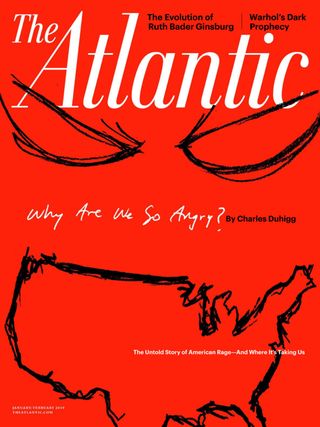

Diese Geschichte stammt aus der January/February 2019-Ausgabe von The Atlantic.
Abonnieren Sie Magzter GOLD, um auf Tausende kuratierter Premium-Geschichten und über 9.000 Zeitschriften und Zeitungen zuzugreifen.
Sie sind bereits Abonnent? Anmelden
WEITERE GESCHICHTEN VON The Atlantic

The Atlantic
What Dante Is Trying to Tell Us
A colloquial translation of Paradiso might make people actually read it.

10 mins
February 2026

The Atlantic
Sense of an Ending
Julian Barnes says goodbye to the novel
9 mins
February 2026

The Atlantic
IS THIS WHAT PATRIOTISM LOOKS LIKE?
Why an ex—police officer assaulted a fellow cop on January 6
37 mins
February 2026
The Atlantic
THE PURGED
DONALD TRUMP'S DESTRUCTION OF THE CIVIL SERVICE IS A TRAGEDY NOT JUST FOR THE ROUGHLY 300,000 WORKERS WHO HAVE BEEN DISCARDED, BUT FOR AN ENTIRE NATION.
8 mins
February 2026

The Atlantic
GROUNDED
THE SPACE PROGRAM ENNOBLED AMERICAN CULTURE AND ADVANCED AMERICAN SCIENCE. DONALD TRUMP HAS CHOSEN TO END THAT ERA OF AMBITION.
17 mins
February 2026
The Atlantic
The New History of Fighting Slavery
What we learn by tracing rebellions from Africa to the Americas
10 mins
February 2026

The Atlantic
MICAELA WHITE
By the beginning of 2025, there was a famine in Sudan, which meant that it was only a matter of time before the U.S.government dispatched Micaela White to the scene. She was America's fixer of choice.
2 mins
February 2026

The Atlantic
WHAT JEFFREY EPSTEIN DIDN'T UNDERSTAND ABOUT LOLITA
Everything.
5 mins
February 2026

The Atlantic
Who Gets to Be Indian- And Who Decides?
The very American story of Chief Buffalo Child Long Lance
22 mins
February 2026

The Atlantic
I'm Not From the Government but I'm Here to Help
The Trump administration is trying to eliminate federal services? Fine. I'll do everything myself.
24 mins
February 2026
Translate
Change font size