Versuchen GOLD - Frei
The Heroine's Journey
The Atlantic
|September 2021
In Joseph Campbell’s classic study of world myths, women were in the background. A new book puts them at the center of the story.

It’s one of the darkest and bloodiest episodes in Ovid’s Metamorphoses. King Tereus of Thrace, having lusted after his sister-in-law, Philomela, inveigles her away from her father’s protection, takes her to a forest dungeon, and rapes her. Philomela, towering in eloquence, vows to tell the world what Tereus has done; her raised voice, she promises him in Arthur Golding’s 1567 translation, will “make the stones to understand.” So Tereus cuts her tongue out. Ovid, characteristically, zooms in: The wound pours; the severed tongue bounces and mutely spasms—“as an adder’s tail cut off doth skip a while,” in Golding’s version. More modern retellers of The Metamorphoses have been similarly transfixed. From Ted Hughes’s Tales From Ovid (1997): “The tongue squirmed in the dust, babbling on—Shaping words that were now soundless.” From Nina MacLaughlin’s Wake, Siren (2019): “Please imagine how it continues to wriggle, how it twitches and moves on the dirt floor.”
It barely qualifies as mythic, the story of Philomela. A sexual assault, a silencing, a mutilated testimony—there is nothing supernatural about any of this. The germ of hope in the tale is that Philomela is not silenced; still trapped by her abductor, the speechless princess secretly weaves her denunciation of Tereus into the imagery of a tapestry, which she then sends to her sister.
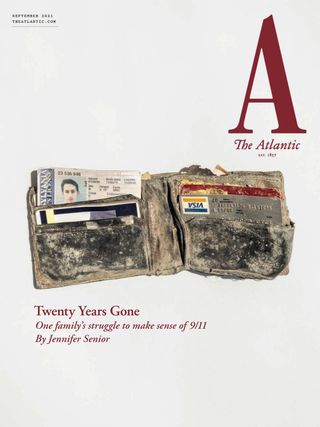

Diese Geschichte stammt aus der September 2021-Ausgabe von The Atlantic.
Abonnieren Sie Magzter GOLD, um auf Tausende kuratierter Premium-Geschichten und über 9.000 Zeitschriften und Zeitungen zuzugreifen.
Sie sind bereits Abonnent? Anmelden
WEITERE GESCHICHTEN VON The Atlantic
The Atlantic
You Had to Be There
An emerging field of history asks if we can ever really understand how our forebears experienced love, anger, fear, and sorrow.

23 mins
January 2026

The Atlantic
By the Horns
The week before the biggest bullfight of her career, in Cádiz, Spain, this past July, 24-year-old Miriam Cabas posted a carefully produced video on Instagram.
1 mins
January 2026

The Atlantic
The New German War Machine
After World War II, Germany embraced pacifism as a form of atonement. Now the country is arming itself again.
18 mins
January 2026
The Atlantic
The Eloquence
The prime minister was watching a disaster movie when we found him.
4 mins
January 2026

The Atlantic
What's for Dinner, Mom?
The women who want to change the way America eats
12 mins
January 2026

The Atlantic
How Terror Works
A 1947 German novel explores the sometimes corrosive, sometimes energizing nature of fear.
8 mins
January 2026

The Atlantic
Yesterday's Idea of a Modern Man
Sam Shepard, a self-made cowboy, was also a poet of masculine angst.
7 mins
January 2026

The Atlantic
ACCOMMODATION NATION
America's colleges have an extra-time-on-tests problem.
11 mins
January 2026

The Atlantic
Respect the Drummer
A new history of rock, told through its overlooked heroes
5 mins
January 2026

The Atlantic
THE MOST POWERFUL MAN IN SCIENCE
WHY IS ROBERT F. KENNEDY JR. SO CONVINCED HE'S RIGHT?
42 mins
January 2026
Translate
Change font size