
Mit Magzter GOLD unbegrenztes Potenzial nutzen
Erhalten Sie unbegrenzten Zugriff auf über 9.000 Zeitschriften, Zeitungen und Premium-Artikel für nur
Versuchen GOLD - Frei
Higher Service Sector Growth Is Redefining India's Growth Narrative
BUSINESS ECONOMICS
|March 16-31, 2019
India’s services sector’s activity accele-rated last February providing some relief to policymakers. It boosted hopes of GDP growth in the quarter ending March 2019. This was after the economy lost momentum in the third quarter of the current year when it grew by 6.6%, the lowest in five quarters.

The Nikkei/IHS Market Services Purchasing Managers' Index rose to 52.5 in February from January's 52.2, staying above the 50-mark that separates growth from contraction. The upturn was driven by a quicker expansion in new work orders that supported a faster increase in output and job creation.
Despite input price pressures remaining high, firms did not fully pass that on to customers, suggesting overall inflation could remain below the central bank’s medium-term target of 4% in the coming months, giving the bank room for lowering policy rates. According to this survey, the service providers are optimistic about growth in the year ahead, although the expectations index still remained below the ong-term average.
It is good news. India’s economic growth in recent years has largely been dependent on the performance of the service sector, which has grown steadily to become the biggest contributor to GDP. India in fact, is often cited as an example of an economy that is modernising by jumping directly into services without passing through manufacturing. The weight of manufacturing in India has been relatively stable over the past two decades, at much lower levels than China and other ASEAN countries. Business services – a high value added sector – represent a larger share of economic activity in India as compared to Europe.
Contribution to GDP apart, the sector’s growth is all the more important as it generates a large number of jobs. As per the ILO’s estimates, among the top 15 economies, the services sector accounted for more than two-thirds of total employment in 2016. If India’s share at 30.6% was lower compared to others, the share increased by about 5.5 percentage point over the decade, between 2006 and 2016.
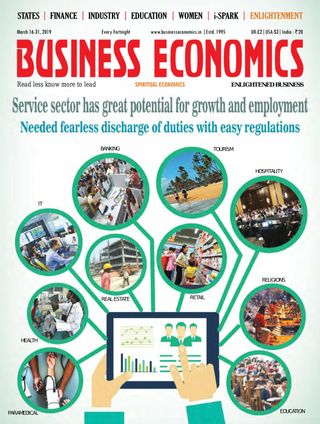

Diese Geschichte stammt aus der March 16-31, 2019-Ausgabe von BUSINESS ECONOMICS.
Abonnieren Sie Magzter GOLD, um auf Tausende kuratierter Premium-Geschichten und über 9.000 Zeitschriften und Zeitungen zuzugreifen.
Sie sind bereits Abonnent? Anmelden
WEITERE GESCHICHTEN VON BUSINESS ECONOMICS

BUSINESS ECONOMICS
Tata Power introduces EZ Home Automation Solutions in Kolkata
Designed to make everyday life more comfortable and secure, Tata Power introduced its Tata Power EZ Home Automation Solutions in Kolkata.

1 min
February 01 - 28, 2026

BUSINESS ECONOMICS
Economic Survey 2025–26
Every year, the Economic Survey is presented in Parliament two days before the Union Budget.
3 mins
February 01 - 28, 2026

BUSINESS ECONOMICS
Navigating the soul's ultimate intelligence
In recent years, psychologists and thinkers have introduced the concept of Spiritual Intelligence (SI) to describe what makes a human being whole, integrated, and profoundly creative.
3 mins
February 01 - 28, 2026

BUSINESS ECONOMICS
Where Bengal meets Rajasthan in heritage conservation
The government of Rajasthan organized a significant heritage preservation initiative as part of the NDTV Conclave - 'Rising Rajasthan Vikas Bhi, Virasat Bhi', held on 24th December at Mandawa Castle, Fort Mandawa, Rajasthan.
1 min
February 01 - 28, 2026

BUSINESS ECONOMICS
Structural glitches trouble Indian economy
India's economy is often described as one of the fastest-growing in the world.
2 mins
February 01 - 28, 2026

BUSINESS ECONOMICS
Tredence sets the stage for Eastern India's AI future with new center in Kolkata
Tredence announced the inauguration of its new office in Kolkata, in the presence of Babul Supriyo, Minister of Information Technology and Electronics, West Bengal.
1 min
February 01 - 28, 2026

BUSINESS ECONOMICS
Educator, Author, and Thought Leader on Consciousness, Education, and Governance
Devesh Gupta works at the intersection of consciousness, education, and public systems.
5 mins
February 01 - 28, 2026

BUSINESS ECONOMICS
Beyond GDP numbers- recalibrating prosperity for 2026
Why growth alone no longer tells the full story
2 mins
February 01 - 28, 2026

BUSINESS ECONOMICS
World's greed for Rare Earth: US steps into Greenland, Venezuela & Ukraine
Attempts to grab Greenland, Ukraine & Venezuela are examples of modern-day colonialism.
3 mins
February 01 - 28, 2026

BUSINESS ECONOMICS
TCG CREST to expand globally with academic hubs in the UK, Japan, and the US
TCG CREST (Deemed University) announced a significant expansion roadmap, outlining its plans to establish academic hubs in the UK, Japan, and the US as part of a broader strategy to deepen global research collaboration and cross-sector engagement.
1 min
February 01 - 28, 2026
Translate
Change font size