
Mit Magzter GOLD unbegrenztes Potenzial nutzen
Erhalten Sie unbegrenzten Zugriff auf über 9.000 Zeitschriften, Zeitungen und Premium-Artikel für nur
Versuchen GOLD - Frei
Educator, Author, and Thought Leader on Consciousness, Education, and Governance
BUSINESS ECONOMICS
|February 01 - 28, 2026
Devesh Gupta works at the intersection of consciousness, education, and public systems.
-
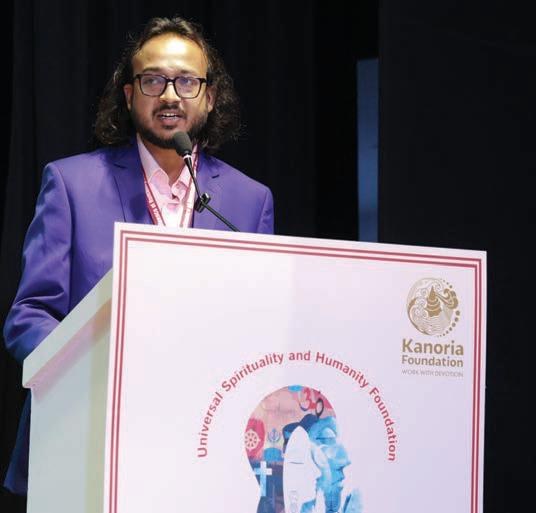
He is the Founder of Emerge, Director of Education & Youth Initiatives at The Dais, and Co-Founder of the Spirituality, Science and Public Policy Network. His work examines how fragmentation in human perception shapes institutions, leadership, and governance — and how action can emerge from awareness rather than identity.
He has collaborated with schools, universities, public institutions, and civic systems in India and internationally. Gupta is the author of Eternal Movement and Governance Without the Self. His forthcoming book, From Fragmentation to Wholeness: Spirituality, Awareness, and the Future Beyond the SDGs, is in press with Emerald Publishing. His recent paper, Perception Before Capacity, explores the limits of skill and capability in an era of ecological, social, and psychological crisis.
Q. Are today's global crises really about lacking skills, or about how we perceive the world?
Most responses to global crises assume a lack of capacity. Climate breakdown is treated as a technological problem, social conflict as a governance failure, and economic instability as a policy flaw. The solution is assumed to lie in better tools, smarter experts, and more efficient systems.
Yet we already live in a world of extraordinary knowledge and capability. The fact that disorder continues to deepen suggests the crisis is not primarily technical - it is perceptual. How we see ourselves in relation to others, to nature, and to consequence determines how skills are used. When perception is fragmented, increasing capacity only magnifies harm. The real issue is not what we can do, but from where action arises.
What is the key difference between being skilled and being intelligent, and why does it matter for education?

Diese Geschichte stammt aus der February 01 - 28, 2026-Ausgabe von BUSINESS ECONOMICS.
Abonnieren Sie Magzter GOLD, um auf Tausende kuratierter Premium-Geschichten und über 9.000 Zeitschriften und Zeitungen zuzugreifen.
Sie sind bereits Abonnent? Anmelden
WEITERE GESCHICHTEN VON BUSINESS ECONOMICS

BUSINESS ECONOMICS
PowerHive Launches 'VION' Lithium-ion Battery Range
PowerHive, the battery and energy storage arm of Vikram Solar Limited, announced the launch of its flagship brand VION, PRODUCT RANGE marking the company's entry into distributed battery storage for electric mobility and residential energy backup.

1 min
April 01 - 30, 2026

BUSINESS ECONOMICS
Iran War: Why & how it affects India
Iran is neither like Iraq nor Venezuela; and President Trump has made the mortal mistake of underestimating Iran's power.
2 mins
April 01 - 30, 2026

BUSINESS ECONOMICS
ICC hosted the 8th Social Impact Summit and Awards
The Indian Chamber of Commerce (ICC) hosted the 8th Social Impact Summit and Awards on March 12, 2026, bringing together experts from diverse fields who emphasized the need to shift corporate social responsibility (CSR) initiatives from symbolic, philanthropic, and structured, yet measurable, inventions capable of driving long-term social transformation.
1 min
April 01 - 30, 2026

BUSINESS ECONOMICS
Insufficient storage systems of Agro-Products and their impact on the Indian Economy
The lack of adequate storage facilities for agro-products significantly affects the Indian economy and creates multiple structural problems.
3 mins
April 01 - 30, 2026
BUSINESS ECONOMICS
Empowered Women
A few days ago, I had the opportunity to participate in a solidarity event in Paris in support of Iranian women. In the context of International Women's Day, many meaningful reflections were shared on the decisive role women play in liberation processes, on the particular hardships they face when belonging to persecuted or penalized groups.
1 mins
April 01 - 30, 2026

BUSINESS ECONOMICS
Why optimum utilisation of India's Rural Economy is essential for achieving developed status
In contrast to mainstream economics, development economics focuses on how underdeveloped or less developed economies transition to developed status.
3 mins
April 01 - 30, 2026

BUSINESS ECONOMICS
Faith-Devotion and Bhakti
Besides Ahimsa (nonviolence, the eternal, natural and highest human value), many other virtuous qualities that genuinely capture the essence of humanity also surface through the core texts of the Sanatana Dharma.
4 mins
April 01 - 30, 2026

BUSINESS ECONOMICS
Bank of Maharashtra opens its 68th Branch in West Bengal and 71st Branch in Kolkata Zone, Ukhra
Bank of Maharashtra (BOM), a public sector Bank (Government Enterprise Undertaking), inaugurated its 68th branch in West Bengal and 71st in the Kolkata zone.
1 min
April 01 - 30, 2026
BUSINESS ECONOMICS
ESCORTS KUBOTA LTD
Escorts Kubota Limited was originally established in 1944 as Escorts Limited. Later, after forming a strategic partnership with Japan's Kubota Corporation, the company was renamed Escorts Kubota Limited to reflect the joint collaboration.
3 mins
April 01 - 30, 2026
BUSINESS ECONOMICS
FTAs alone will not deliver export gains unless non-tariff barriers are addressed: GTRI
India has already signed 18 Free Trade Agreements (FTAs), and negotiations with the United Kingdom and the European Union are nearing completion.
3 mins
April 01 - 30, 2026
Listen
Translate
Change font size