Versuchen GOLD - Frei
Saving Water And Inputs With Variable Rate Irrigation
Farmer's Weekly
|June 21, 2019
Cost-effective farming practices and optimal efficiency are both crucial to the survival of South Africa’s sugar cane industry. Faced with dwindling sugar prices and high input costs, RCL Foods is trialling variable rate irrigation on one of their farms, with excellent results. Lindi Botha reports.
-

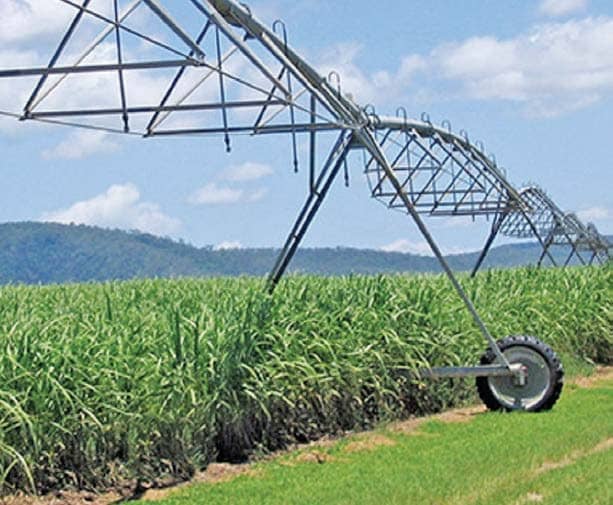
Avariable rate irrigation (VRI) system implemented on a centre pivot at one of RCL Foods’ sugar cane farms in Malelane, Mpumalanga, has resulted in greater efficiency and considerable savings. While still in its trial phase, the project is showing promising results, with a 30% reduction in input costs.
Although an established technology in agriculture that delivers proven benefits, VRI is not widely used in South Africa.
Hennie Greyling, cane operations manager at RCL Foods’ sugar and milling division in Malelane, explains that with an increasing focus on saving water and improving the profitability of sugar production, the company decided to explore VRI, as Canadian farmers had had much success with it.
“The technology has never been widely implemented in South Africa because water availability had never really been a problem [for sugar cane growers] until the drought hit us three years ago. We’re now conducting a trial to see how the technology fares under our conditions. So far, we’ve been happy with the results, but we need at least five years of data to make a call. After that, we could end up converting all our pivots to VRI.”
RCL Foods launched the trial last year on an 80ha land fitted with a centre pivot irrigation system.
Since implementation, the company has saved 33% in pumping and fertiliser costs and a further 30% on water usage. Greyling notes that if they continue on this path, the R1 million invested in the technology will pay for itself in three years.
SOIL MAPPING
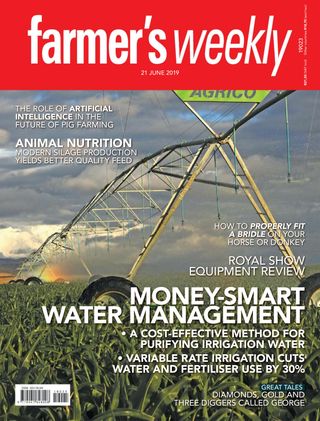

Diese Geschichte stammt aus der June 21, 2019-Ausgabe von Farmer's Weekly.
Abonnieren Sie Magzter GOLD, um auf Tausende kuratierter Premium-Geschichten und über 9.000 Zeitschriften und Zeitungen zuzugreifen.
Sie sind bereits Abonnent? Anmelden
WEITERE GESCHICHTEN VON Farmer's Weekly

Farmer's Weekly
How AFGRI uses technology to unlock farm finance from asset to market
As modern farming becomes more capital-intensive and digitally driven, AFGRI is reinventing agricultural finance by linking technology directly to lending decisions.

5 mins
January 16-23, 2026

Farmer's Weekly
Adele's Mohair: a living tapestry of craft, colour and rural heritage
Octavia Avesca Spandiel spoke to Adele Cutten, founder of Adele's Mohair, to explore how a small spinning experiment grew into a thriving rural craft enterprise rooted in South Africa's rich mohair heritage.
6 mins
January 16-23, 2026

Farmer's Weekly
How Merino farmers are battling predation, disease and rising costs
Whether you are a stud breeder or commercial Merino farmer, environmental, operational, and infrastructural challenges have an equal impact on a farming operation. The aim of any livestock farmer, whether stud or commercial, is to keep losses at a minimum, and although farmers are facing many challenges, they implement various strategies to ensure both the survival and financial security or profitability of farming operations.
9 mins
January 16-23, 2026
Farmer's Weekly
The future of SA wool: refined infrastructure and wool traceability
As the agriculture sector starts to adapt to the fast-paced development of technology, producers and processors need to decide what to implement and what to avoid. Henning Naudé spoke to Izak Klopper, manager of shearer training at the National Wool Growers' Association, about how shearing has changed, and what the industry can expect from new research and development from international markets.
5 mins
January 16-23, 2026
Farmer's Weekly
Cannabis and marketing in South Africa
The path from cultivation to commercial success remains complicated by regulatory ambiguity. Cultivators who master compliant marketing while delivering verifiable quality will build sustainable businesses, says Thomas Walker.
2 mins
January 16-23, 2026
Farmer's Weekly
Foot-and-mouth disease project targets waste reduction and regulatory reform
A groundbreaking research collaboration between Red Meat Industry Services, the University of Pretoria, and global animal health leader Zoetis is aiming to transform South Africa's approach to foot-and-mouth disease.
3 mins
January 16-23, 2026
Farmer's Weekly
What to expect in 2026
The world faces a complex interplay of economic, geopolitical, environmental, technological, and social pressures.
3 mins
January 16-23, 2026

Farmer's Weekly
How drones are revolutionising pest and disease detection in agriculture
Drones are reshaping modern crop protection by giving farmers a powerful new vantage point: the sky. With advanced sensors, high-resolution imaging, and artificial intelligence-driven analytics, these unmanned aerial vehicles can detect early signs of disease, water stress, and pest damage long before the human eye can. Jedrie Harmse spoke to agricultural drone specialist Monique Heydenrych.
7 mins
January 16-23, 2026
Farmer's Weekly
Generic advertising in perspective
Dr Koos Coetzee explains how industry organisations and the agriculture sector actually have the ability to prudently manage the negative perceptions surrounding generic advertising campaigns.
2 mins
January 16-23, 2026

Farmer's Weekly
The modern Merino: the benchmark breed
The Merino breed has transformed dramatically over the past seven decades-from the skin-folded wool specialists of the 1950s to today's plain-bodied, fertile, well-balanced sheep prized for their dual-purpose productivity. Yet, despite its versatility, myths persist. Willie van Heerden, manager at Merino South Africa, dispels some of these myths.
2 mins
January 16-23, 2026
Translate
Change font size