Versuchen GOLD - Frei
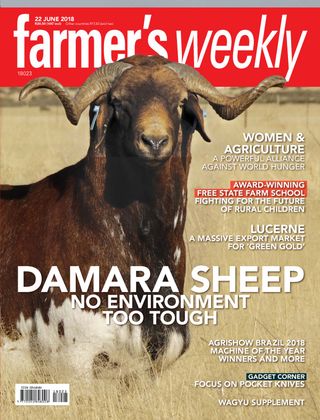
Bright Future For Fast-growing Modern Damara Sheep
Farmer's Weekly
|June 22, 2018
Since importing his first Damaras from Namibia in the late 1980s, stud breeder Frank Blumenthal has firmly believed in the integrity of the breed. The Free State farmer says that the modern indigenous Damara has over the years evolved into a well-muscled animal with outstanding disease resistance and fertility under the hottest, driest conditions. Annelie Coleman reports.

Frank Blumenthal’s passion for his Damaras is almost tangible. “I’m far too loyal to my breed to even consider crossbreeding,” he says.
He knew from the first time he came across the Damara in 1979 in the far northern corners of Namibia that this was the ideal sheep breed for South Africa’s harsh, arid farming areas. The name of the breed is derived from the Damara area of Namibia.
THE FIRST DAMARAS
Blumenthal and his family farm on Zandraai (6 000ha) on the banks of the Orange River, near Luckhoff in the Free State. Zandraai Farms specialises in the production of export-quality popcorn and wheat under irrigation. The Damara sheep are kept on Karoo-type veld and grain stover. The farm’s official carrying capacity is one small stock unit on 3,5ha, and the flock is rotated according to grazing conditions. The flock normally consists of about 1 000 animals kept in 21 camps, each with its own watering point.
Temperatures fluctuate from below freezing in winter to the high 30s in summer, and the annual average rainfall is about 250mm. At the time of Farmer’s Weekly’s visit, the flock was down to 800 animals.
Blumenthal brought his first Damaras to South Africa from Namibia in 1987 and continued importing them until 1992. The animals came from a wide area north of Kamanjab and Grootfontein. He was determined to acquire as many of the true Kaokoland Damaras as possible, and therefore obtained animals from a variety of owners and breeders. This enabled him to establish a wide genetic base.
According to Blumenthal, Damara-type sheep occur in most of Africa’s desert areas, including Nigeria, Mali, Niger and Mauritania. With survival of the fittest being the main selection criterion in nature, only the hardiest and most adaptable animals have survived over the millennia, thus retaining the breed’s robust genetics.

Diese Geschichte stammt aus der June 22, 2018-Ausgabe von Farmer's Weekly.
Abonnieren Sie Magzter GOLD, um auf Tausende kuratierter Premium-Geschichten und über 9.000 Zeitschriften und Zeitungen zuzugreifen.
Sie sind bereits Abonnent? Anmelden
WEITERE GESCHICHTEN VON Farmer's Weekly

Farmer's Weekly
The foot-and-mouth disease threat is growing
Foot-and-mouth disease poses a growing threat to the livestock industry, especially communal farmers, with devastating economic consequences unless awareness and compliance improve, writes Shane Brody.

3 mins
January 30 - February 06, 2026

Farmer's Weekly
Shipping conditions to ease in 2026, but risk remains high
Early signs suggest a more favourable export season for South African producers, as easing global shipping congestion and improved performance by Transnet point to higher throughput at local ports. Lindi Botha reports.
2 mins
January 30 - February 06, 2026

Farmer's Weekly
A path of accelerating land reform in South Africa
Delivering the ANC's January 8th Statement a few weeks ago, President Cyril Ramaphosa noted, amongst other things, that: “Land reform remains one of the most urgent tasks of the National Democratic Revolution. While progress has been made, much more is required to give effect to the constitutional requirement for redress and equitable access to land.”
2 mins
January 30 - February 06, 2026
Farmer's Weekly
Reflections on 2025 and the policy space for 2026
The year 2025 was a year characterised initially by a wave of misinformation, particularly relating to legislation and tariff issues. This year some big moves are expected in the trade space.
3 mins
January 30 - February 06, 2026

Farmer's Weekly
From planning to peak lay: building a profitable egg business
Mpumalanga poultry farmer Lebogang Mashego spoke to Octavia Avesca Spandiel, and shared practical insights on planning, building systems that work, breed choice, feed management, and markets to build a profitable and sustainable egg business.
5 mins
January 30 - February 06, 2026

Farmer's Weekly
Impofu Wind Farm becomes a canvas for community connection through Enel's Blowing Art Initiative
Enel Green Power South Africa has introduced the Blowing Art Initiative at the Impofu Wind Farm in the Eastern Cape, a creative community project that turns renewable energy infrastructure into a living gallery.
2 mins
January 30 - February 06, 2026

Farmer's Weekly
Geely is intent on hanging around
Having fallen off the radar around a decade ago following a short local stint, Chinese manufacturer Geely has announced its proposed return to South Africa towards the end of 2026. The Citizen's Jaco van der Merwe reports.
4 mins
January 30 - February 06, 2026

Farmer's Weekly
Great reads to enjoy during ‘me-time'
Patricia McCracken has plucked an assortment of fascinating titles covering different areas of interest, from coastal exploration and dining in the wild, to African traditions surrounding love and marriage.
3 mins
January 30 - February 06, 2026
Farmer's Weekly
Thokoman Peanut Butter marks 25-year milestone with R500 000 commitment to food security
Thokoman Peanut Butter, one of South Africa's biggest producers of peanut butter, celebrates 25 years of consistent quality and community support, marking the occasion with a significant R500 000 partnership with Hot 102.7's Hot Cares initiative for 2026.
2 mins
January 30 - February 06, 2026
Farmer's Weekly
South Africa's famous wandering hippo
From 1928 to 1931, a hippopotamus trekked 1 600km from what was then northern Natal to the Eastern Cape's Keiskamma River near Peddie, where it was shot dead by a posse of farmers. As Mike Burgess writes, this journey would immortalise the hippo in South African history.
3 mins
January 30 - February 06, 2026
Translate
Change font size