Prøv GOLD - Gratis
Success & Luck
Philosophy Now
|February/March 2024
Carlo Filice argues that we should share our success, even if it's hard earned, because we often don't deserve it as much as we'd like to think.
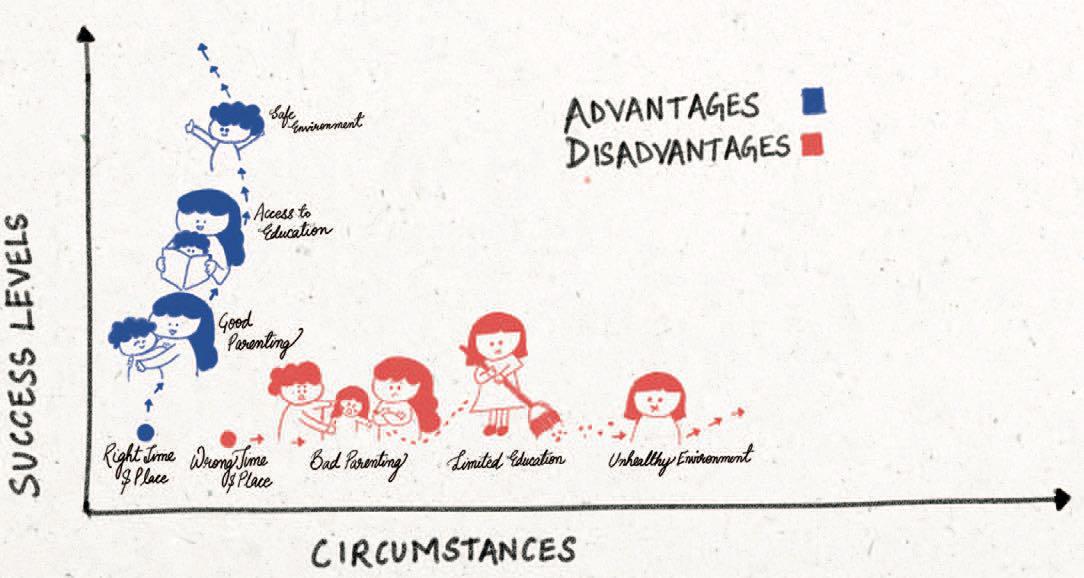
In thinking about slightly redistributive economic policies, it is essential to address a belief many people hold deeply. This is the belief that honest, hard-working people always deserve most or all that they earn. This belief is bound up with notions of fairness, of self-ownership, and with ideas of the very essence of what a person is. Unfortunately these are also the very notions that undermine the belief in absolute deserving, once examined.
Let's start with the part that's hard to dispute. Those who end up toiling hard in low paid physical or mental labor deserve their pay, and much more. At the opposite end are those who end up fabulously wealthy who have often been targeted as undeserving of their sheer amounts of money. A case in their defense could be made if their success was attained fairly and was a necessary by-product of the best possible market system meaning the one that benefits people more than any of the alternatives. But neither of these conditions are empirically true.
First, most current market systems do not benefit all people, or even a greater percentage of people, more than all alternative systems. Scandinavian countries often do best on overall happiness, and they operate extensive welfare systems. Second, the neo-liberal free market system is not like Monopoly, where chance and skill combine to produce winners fairly because all the players start out with equal resources. Rather, the starting points are always deeply unequal. Not surprisingly, most children of upper class families remain in the upper classes as adults, and most children of lower class families remain in the lower classes. This is so even if there is no formal cheating by the upper class parents and children. The sociological data supporting this seems incontrovertible.

Denne historie er fra February/March 2024-udgaven af Philosophy Now.
Abonner på Magzter GOLD for at få adgang til tusindvis af udvalgte premiumhistorier og 10.000+ magasiner og aviser.
Allerede abonnent? Log ind
FLERE HISTORIER FRA Philosophy Now

Philosophy Now
Star Trek: Enterprise
Sofia Villaweaver asks, what kind of future do we want — Gene Roddenberry's, or Friedrich Nietzsche's?

7 mins
June/July 2026

Philosophy Now
The Delphic Injunctions
Massimo Pigliucci philosophises about prophetic principles.
4 mins
June/July 2026

Philosophy Now
What’s the Value of Mountaineering?
Suleyman Moollan wonders why people climb mountains.
8 mins
June/July 2026

Philosophy Now
Death as Life’s Picture Frame
Joshua Clements puts us in the picture.
10 mins
June/July 2026
Philosophy Now
Philosophers on Butterflies
Summer is upon those of us in the northern hemisphere. That invites reflection.
2 mins
June/July 2026

Philosophy Now
Margalit & Limits to Political Compromise
Laure Gillot-Assayag reflects on the political philosophy of Avishai Margalit.
12 mins
June/July 2026

Philosophy Now
Making Omelettes & A Future Like Ours
Jimmy Alfonso Licon wonders what's wrong with killing — first chickens, then humans.
5 mins
June/July 2026

Philosophy Now
Breakfast with Habermas
Matt Qvortrup recalls chat over coffee and scrambled eggs with a champion of reasoned debate.
5 mins
June/July 2026

Philosophy Now
Who Wants to Live Forever?
Dan Pollen weighs up the pros and cons of indefinitely extended life.
10 mins
June/July 2026

Philosophy Now
Carl Schmitt (1888-1985)
Marco Pandolfini on the ideas of a highly contentious legal theorist.
9 mins
June/July 2026
Listen
Translate
Change font size