Versuchen GOLD - Frei
Success & Luck
Philosophy Now
|February/March 2024
Carlo Filice argues that we should share our success, even if it's hard earned, because we often don't deserve it as much as we'd like to think.
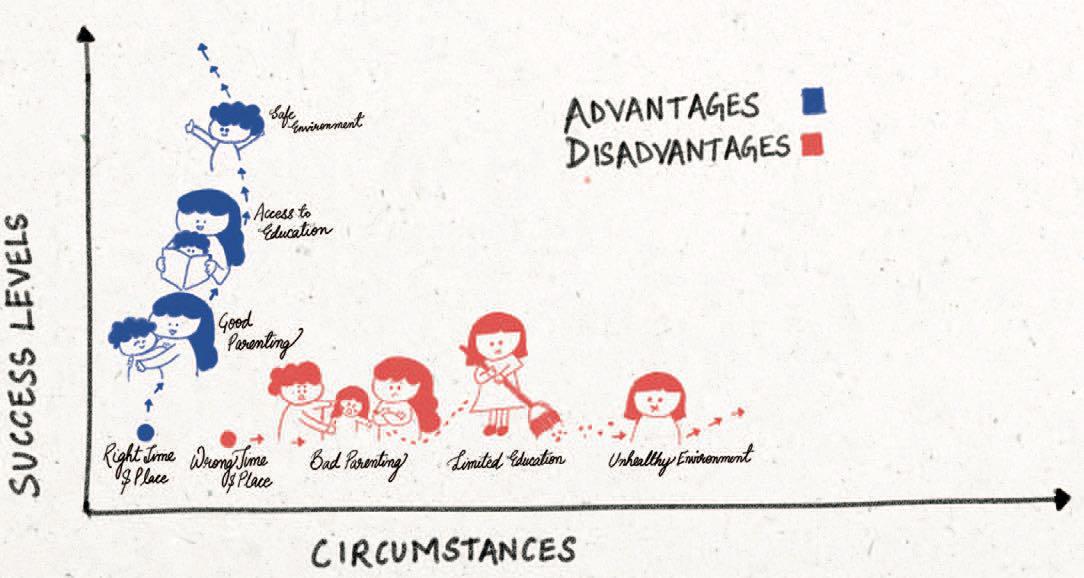
In thinking about slightly redistributive economic policies, it is essential to address a belief many people hold deeply. This is the belief that honest, hard-working people always deserve most or all that they earn. This belief is bound up with notions of fairness, of self-ownership, and with ideas of the very essence of what a person is. Unfortunately these are also the very notions that undermine the belief in absolute deserving, once examined.
Let's start with the part that's hard to dispute. Those who end up toiling hard in low paid physical or mental labor deserve their pay, and much more. At the opposite end are those who end up fabulously wealthy who have often been targeted as undeserving of their sheer amounts of money. A case in their defense could be made if their success was attained fairly and was a necessary by-product of the best possible market system meaning the one that benefits people more than any of the alternatives. But neither of these conditions are empirically true.
First, most current market systems do not benefit all people, or even a greater percentage of people, more than all alternative systems. Scandinavian countries often do best on overall happiness, and they operate extensive welfare systems. Second, the neo-liberal free market system is not like Monopoly, where chance and skill combine to produce winners fairly because all the players start out with equal resources. Rather, the starting points are always deeply unequal. Not surprisingly, most children of upper class families remain in the upper classes as adults, and most children of lower class families remain in the lower classes. This is so even if there is no formal cheating by the upper class parents and children. The sociological data supporting this seems incontrovertible.

Diese Geschichte stammt aus der February/March 2024-Ausgabe von Philosophy Now.
Abonnieren Sie Magzter GOLD, um auf Tausende kuratierter Premium-Geschichten und über 9.000 Zeitschriften und Zeitungen zuzugreifen.
Sie sind bereits Abonnent? Anmelden
WEITERE GESCHICHTEN VON Philosophy Now

Philosophy Now
Bilbo Theorizes About Wellbeing
Eric Comerford overhears Bilbo and Gandalf discussing happiness.

9 mins
December 2025 / January 2026

Philosophy Now
What Women?
Marcia Yudkin remembers almost choking at Cornell
11 mins
December 2025 / January 2026
Philosophy Now
Islamic Philosophers On Tyranny
Amir Ali Maleki looks at tyranny from an Islamic perspective.
4 mins
December 2025 / January 2026

Philosophy Now
Peter Singer
The controversial Australian philosopher defends the right to choose to die on utilitarian grounds
5 mins
December 2025 / January 2026

Philosophy Now
Another Conversation with Martin Heidegger?
Raymond Tallis talks about communication problems.
7 mins
December 2025 / January 2026

Philosophy Now
Letters
When inspiration strikes, don't bottle it up. Email me at rick.lewis@philosophynow.org Keep them short and keep them coming!
17 mins
December 2025 / January 2026

Philosophy Now
The Philosophy of William Blake
Mark Vernon looks at the imaginative thinking of an imaginative artist.
9 mins
December 2025 / January 2026

Philosophy Now
Philosophical Haiku
Peering through life’s lens God in nature is deduced: The joy of being.
1 mins
December 2025 / January 2026

Philosophy Now
Philosophy Shorts
More songs about Buildings and Food' was the title of a 1978 album by the rock band Talking Heads. It was about all the things rock stars normally don't sing about. Pop songs are usually about variations on the theme of love; tracks like Rose Royce's 1976 hit 'Car Wash' are the exception. Philosophers, likewise, tend to have a narrow focus on epistemology, metaphysics and trifles like the meaning of life. But occasionally great minds stray from their turf and write about other matters, for example buildings (Martin Heidegger), food (Hobbes), tomato juice (Robert Nozick), and the weather (Lucretius and Aristotle). This series of Shorts is about these unfamiliar themes; about the things philosophers also write about.
2 mins
December 2025 / January 2026

Philosophy Now
Hedonic Treadmills in the Vale of Tears
Michael Gracey looks at how philosophers have pursued happiness.
8 mins
December 2025 / January 2026
Listen
Translate
Change font size