
استمتع بـUnlimited مع Magzter GOLD
احصل على وصول غير محدود إلى أكثر من 9000 مجلة وصحيفة وقصة مميزة مقابل
يحاول ذهب - حر
Flashes in the Night
January 2026
|Scientific American
Celestial transients shine furiously and briefly. Astronomers are just beginning to understand them
Ann Finkbeiner is a science writer based in Baltimore. She specializes in writing about astronomy and cosmology, grief, women in science, and the intersection of science and national security. She is co-proprietor of the science blog The Last Word on Nothing.
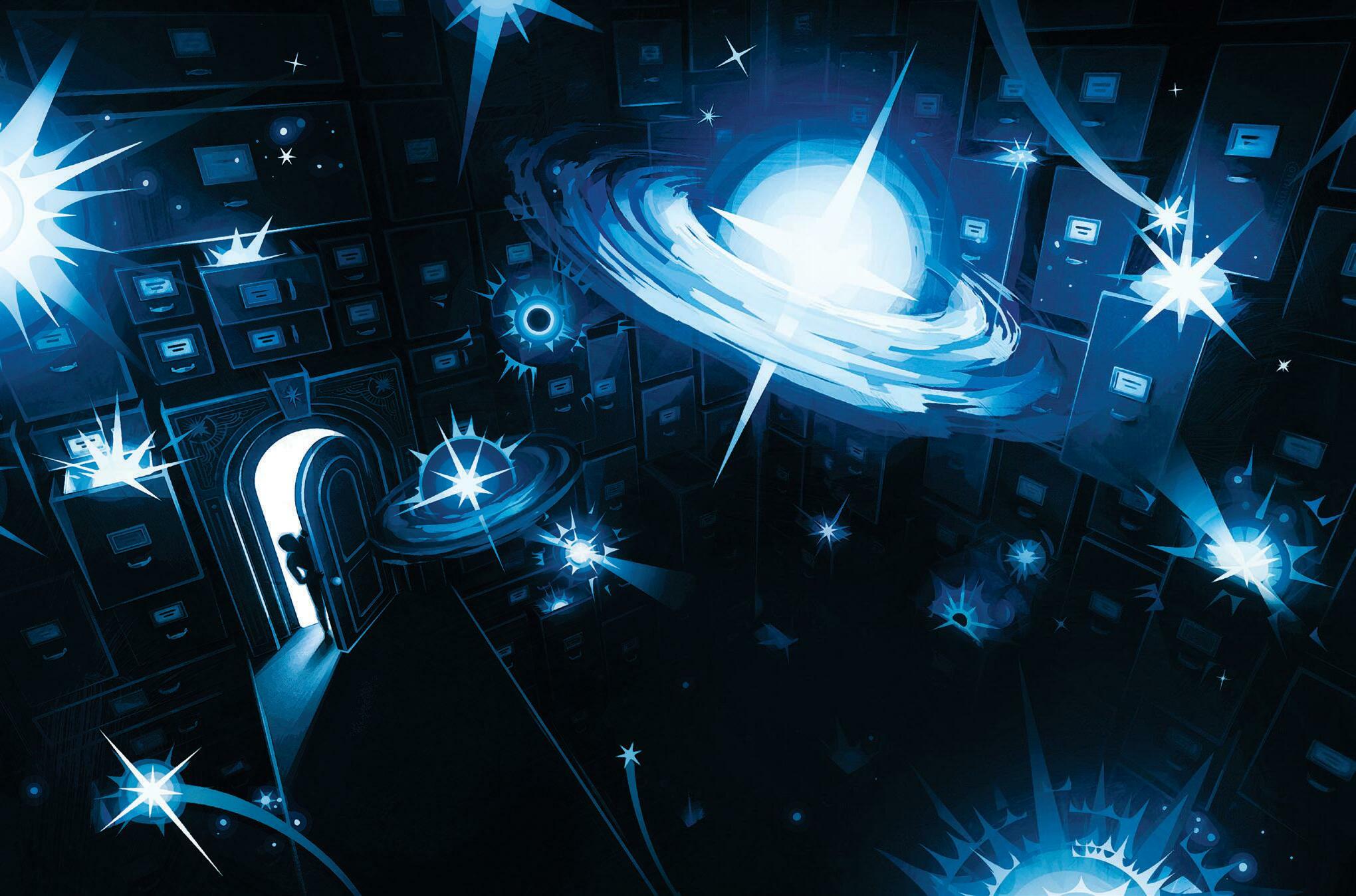
LONG, LONG AGO A CLOUD OF STARS CIRCLED A GALAXY-SIZE BLACK HOLE, safely at a distance. Then about 200 million years ago one member of the cloud bumped another, a sun-size star, and sent it toward the black hole. The black hole was a million times more massive than the sun-size star, and its gravitational pull proportionately stronger, so the star was drawn closer and closer—until it got too close. Some of the star's gas was pulled into an orbiting stream around the black hole that widened into a flat pancake called an accretion disk. The rest of the star came apart in a sudden and great flash of light.
On September 19, 2019, just before noon, the flash reached the 1.2-meter mirror of the Zwicky Transient Facility in southern California. Astronomers named the flash AT2019qiz and noted that they hadn't seen it three days before. On September 25, 2019, the 10-meter Keck I telescope in Hawaii identified AT2019qiz as a so-called tidal disruption event—a flareup that occurs when a black hole's gravitational tides rip a small object apart. The star the size of the sun exploded with 10 billion times the sun's luminosity.
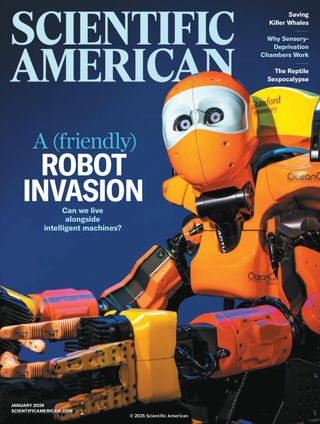

هذه القصة من طبعة January 2026 من Scientific American.
اشترك في Magzter GOLD للوصول إلى آلاف القصص المتميزة المنسقة، وأكثر من 9000 مجلة وصحيفة.
هل أنت مشترك بالفعل؟ تسجيل الدخول
المزيد من القصص من Scientific American

Scientific American
The Quiet Math Problem That Runs the Planet
How Diffie-Hellman key exchange secures everything from your text messages to government secrets

7 mins
May 2026

Scientific American
The Fog of Science
Did an adversary just invent a world-changing weapon, or are they making it up? DARPA is building an AI to instantly call their bluff
4 mins
May 2026
Scientific American
The Hubble Space Telescope Is Still Awesome
Hubble is going strong despite its decades in space and next-generation successors
4 mins
May 2026

Scientific American
Meet America's Native Bees
Scientists estimate there are about 4,000 species of native bees in the U.S.
5 mins
May 2026

Scientific American
The Chemistry of Desire
Inside the secretive laboratories where scientists build novel molecules to make luxury fragrance feel like pure emotion
5 mins
May 2026

Scientific American
Scanning the Stone
As ore gets harder to find, the mining industry is turning to subatomic-particle sensors to push deep underground
8 mins
May 2026

Scientific American
YOUR HEART IN FLAMES
Inflammation may be the true cause of cardiovascular diseaseand there's a drug to treat it
13 mins
May 2026

Scientific American
Ancient Lexicon
Stone Age art may reveal a 40,000-year-old precursor to writing
2 mins
May 2026

Scientific American
Thermal Breakthrough
A new super heat conductor challenges fundamental physics
2 mins
May 2026
Scientific American
How to Vacation in Space
Planned orbital hotels promise luxury, but can they deliver?
4 mins
May 2026
Listen
Translate
Change font size