يحاول ذهب - حر
IS OUR UNIVERSE THE ONLY ONE?
Issue 202
|How It Works UK
Might our universe – as vast as it is – be simply one of many? We look at the growing evidence that there's more than one cosmos out there
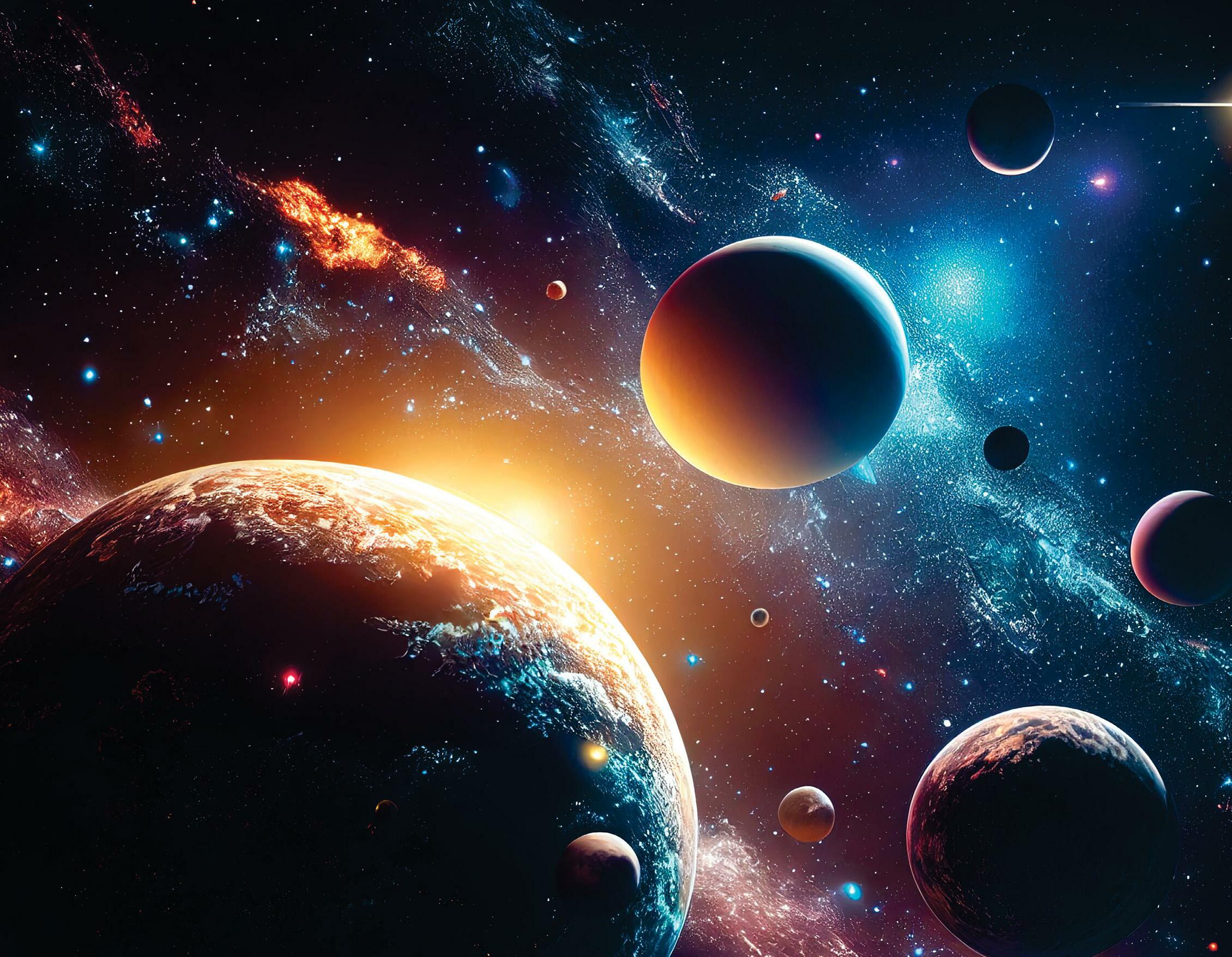
In 1543, Prussian astronomer Nicolaus Copernicus lay dying. His life's work, On the Revolutions of the Heavenly Spheres, had just been sent off to be printed. This book, which explained that Earth rotates around the Sun, and not the other way around as had been believed, would forever change how humanity viewed its place in space. We were no longer the centre of the universe.
Nearly 500 years on, we're facing a similar revolution. The observable universe now stretches 46 billion light years in every direction, but physicists have compelling ideas about what may lie beyond.
It might just be that there are countless other universes, each one slightly different from the rest. Indeed, the results of a recent study of the cosmic microwave background – the thermal radiation left over from the Big Bang - make this seemingly outlandish proposition look increasingly likely.
Our universe began 13.8 billion years ago. A great exploding fireball of matter and radiation produced a hot plasma that quickly cooled, allowing subatomic particles to form within a few seconds. Over the next million years, atoms were created, and some 480 million years later these coalesced to form stars, planets and entire galaxies.
But the Big Bang theory, the theory about how the whole process got started, tells us nothing about the ‘bang’ itself. For that we need to look to another idea, called cosmic inflation. This theory says that in the first tiny fraction of a second after the Big Bang, the universe must have expanded faster than the speed of light.
Cosmic inflation theory was first proposed by American particle physicist Professor Alan Guth. In 1979, while working on equations to describe the early universe, Guth hit upon something astonishing: the false vacuum. This is unlike what we think of as a vacuum in that it's not empty. Rather, it's a material, and a powerful force in its own right – a force great enough to ignite an entire universe.

هذه القصة من طبعة Issue 202 من How It Works UK.
اشترك في Magzter GOLD للوصول إلى آلاف القصص المتميزة المنسقة، وأكثر من 9000 مجلة وصحيفة.
هل أنت مشترك بالفعل؟ تسجيل الدخول
المزيد من القصص من How It Works UK

How It Works UK
WHY ANIMALS PLAY DEAD
These species have mastered faking their own deaths for several different reasons

1 min
Issue 214
How It Works UK
THE JAMES WEBB SPACE TELESCOPE MAPS 3D AURORAE ON URANUS
An international team of researchers has uncovered new insights into the upper atmosphere of Uranus, where ions swirling above the ice giant's clouds meet its magnetic field.
1 min
Issue 214
How It Works UK
LASERS BEAM 'ARTIFICIAL STARS' INTO CHILE'S SKIES
The European Southern Observatory has released a breathtaking photo of the Milky Way shining over Paranal Observatory in Chile as lasers create artificial 'guide stars' in the dark sky above.
1 min
Issue 214

How It Works UK
WHISKERS AT WORK
How long hairs on a cat's face fine-tune their senses
2 mins
Issue 214

How It Works UK
HOW AI IMPROVES CAR SAFETY
The vehicle technology that saves lives today - and the innovations that will soon make the roads safer for everyone
4 mins
Issue 214

How It Works UK
APOLLO 17: THE LAST CREWED MOON LANDING
It's been over 50 years since the final Apollo mission, so why haven't we put astronauts on the Moon since then?
4 mins
Issue 214

How It Works UK
WHAT IS LIMESCALE?
Why 'hard' water leaves chalky, flaky deposits wherever it settles
2 mins
Issue 214

How It Works UK
Astronauts describe the moment a crack was discovered on their spacecraft
Chinese astronauts have described what happened when they were nearly stranded in space last year after a suspected piece of space junk struck their return capsule.
2 mins
Issue 214
How It Works UK
The Vera C. Rubin Observatory found 800,000 objects of interest in a single night
The newly commissioned Vera C. Rubin Observatory has issued 800,000 astronomy alerts in just one night, a staggering number of nightly discoveries that's expected to grow nearly tenfold by the end of this year.
2 mins
Issue 214

How It Works UK
RETURN TO THE MOON
Project Artemis is accelerating its push to put humans back on Earth's orbital dancing partner before the end of the decade
5 mins
Issue 214
Listen
Translate
Change font size