
استمتع بـUnlimited مع Magzter GOLD
احصل على وصول غير محدود إلى أكثر من 9000 مجلة وصحيفة وقصة مميزة مقابل
يحاول ذهب - حر
EARTH IS WARMING FASTER
November 16, 2025
|Down To Earth
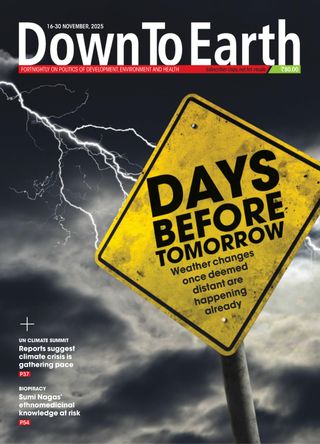
Changes in weather systems, once expected decades hence, appear to be unfolding now. In India the consequences are intensifying

THEY ARE akin to aliens in the world of meteorology—unimaginable and unpredictable. And now they seem to be invading. That, at least, was how it felt when cloudburst-like downpours lashed much of India’s plains in the monsoon months of August and September.
Meteorologists define cloudburst as rainfall exceeding 100 mm in an hour over an area of 20 to 30 sq km. Such events are typically confined to hilly terrain. But on August 30, the Manali area of Chennai, Tamil Nadu’s coastal capital, recorded 106 mm of rain in an hour starting at 10 pm. A second spell, from 11 pm to midnight, brought another 127 mm. In the same hour nearby Wimco Nagar saw over 157 mm of rainfall, Korattur recorded 137 mm, and New Manali received 103 mm of rains. The city as a whole experienced five cloudbursts or cloudburst-like events within two hours. Just two days earlier, Kamareddy city of Telangana, had endured 576 mm of rain in 48 hours—its heaviest downpour in 35 years. Much of it fell within just a few hours.
Meteorological records show that several blocks of the district received more than 300 mm during that period.
Such rain events also struck other states. Rain-shadowed Nanded, in Maharashtra, received 206 mm rainfall on August 17-18. Between the mornings of September 22 and 23, Kolkata was drenched with 251 mm of rainfall—highest for any September day in the last 39 years and the sixth highest in the city’s history. Of this, 180 mm fell within three hours; 98 mm in a single hour.

هذه القصة من طبعة November 16, 2025 من Down To Earth.
اشترك في Magzter GOLD للوصول إلى آلاف القصص المتميزة المنسقة، وأكثر من 9000 مجلة وصحيفة.
هل أنت مشترك بالفعل؟ تسجيل الدخول
المزيد من القصص من Down To Earth

Down To Earth
THINK TWICE BEFORE FELLING SAL TREES
Many trees considered to be affected by sal borer in the 1990s are still alive today

1 mins
February 16, 2026

Down To Earth
EDGE OF SURVIVAL
Caste divides deny marginalised communities land, resources and essential aid, leaving them more vulnerable to climate disasters
6 mins
February 16, 2026

Down To Earth
A WISH LIST?
Union Budget for 2026-27 conveys the impression of a roll-call of intentions and ambitious proposals, with little detail on their formulation
6 mins
February 16, 2026
Down To Earth
Break down the gender wall
THE RULING National Democratic Alliance (NDA) government has been heavily invested in the goal to make India a developed economy by 2047.
2 mins
February 16, 2026

Down To Earth
MENSTRUAL HEALTH, NOW A FUNDAMENTAL RIGHT
In a landmark judgement, the Supreme Court has recognised menstrual health and hygiene as a fundamental right under Article 21 of the Constitution of India, which guarantees the right to life and dignity.
8 mins
February 16, 2026

Down To Earth
Of devolution and new disasters
The 16th Finance Commission pushes for changes in view of new fiscal and climatic conditions
11 mins
February 16, 2026
Down To Earth
Rising risks of plastics
NEGATIVE IMPACTS on human health due to emissions linked to the plastic lifecycle could double by 2040, according to a study published in The Lancet Planetary Health in January.
1 min
February 16, 2026

Down To Earth
GAP BETWEEN EPIDEMICS NARROWING
A watershed-based and landscape-level approach is needed to address forest degradation
2 mins
February 16, 2026
Down To Earth
WAITING TO STRIKE
Sal heartwood borer is considered the biggest threat to forestry in India, especially to the sal tree, where it lives and breeds.
11 mins
February 16, 2026

Down To Earth
A SPRING DELIGHT
Mustard flowers are not meant only for the eyes. Invite them to your plate once in a while
3 mins
February 16, 2026
Listen
Translate
Change font size