يحاول ذهب - حر
Expert processing tips to enhance your astrophotos ASTROPHOTOGRAPHY PROCESSING
October 2022
|BBC Sky at Night Magazine
Subtract stars to get more from deep-sky data
-
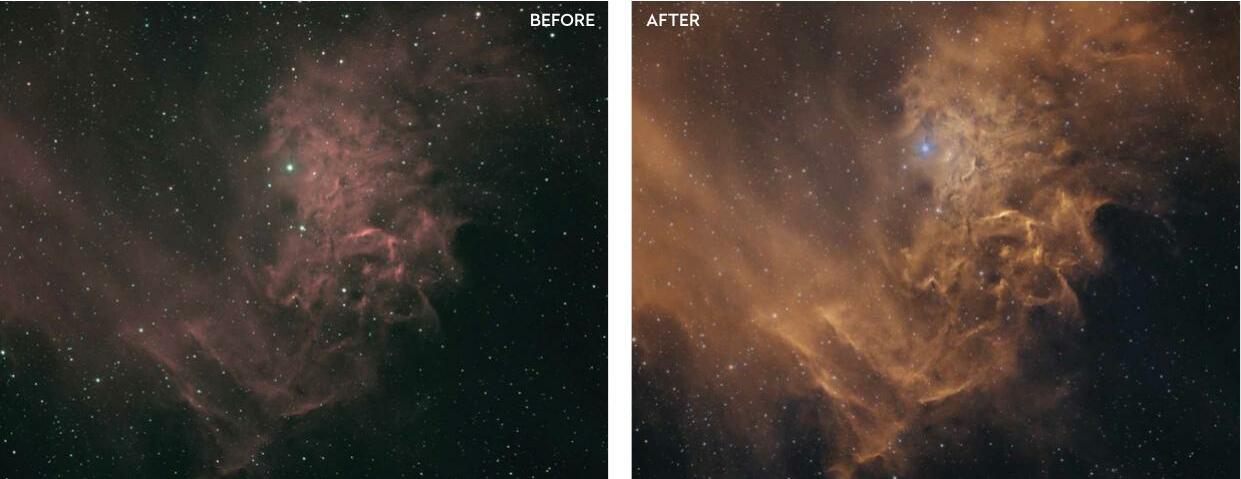
Avoid distortion while processing by taking the stars out of the picture with free software
A strophotography processing is all about the art of data control and getting the right balance between stretching data to tease out details, without going too far and 'clipping' it. Once the data is overstretched, delicate details are lost, or the image becomes noisy.
Stars are one major obstacle during processing. They limit the extent to which data can be enhanced, as they distort or become bloated. This reduces the desired 'natural' appearance for deep-sky images. Software that can remove stars therefore allows the user to work on all the delicate details, without being hindered by stars. One example is the free software StarNet++. Originally developed as a PixInsight module, it's now available as a standalone program via www.starnetastro.com/download. StarNet++ is compatible with both CCD and DSLR data, and so a popular choice for most astrophotographer toolkits.
Version 2 of the software was released early 2022 and includes a handy graphical user interface (GUI) that makes it more intuitive. This is the version we used to process our image of the Flaming Star Nebula (IC 405). Here we will go through the steps we took to remove the stars using StarNet++ and then use Photoshop to recover a 'stars-only' file which we could reapply to our fully processed nebula at the end.
Takeaway time


هذه القصة من طبعة October 2022 من BBC Sky at Night Magazine.
اشترك في Magzter GOLD للوصول إلى آلاف القصص المتميزة المنسقة، وأكثر من 9000 مجلة وصحيفة.
هل أنت مشترك بالفعل؟ تسجيل الدخول
المزيد من القصص من BBC Sky at Night Magazine
BBC Sky at Night Magazine
The Giant Leap: Why Space is the Next Frontier in the Evolution of Life
“Earth is the cradle of humanity, but one cannot live in the cradle forever,” wrote Konstantin Tsiolkovsky in 1911.

1 mins
February 2026
BBC Sky at Night Magazine
Tele Vue Nagler Type-7 series eyepieces
These premium optics were inspired by Apollo - and deliver a giant leap to your views
4 mins
February 2026
BBC Sky at Night Magazine
Once Upon a Time in Space
While the Space Race of the Cold War years was ultimately a geopolitical contest between the USA and the Soviet Union, the rivalry sparked rapid innovation and inspired multiple generations to look skyward.
1 mins
February 2026
BBC Sky at Night Magazine
The Multiverse: When One Universe Isn't Enough
The concept of a 'multiverse' – the idea that our Universe may be just one of many – is widespread in science fiction and a common thread of online discussions.
1 mins
February 2026
BBC Sky at Night Magazine
Q&A WITH A GAMMA RAY SPECIALIST
In 2025, astronomers detected a blast from space that lasted seven hours. Now they're uncovering the strange processes behind the exceptional outburst
3 mins
February 2026
BBC Sky at Night Magazine
Astronomy Photographer of the Year
The world-leading astrophotography competition returns. Could your image take the top prize of £10,000?
2 mins
February 2026
BBC Sky at Night Magazine
MOONWATCH
February's top lunar feature to observe
2 mins
February 2026
BBC Sky at Night Magazine
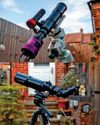
NOVAStar Scarlet A62Q 62mm f/8.4 quadruplet achromatic refractor
Well-built and capable, this beginner scope punches well above its bargain price
4 mins
February 2026
BBC Sky at Night Magazine
STAR OF THE MONTH
Rasalas, Leo the Lion's metal-rich crown
1 min
February 2026
BBC Sky at Night Magazine
Comet 24P/Schaumasse
Having reached perihelion on 8 January, comet 24P/ Schaumasse is now fading. Starting the month at a small-telescope-friendly mag. +10.5, it dims throughout February to below 12th magnitude.
1 min
February 2026
Translate
Change font size