يحاول ذهب - حر
Unmasking The Budget
February 16, 2018
|Down To Earth
The last full budget presented by Arun Jaitley was overwhelmingly focused on pro-people initiatives and the finance minister spent the initial 20 minutes of his speech on agriculture. The second most important part of his speech was public health. Jaitley was also eager to underline the achievements of his government ahead of next year's general elections and highlighted programmes like Ujjwala Yojana, Saubhagya Yojana, implementation of GST and improved ranking in ease of doing business. However, the government neglected a number of issues like climate change and its flagship programme Swachh Bharat Mission.

THE HOLLOW PROMISE OF INCREASING MSP
ON FEBRUARY 1, when Finance Minister Arun Jaitley said in the budget announcement that farmers would get 50 per cent higher minimum support price (MSP) than the cost of production for all crops grown in the current rabi season (2017-18) and upcoming kharif season, it should have infused enthusiasm among the country’s small farmers. But it has failed to uplift the spirit of Ramlal Singh, a small farmer from Bihar’s Sitamarhi district. Singh is one among the country’s 94 per cent of farmers who fail to benefit from MSP, no matter how high it is, in the absence of assured procurement by the government. Last year, though the government had fixed MSP of paddy at ₹ 1,550 per quintal, Singh was forced to sell his produce in the open market for ₹1,200.
If you think Jaitley’s announcement will benefit those who manage to sell their produce at MSP, think again. The government has not defined the cost of production, which lies at the heart of calculating MSP. The Commission for Agricultural Costs and Prices (CACP), which formulates and recommends MSP, categorises three types of cost of production: A2, A2+FL and C2. A2 represents the actual cost of farming including seeds, fertilisers and hired labourers. A2+FL represents family labourers in addition to A2. And C2 represents the cost of land rentals or interest on invested capital in addition to A2+FL. As many as 16 agriculture universities and institutions based in 19 states collect data from 10 farms of different sizes every day to ascertain the data related to cost of production.
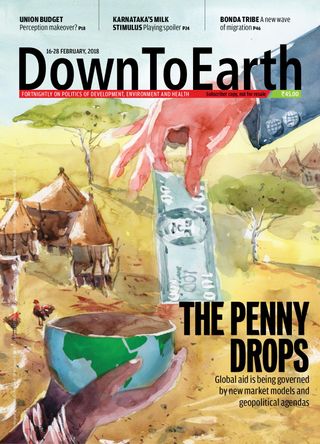

هذه القصة من طبعة February 16, 2018 من Down To Earth.
اشترك في Magzter GOLD للوصول إلى آلاف القصص المتميزة المنسقة، وأكثر من 9000 مجلة وصحيفة.
هل أنت مشترك بالفعل؟ تسجيل الدخول
المزيد من القصص من Down To Earth

Down To Earth
THINK TWICE BEFORE FELLING SAL TREES
Many trees considered to be affected by sal borer in the 1990s are still alive today

1 mins
February 16, 2026

Down To Earth
EDGE OF SURVIVAL
Caste divides deny marginalised communities land, resources and essential aid, leaving them more vulnerable to climate disasters
6 mins
February 16, 2026

Down To Earth
A WISH LIST?
Union Budget for 2026-27 conveys the impression of a roll-call of intentions and ambitious proposals, with little detail on their formulation
6 mins
February 16, 2026
Down To Earth
Break down the gender wall
THE RULING National Democratic Alliance (NDA) government has been heavily invested in the goal to make India a developed economy by 2047.
2 mins
February 16, 2026

Down To Earth
MENSTRUAL HEALTH, NOW A FUNDAMENTAL RIGHT
In a landmark judgement, the Supreme Court has recognised menstrual health and hygiene as a fundamental right under Article 21 of the Constitution of India, which guarantees the right to life and dignity.
8 mins
February 16, 2026

Down To Earth
Of devolution and new disasters
The 16th Finance Commission pushes for changes in view of new fiscal and climatic conditions
11 mins
February 16, 2026
Down To Earth
Rising risks of plastics
NEGATIVE IMPACTS on human health due to emissions linked to the plastic lifecycle could double by 2040, according to a study published in The Lancet Planetary Health in January.
1 min
February 16, 2026

Down To Earth
GAP BETWEEN EPIDEMICS NARROWING
A watershed-based and landscape-level approach is needed to address forest degradation
2 mins
February 16, 2026
Down To Earth
WAITING TO STRIKE
Sal heartwood borer is considered the biggest threat to forestry in India, especially to the sal tree, where it lives and breeds.
11 mins
February 16, 2026

Down To Earth
A SPRING DELIGHT
Mustard flowers are not meant only for the eyes. Invite them to your plate once in a while
3 mins
February 16, 2026
Translate
Change font size