يحاول ذهب - حر
Rise After The Fall
September 01, 2018
|Down To Earth
Sikkim, once the world's largest producer of large cardamom, is trying to regain its lost glory. Can it achieve the feat in the face of a changing climate?

AT 92, Til Bahadur Chhetri is a living witness of the rise and fall of large cardamom in Sikkim. Prized for its complex aroma, the exotic spice Amomum subulatum is grown across the eastern Himalayan region, including Sikkim and the Darjeeling hills in India. “Till the late 1990s, I used to get 40 sacks (about 2,000 kg) of dry large cardamom a year from my 7.2-hectare (ha) land. After that production started to decline,” says Bahadur, a resident of Hee Patal village in West Sikkim district. “Though it has improved in recent years, all I get now is a measly 300 kg,” he laments. In neighbouring Hee Martam village, Ganesh Chhetri, a young farmer, recounts a similar tale. “Just 10 years ago, my 2 ha land used to yield 300 kg of cardamom. It is now down to 100 kg,” says Ganesh, adding that the decline has forced farmers to shift to less lucrative crops like corn, vegetables and fodder.
The trend is evident across the Northeastern state, which till 2003- 2004 was regarded as the world’s largest producer of large cardamom. Though it continues to be the largest producer of large cardamom in India, the title of the world’s leading producer now rests with neighbouring Himalayan country, Nepal, which caters to about 68 per cent of the global market share of the spice.
A 2014 working paper by the International Centre for Integrated Mountain Development (ICIMOD), an intergovernmental learning and knowledge sharing centre based in Nepal, shows that the area under large cardamom in Sikkim increased from 19,912 ha to 22,714 ha between 1999 and 2004. That year, the state saw a record production of 5,152 tonnes of cardamom, up from 3,710 tonnes five years ago (see ‘Falling out of favour’).
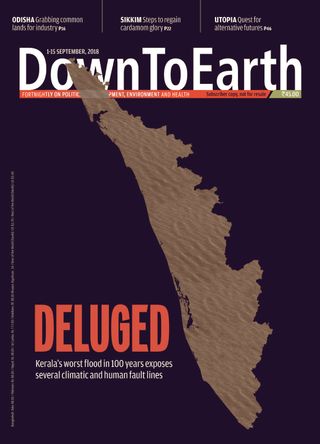

هذه القصة من طبعة September 01, 2018 من Down To Earth.
اشترك في Magzter GOLD للوصول إلى آلاف القصص المتميزة المنسقة، وأكثر من 9000 مجلة وصحيفة.
هل أنت مشترك بالفعل؟ تسجيل الدخول
المزيد من القصص من Down To Earth

Down To Earth
THINK TWICE BEFORE FELLING SAL TREES
Many trees considered to be affected by sal borer in the 1990s are still alive today

1 mins
February 16, 2026

Down To Earth
EDGE OF SURVIVAL
Caste divides deny marginalised communities land, resources and essential aid, leaving them more vulnerable to climate disasters
6 mins
February 16, 2026

Down To Earth
A WISH LIST?
Union Budget for 2026-27 conveys the impression of a roll-call of intentions and ambitious proposals, with little detail on their formulation
6 mins
February 16, 2026
Down To Earth
Break down the gender wall
THE RULING National Democratic Alliance (NDA) government has been heavily invested in the goal to make India a developed economy by 2047.
2 mins
February 16, 2026

Down To Earth
MENSTRUAL HEALTH, NOW A FUNDAMENTAL RIGHT
In a landmark judgement, the Supreme Court has recognised menstrual health and hygiene as a fundamental right under Article 21 of the Constitution of India, which guarantees the right to life and dignity.
8 mins
February 16, 2026

Down To Earth
Of devolution and new disasters
The 16th Finance Commission pushes for changes in view of new fiscal and climatic conditions
11 mins
February 16, 2026
Down To Earth
Rising risks of plastics
NEGATIVE IMPACTS on human health due to emissions linked to the plastic lifecycle could double by 2040, according to a study published in The Lancet Planetary Health in January.
1 min
February 16, 2026

Down To Earth
GAP BETWEEN EPIDEMICS NARROWING
A watershed-based and landscape-level approach is needed to address forest degradation
2 mins
February 16, 2026
Down To Earth
WAITING TO STRIKE
Sal heartwood borer is considered the biggest threat to forestry in India, especially to the sal tree, where it lives and breeds.
11 mins
February 16, 2026
Down To Earth
A SPRING DELIGHT
Mustard flowers are not meant only for the eyes. Invite them to your plate once in a while
3 mins
February 16, 2026
Translate
Change font size