يحاول ذهب - حر
HAVE WE GIVEN IN?
May 16, 2020
|Down To Earth
Countries are taking a leap of faith to return to normalcy and get the economy going. India is desperately trying to follow suit. But can it do so without letting its guard down?

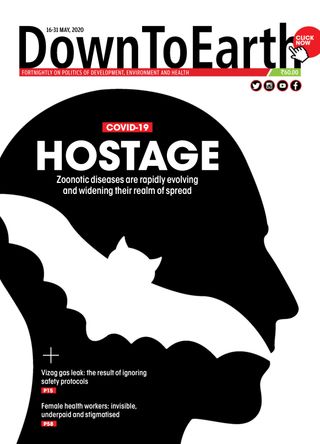
WE HAVE to live with the virus. These words have somewhat become like an anthem in this time of despair. There has not been a day since March 8, when the world, barring a few countries, has not reported record spike in COVID-19 cases. Yet, it has become ingrained in our collective consciousness that we have to live with this novel coronavirus, like over a thousand other pathogens, including hiv, Ebola, cholera and rabies, that are now part of our ecosystem and keep cropping up from time to time (see ‘Bats spread viruses, so do humans’, p38). This mood of resigned acceptance also reflects in the strategies of political leadership across countries, including India.
On May 8, while holding a press briefing, Lav Agarwal, India’s official spokesperson on the COVID-19 crisis, said: “It is important that today when we are talking about relaxation, when we are talking about return of migrant workers, we have a great challenge and we need to understand that we have to learn to live with the virus.” Earlier on May 4, as the Union government extended the nationwide lockdown, dubbed the biggest in world history, to 54 days, Chief Minister of Delhi Arvind Kejriwal also used “living with the virus” as a truism while urging the Union government for dilution of the lockdown rules. With 7,998 cases and 106 deaths as on May 11, Delhi is the third worst affected state in the country.

هذه القصة من طبعة May 16, 2020 من Down To Earth.
اشترك في Magzter GOLD للوصول إلى آلاف القصص المتميزة المنسقة، وأكثر من 9000 مجلة وصحيفة.
هل أنت مشترك بالفعل؟ تسجيل الدخول
المزيد من القصص من Down To Earth

Down To Earth
A WISH LIST?
Union Budget for 2026-27 conveys the impression of a roll-call of intentions and ambitious proposals, with little detail on their formulation

6 mins
February 16, 2026

Down To Earth
MENSTRUAL HEALTH, NOW A FUNDAMENTAL RIGHT
In a landmark judgement, the Supreme Court has recognised menstrual health and hygiene as a fundamental right under Article 21 of the Constitution of India, which guarantees the right to life and dignity.
8 mins
February 16, 2026

Down To Earth
Of devolution and new disasters
The 16th Finance Commission pushes for changes in view of new fiscal and climatic conditions
11 mins
February 16, 2026
Down To Earth
Rising risks of plastics
NEGATIVE IMPACTS on human health due to emissions linked to the plastic lifecycle could double by 2040, according to a study published in The Lancet Planetary Health in January.
1 min
February 16, 2026

Down To Earth
WAITING TO STRIKE
Sal heartwood borer is considered the biggest threat to forestry in India, especially to the sal tree, where it lives and breeds.
11 mins
February 16, 2026
Down To Earth
Cold January for West
ON JANUARY 23-27, parts of the Western Hemisphere—Colombia, Mexico, US and Canada—were hit by a winter storm bringing a mix of rain, sleet, freezing rain and snow across the region.
1 min
February 16, 2026

Down To Earth
Queries on ashwagandha
The article “Sip and unwind” (1-15 October, 2025) highlights the popularity of Withania somnifera (ashwagandha) and its use in contemporary wellness practices.
2 mins
February 16, 2026
Down To Earth
Mining impunity
A fatal blast in Meghalaya highlights the deep failure to curb rat-hole mining despite court orders and enforcement measures
4 mins
February 16, 2026
Down To Earth
Games of change
In Odisha's Sundargarh district, tribal women use games to learn their rights, and confront harassment
2 mins
February 16, 2026
Down To Earth
Popular distrust
THE WORLD seems to be going through a period of stasis despite facing an unfathomable polycrisis.
2 mins
February 01, 2026
Translate
Change font size