يحاول ذهب - حر
A WINNING FORMULA
January 2022
|BBC Science Focus
Beneath the rainforests of South America lives a fungi that consumes 50,000 leaves a day without ever coming to the surface. It relies on ants to bring it food in exchange for nutrients. This unlikely partnership starred in Sir David Attenborough’s new wildlife series The Green Planet. Evolutionary biologist Dr Pepijn Kooij speaks to Amy Barrett about this special relationship…

THE LEAF-CUTTER ANTS RELY ON THEIR FUNGUS FOR FOOD. WHY DON’T THEY JUST CUT OUT THE MIDDLEMAN AND EAT THE LEAVES THEMSELVES?
Digesting plant material is a difficult process, even for us humans. It’s a hard thing to do.
Think about herbivores, carnivores and omnivores, and just look at, for example, the lengths of their intestines. If you take a tiger – a carnivore – the length of its intestines is about six metres. But if you look at a cow – the perfect example of a herbivore – the intestine is about 24 metres long, and cows also have multiple stomachs. It’s a long process to digest plant material, and you need lots of different bacteria to help you do it.
Plants have this defence mechanism: an enormous cell wall around their cells to protect them from being eaten. It takes a lot of energy to get to the parts in the plants that we actually need – the nitrogen and proteins. But there are specialised organisms, such as bacteria [in a cow’s stomach], that are designed to do that kind of work. For the ants, they want those proteins, but it’s very hard for the insects to actually extract them. So they have their fungus help penetrate the cell, then the ants feed on the fungus.
BUT DOESN’T THE FUNGUS NEED THE PROTEIN? WHY WOULD IT SHARE?
Well, the fungus takes some of the proteins, but it has developed this relationship with the leafcutter ants. The fungus grows specialised organs, which we call gongylidia. Inside the gongylidia are fats and proteins, which are nutritious for the ants. The ants eat these gongylidia.

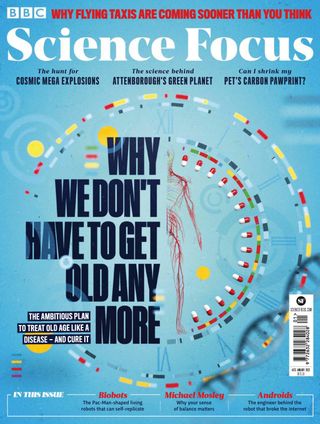

هذه القصة من طبعة January 2022 من BBC Science Focus.
اشترك في Magzter GOLD للوصول إلى آلاف القصص المتميزة المنسقة، وأكثر من 9000 مجلة وصحيفة.
هل أنت مشترك بالفعل؟ تسجيل الدخول
المزيد من القصص من BBC Science Focus
BBC Science Focus
World's biggest cobweb is home to 100,000 spiders
Spiders don't normally create such large colonies, so there's no need to worry about finding one in your basement

1 min
February 2026

BBC Science Focus
A dementia vaccine could be gamechanging – and available already
Getting vaccinated against shingles could protect you from getting dementia, or slow the progression of the disease
1 mins
February 2026

BBC Science Focus
DATA IN SPACE
An unusual spacecraft reached orbit in November 2025, one that might herald the dawn of a new era.
7 mins
February 2026
BBC Science Focus
Climate change is already shrinking your salary
No matter where you live, a new study has found warmer temperatures are picking your pocket
4 mins
February 2026

BBC Science Focus
A MENTAL HEALTH GLOW-UP
Forget fine lines. Could Botox give you an unexpected mental health tweakment?
3 mins
February 2026
BBC Science Focus
Most people with high cholesterol gene don't know they have it
Standard testing struggles to detect the condition
1 mins
February 2026

BBC Science Focus
HOW CAN I BOOST MY IQ?
If you're serious about getting smarter, it's time to ditch the brain-training apps
4 mins
February 2026
BBC Science Focus
Humans are absolutely terrible at reading dogs' emotions
Think you can tell how our furry friends are feeling? Think again
1 mins
February 2026

BBC Science Focus
HOW TO TEACH AI RIGHT FROM WRONG
If we want to get good responses from AI, we may need to see what it does when we ask it to be evil
3 mins
February 2026

BBC Science Focus
What Australia's social media ban could really mean for under-16s
Many people think social media is bad for our kids. Australia is trying to prove it
5 mins
February 2026
Translate
Change font size