يحاول ذهب - حر
THE SIEGE
June 2022
|BBC History Magazine
When some 6,000 parliamentarians tried to prise a few hundred royalists out of Basing House in 1643, they began a brutal siege that would drag on for years - and see thousands slaughtered. Jessie Childs tells the story of a desperate struggle that became a defining episode of the Civil War

In the line of fire
The siege of Basing House, in a contemporary engraving. The royalist stronghold was seen as a "microcosm of Stuart degeneracy", which the parliamentarians were determined to purge
On a plant-finding expedition to Kent in 1633, the apothecary Thomas Johnson looked out from the tower of Canterbury Cathedral and despaired at the inadequacy of the town's defences. "Our people," he lamented, "like the Spartans of old, set more store upon arms than upon walls for protection." A decade later, Lieutenant Colonel Johnson was shoring up the defences of Basing House in Hampshire, ahead of an imminent parliamentarian attack and presumably wishing that someone had listened to him earlier.
We have always preferred the glamour of the battle to the dog-work of a siege. We hear the rumble of the cavalry charge and the first dry rattle of new-drawn steel more keenly than the sound of digging and guard duty. We imagine the king's battle standard rescued at Edgehill and the royalist horse reduced to "stubble" by Cromwell's troops on Marston Moor, but a half-starved garrison negotiating terms of surrender is rarely part of the picture.
Yet the Civil War was not only won at Marston Moor, nor even at Naseby when Charles I lost his artillery and a large part of his officer corps in June 1645. It was won three months later, at Bristol, when his nephew Prince Rupert yielded England's second city and, with it, his command of the royalist army. It was won when further strongholds were taken and destroyed, securing parliament's supply lines and, ultimately, giving the king nowhere to hide.
"We make war more like foxes than lions," wrote Roger Boyle. "You will have 20 sieges for one battle"

هذه القصة من طبعة June 2022 من BBC History Magazine.
اشترك في Magzter GOLD للوصول إلى آلاف القصص المتميزة المنسقة، وأكثر من 9000 مجلة وصحيفة.
هل أنت مشترك بالفعل؟ تسجيل الدخول
المزيد من القصص من BBC History Magazine
History Extra
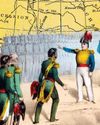
A treaty transformed North American history
California became American territory just days after gold had been discovered in the Sierra Nevada foothills – and Mexico lost out

3 mins
April 2026

History Extra
England's mistress
Nell Gwyn became famous for her love affair with Charles II, and for her love of drinking, gambling and carousing. Yet, writes Sophie Shorland, this upwardly mobile celebrity was also a canny political operator who wielded substantial power in court
10 mins
April 2026

History Extra
Across history, intellectual life repeatedly becomes suspect when societies fracture
A mistrust of ‘experts’ and ‘intellectuals’ has recently crystallised into US government interventions targeting academic institutions. EMILY KNOX and JOAN SCOTT share their thoughts with Danny Bird about the troubling history of anti-intellectualism
9 mins
April 2026
History Extra
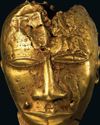
BLOOD AND PLUNDER
It's a tale of slavery, racism and naked imperial power. Barnaby Phillips traces the fate of the exquisite golden treasures looted by British forces from the kingdom of Asante 150 years ago
10 mins
April 2026
History Extra
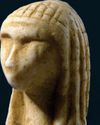
THE FACE FIXATION
From a Stone Age Venus and an Egyptian death mask to an unflinchingly challenging 21st-century sculpture, Fay Bound-Alberti introduces seven depictions of the face that track humanity's ever-evolving relationship with creativity, hierarchy and self-image
9 mins
April 2026
History Extra
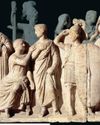
ROME'S PEOPLE POWER
From Romulus's open-city policy to Claudius's reforms, citizenship was used by Rome as both a reward and a weapon. And, as Shushma Malik explains, it enabled the burgeoning empire to build power and define identity
10 mins
April 2026
History Extra
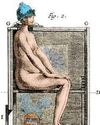
Sex in the city
A study of the understanding and treatment of sexually transmitted disease fascinates
2 mins
April 2026
History Extra
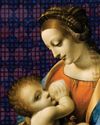
How medieval mothers took back control
In the Middle Ages, the bearing and raising of children defined women's lives. But as Elinor Cleghorn explains, there were women who had other ideas and boldly challenged attitudes towards motherhood
10 mins
April 2026
History Extra
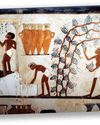
Ancient Egyptian omelette
ELEANOR BARNETT whips up an eggah - a tasty dish that continues to be enjoyed in Egypt to this day
2 mins
April 2026

History Extra
Seventy years ago, Nikita Khrushchev stood before a packed hall in central Moscow and delivered a four-hour denunciation of Josef Stalin, one that exposed mass terror and attempted to reclaim the legacy of Leninism. So what drove this extraordinarily radical move? And did the Soviet people buy Khrushchev's message?
When I was an undergraduate, a perennial exam question was ‘Did Stalin betray the revolution?’.
11 mins
April 2026
Translate
Change font size