
Magzter GOLD ile Sınırsız Olun
Sadece 9.000'den fazla dergi, gazete ve Premium hikayeye sınırsız erişim elde edin
Denemek ALTIN - Özgür
Autonomous Car Racing—A paradox, a sharp turn or the final lap of racing?
PCQuest
|August 2022
As bizarre and as bold it may sound, the idea of a racecar without a driver is a cockpit full of mystery, incremental innovations, hurdles and dilemma-packed scenarios. How does this even work? Let’s warm up this engine a bit

What’s the most fascinating part about F1 racing cars? That they can—in theory, so far—drive upside down for a few seconds? That the driver wears two suits and still loses a couple of kgs due to the extreme heat inside? That back then, in 1950s, safety was all about wearing a cloth-helmet and crossing your fingers that you would come out of the race without a scratch? That the most important part of a driver’s training— which, by the way, is years and years—is not the driving but the braking?
How about this? The longest pit-stop time recorded has been a good 43 hours—yeah, it took that many hours to dislodge the right wheel from a big team’s car. Sounds weird in an age where we talk of 1.82 seconds when we think of the best pit-stop time. But it is also a reminder that even the most record-breaking human feats start from a humble lane before they go on to smash scoreboards.
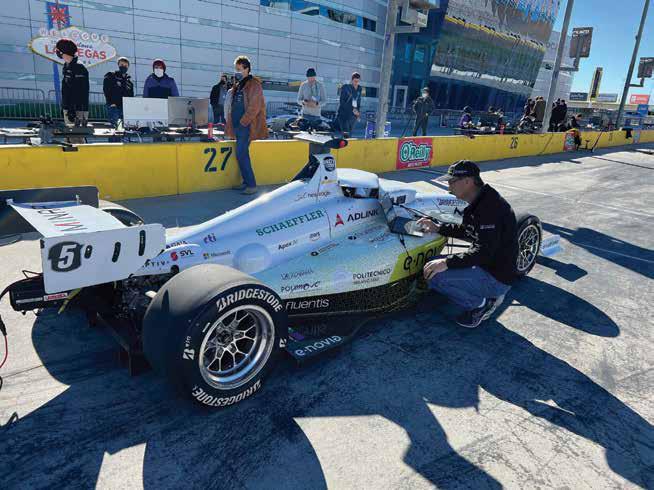
Something that’s now happening with autonomous car racing. We seem to have crossed the Woodcote (the first corner that drivers tackled in the very first F1 race many many decades back). Let’s see how far we are from the ensuing turns. It’s a good time to check how tricky the Copse, the Maggots, and the Club are going to be on this strange, but mind-bending, racecourse. More so, as this race is not about a driver’s dexterity to brake when required, but of data to accelerate—and in all directions.
Software in the Driving Seat
An autonomous race car is like any other racecar—except the human factor is not sitting inside the cockpit, but outside. Here, the driver is not a human head but a nerve-centre of sensors, wires, algorithms and Machine Learning marvels.


Bu hikaye PCQuest dergisinin August 2022 baskısından alınmıştır.
Binlerce özenle seçilmiş premium hikayeye ve 9.000'den fazla dergi ve gazeteye erişmek için Magzter GOLD'a abone olun.
Zaten abone misiniz? Oturum aç
PCQuest'den DAHA FAZLA HİKAYE
PCQuest
When Software Drives the Machine Need for Enterprise-Grade Software
Cars used to fail because of broken parts.Now they fail because of broken code. As vehicles become rolling computers, enterprise-grade software, ruthless testing, and fail-safe architecture decide one thing: whether a car keeps moving safely at 100 km/h

2 mins
March 2026

PCQuest
AI on the ground Practical use cases of AI in large enterprise operations
AI isn't a side project anymore, it's the quiet operator inside global giants. It reads invoices, senses machine fatigue, tailors every customer moment, flags risk in real time, and feeds leaders sharper instincts. Scale just got smarter
3 mins
March 2026

PCQuest
From AI experiments in 2025 to enterprise scale in 2026: Why data foundations will decide the winners
Everyone's betting big on Al, but most are burning cash instead of building value. The hidden culprit? Dirty data, clunky processes, and missing context. What if fixing your foundation, not your algorithms, was the real AI game-changer?
4 mins
March 2026

PCQuest
How automation at the periphery is accelerating digital transformation
Digital transformation is not tearing down the core anymore. It is happening at the edges. With AI and automation layered onto existing systems, companies are cutting costs, boosting productivity by up to 40%, and scaling smarter without risking operational chaos
2 mins
March 2026

PCQuest
When AI moves from chips to racks
AI performance is no longer just about faster chips. It is about how racks, power, networking, and orchestration work together. As agentic AI grows, infrastructure must become predictable, open, and built for scale from day one
4 mins
March 2026

PCQuest
Designing enterprise AI systems that stay fair
In 2026, bias is no longer treated as a communications issue or a public relations headache.
6 mins
March 2026

PCQuest
HALO smart sensor
What if bathrooms, locker rooms, and isolated spaces could become safer without adding cameras?
2 mins
March 2026

PCQuest
Building enterprise AI that doesn't discriminate
Bias in enterprise AI is not a side issue. It starts in data pipelines, training systems, product design, and engineering workflows. As AI scales, fairness, transparency, and accessibility are becoming core software requirements
4 mins
March 2026

PCQuest
Bias travels faster than code
Bias in enterprise AI is not a surface issue. It enters through data, features, model training, APIs, and UI logic, then spreads across the stack. The technical response is shifting from audits to architecture, observability, and deployment controls
6 mins
March 2026

PCQuest
How hospitals can use AI without risking patient data
With the fast pace of adoption of Artificial Intelligence (AI) and digital health systems in Indian hospitals, issues related to the security of patient data are also increasing at an equal rate.
2 mins
March 2026
Translate
Change font size