Denemek ALTIN - Özgür
How to Fine-Tune LLMS for Domain-Specific Adaptation
Open Source For You
|March 2026
In this first part of a two-part series, discover why we need to fine-tune large language models, and get introduced to the core concepts and techniques used for their domain-specific adaptation.
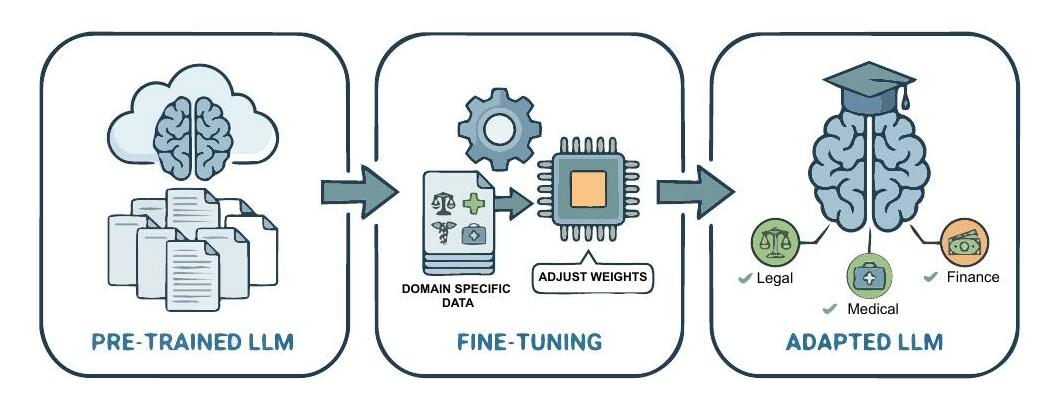
Large language models (LLMs) are deep neural networks, typically based on the Transformer architecture, trained on massive text corpora to predict the next token in a sequence. These models can generate text, write code, summarise documents, and answer complex questions. However, a general-purpose LLM cannot automatically perform well in specialised domains such as finance, healthcare, legal compliance, or enterprise-specific tasks. This limitation creates the need for LLM adaptation, where a pre-trained model is modified to behave correctly for domain-specific use cases.
Approaches to LLM adaptation LLMs often need adaptation for two main reasons. The first is the limitations of base models -pre-trained models possess generic knowledge and may produce inaccurate or contextually irrelevant responses (i.e., prone to hallucinations).
The second reason is the need for customisation, as enterprises require outputs that follow internal standards -specific tone, formats, templates, and regulatory language.
There are three main approaches to adapting an LLM: prompt engineering, RAG, and fine-tuning.
Prompt engineering: Prompt engineering adjusts the model's behaviour through carefully crafted instructions without changing the model itself. It is best suited for quick behavioural adjustments in situations where the base model already has sufficient domain knowledge.
RAG (retrieval-augmented generation): RAG enriches the model's responses by retrieving relevant external documents and injecting them into the prompt at inference time. This enables the model to generate knowledge-based answers using fresh or domain-specific information without requiring retraining.

Bu hikaye Open Source For You dergisinin March 2026 baskısından alınmıştır.
Binlerce özenle seçilmiş premium hikayeye ve 9.000'den fazla dergi ve gazeteye erişmek için Magzter GOLD'a abone olun.
Zaten abone misiniz? Oturum aç
Open Source For You'den DAHA FAZLA HİKAYE
Open Source For You
I2C and I3C: How Modern Devices Communicate
I3C and I2C are both two-wire communication protocols that help exchange data between multiple devices. While I3C preserves the simplicity of I2C, it introduces new features suited for today's sensor-rich devices.

8 mins
March 2026
Open Source For You
Data Deduplication Done the Right Way
Deduplication helps to save space on Linux-based storage systems. Choose the right platform and check whether it meets your goals.
5 mins
March 2026

Open Source For You
The Relevance of Rubber Duck Debugging in the Age of AI
Discover why rubber duck debugging is a powerful process today.
4 mins
March 2026

Open Source For You
Sending IoT Sensor Data to Public or Private Servers
This IoT system shows a simple and effective way to send sensor data using an ESP8266 microchip.
3 mins
March 2026

Open Source For You
Optimising RAM Usage with Python
Discover how we can make better use of RAM by applying various Python optimisation techniques.
7 mins
March 2026

Open Source For You
How a Job Portal Benefited from Microservices Architecture
Microservices architecture has emerged as a preferred pattern for building scalable and maintainable software applications. Here's how a monolithic job portal application was re-engineered into a microservices-based system. The migration process, key design decisions, the technology stack used, and measurable improvements in performance and flexibility are all laid out for you.
9 mins
March 2026

Open Source For You
The Role that Software Architects Play
Software architects design software projects and ensure these meet their goals. They must balance tech skills with leadership and mentoring abilities.
5 mins
March 2026

Open Source For You
The Path to Cybersecurity in the Quantum Era
The rise of quantum computing will be accompanied by a failure of conventional cryptography. Post-quantum cryptography and advanced threat detection methodologies, among other techniques, are being evolved to counter security threats in the quantum era.
8 mins
March 2026

Open Source For You
Why Open Source Large Language Models are Popular
Open source large language models mark a pivotal moment in the evolution of generative Al. By lowering barriers to entry and fostering collaborative innovation,these models are enabling a broader spectrum of organisations to benefit from Al.
7 mins
March 2026

Open Source For You
Ant Group open sources two frontier AI models
Ant Group has open sourced two trillion-parameter frontier AI models-Ling2.5-1T and Ring-2.5-1T-placing advanced large language and reasoning systems directly in the hands of developers and researchers worldwide.
1 min
March 2026
Listen
Translate
Change font size