
Magzter GOLD ile Sınırsız Olun
Sadece 9.000'den fazla dergi, gazete ve Premium hikayeye sınırsız erişim elde edin
Denemek ALTIN - Özgür
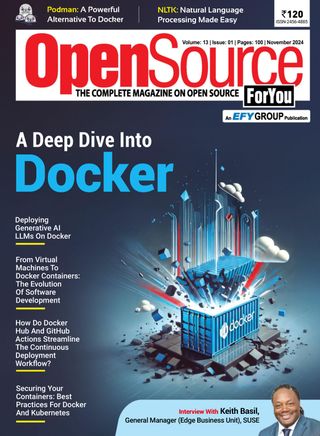
Containerisation: The Cornerstone of Multi-Cloud and Hybrid Cloud Success
Open Source For You
|November 2024
Open source containerisation software provides the flexibility, cost-effectiveness, and community support needed to build and manage complex multi-cloud and hybrid cloud environments. By leveraging this software, businesses can unlock the full potential of multicloud and hybrid cloud architectures while minimising vendor lock-in risks.
-

Containerisation in the cloud is a key aspect of modern cloud computing architectures, particularly in multi-cloud and hybrid cloud environments. It involves encapsulating applications and their dependencies into lightweight, standalone units known as containers. This approach offers several benefits, including portability, fault isolation, ease of management, and simplified security.
The rise of multi-cloud and hybrid cloud architectures has dramatically reshaped the IT landscape. These models offer businesses greater flexibility, scalability, and resilience. However, they also introduce new complexities and challenges. Here, open source software emerges as a crucial enabler, providing a foundation for building and managing these intricate environments. The popularity of open source container platforms like Dockers, Kubernetes and OpenStack has led to rapid adoption of “write once and run anywhere” across on-premises data centres, hybrid cloud and multicloud environments. In addition to the flexibility, the architecture design speeds up development and prevents cloud vendor lock-in.
Understanding multi-cloud and hybrid cloud
Containerisation has become a cornerstone of modern cloud computing. Its benefits, such as portability and resource efficiency, make it a game changer. Understanding containerisation involves grasping the concept of encapsulating applications and their dependencies into lightweight, standalone units known as containers. Multi-cloud and hybrid cloud are two prominent cloud computing architectures that have gained significant traction in recent years, enabling the containerisation of applications.
Multi-cloud: This refers to the use of multiple cloud platforms from different providers, such as AWS, Azure, and GCP. It offers increased flexibility, vendor independence, and disaster recovery capabilities.

Bu hikaye Open Source For You dergisinin November 2024 baskısından alınmıştır.
Binlerce özenle seçilmiş premium hikayeye ve 9.000'den fazla dergi ve gazeteye erişmek için Magzter GOLD'a abone olun.
Zaten abone misiniz? Oturum aç
Open Source For You'den DAHA FAZLA HİKAYE

Open Source For You
Sending IoT Sensor Data to Public or Private Servers
This IoT system shows a simple and effective way to send sensor data using an ESP8266 microchip.

3 mins
March 2026

Open Source For You
Popular FOSS Tools for LLM Observability, Monitoring and Evaluation
This overview of popular tools for monitoring large language models also sheds light on how LLM-as-a-judge enhances their performance.
2 mins
March 2026
Open Source For You
Data Deduplication Done the Right Way
Deduplication helps to save space on Linux-based storage systems. Choose the right platform and check whether it meets your goals.
6 mins
March 2026

Open Source For You
The Relevance of Rubber Duck Debugging in the Age of AI
Discover why rubber duck debugging is a powerful process today. There's also a step-by-step guide on how to use it in the age of artificial intelligence.
4 mins
March 2026

Open Source For You
GitHub weighs turning off pull requests as AĬ slop floods projects
GitHub has formally acknowledged that AI-generated 'slop' is overwhelming open source projects, forcing maintainers to sift through poor pull requests (PRS), abandoned submissions and guideline violations - and is now considering restricting or even disabling pull requests, the core mechanism of open collaboration.
1 min
March 2026

Open Source For You
Global banks are deploying Ethereum's Layer-2 stack
Banks are standardising on Ethereum's open source stack as production financial infrastructure, shifting from experimental pilots and proprietary blockchains to live Layer-2 networks for tokenised deposits, interbank payments, and cross-border settlement.
1 min
March 2026

Open Source For You
OpenClaw's creator joins OpenAl
In a move that reinforces its commitment to open development rather than acquisition, OpenAI has brought Peter Steinberger, founder of OpenClaw, into the company while placing the popular AI agent under a foundation structure to ensure it remains open source.
1 min
March 2026
Open Source For You
LibreOffice 26.2 comes with native Markdown support
LibreOffice 26.2 has been released by The Document Foundation, strengthening its position as a fully free and open source office suite for Windows, macOS, and Linux, with support for more than 120 languages.
1 min
March 2026

Open Source For You
Indian government mandates labelling of Al-generated content and quicker deletion of illegal deepfakes
India has introduced sweeping AI content rules that immediately place pressure on social platforms and open source AI ecosystems to label, trace and rapidly remove AI Open ource synthetic media at scale.
1 min
March 2026
Open Source For You
I2C and I3C: How Modern Devices Communicate
I3C and I2C are both two-wire communication protocols that help exchange data between multiple devices. While I3C preserves the simplicity of I2C, it introduces new features suited for today's sensor-rich devices.
8 mins
March 2026
Listen
Translate
Change font size