
Magzter GOLD ile Sınırsız Olun
Sadece 9.000'den fazla dergi, gazete ve Premium hikayeye sınırsız erişim elde edin
Denemek ALTIN - Özgür
Unchecked Megaconstellations
Scientific American
|June 2026
Satellite swarms could destroy our view of the heavens and seriously damage our planet
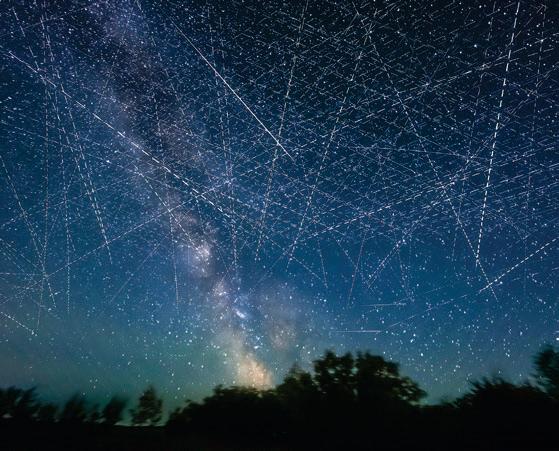
I REMEMBER THE FIRST TIME I SAW A SATELLITE. I was a teenager, standing in my mildly light-polluted suburban yard and doing my usual stargazing. The satellite was a faint “star” moving slowly and smoothly across the sky, and as I watched it I felt a mix of awe and wonder that such a thing could be seen—and that humans could put an object into orbit at all.
That was a lifetime ago, and I now look back on that evening with more discomfiture than nostalgia; my adolescent naivete feels almost embarrassing.
That’s because these days, seeing one of those celestial travelers fills me with dread. We are firmly in the era of the satellite constellation—groups of dozens of similar satellites—and are currently entering the era of the megaconstellation, wherein groups of thousands of satellites swarm the skies. The clusters of satellites started small, but like a viral outbreak, they grew almost without us noticing—and now we’re dealing with a pandemic.
I wrote about this problem for Scientific American in May 2023. At the time, there were 7,500 active satellites orbiting Earth; about 4,000 of them were SpaceX Starlink satellites that provided Internet service. In the three years or so since then, the number of Starlink satellites in orbit has surpassed 10,000. Today there are more Starlink satellites up there than the sum total of all other operational satellites.
This ratio will almost certainly get more skewed toward Starlink, too; back in 2019, when the first Starlink satellites were launched, SpaceX filed proposals with the Federal Communications Commission for up to 30,000 additional satellites.
Does that sound bad? Well, there may come a day, all too soon, when we’re nostalgic for that small a number of satellites cluttering the sky. On January 30, 2026, SpaceX applied for permission to launch as many as one million more satellites.
Yes, one million.


Bu hikaye Scientific American dergisinin June 2026 baskısından alınmıştır.
Binlerce özenle seçilmiş premium hikayeye ve 9.000'den fazla dergi ve gazeteye erişmek için Magzter GOLD'a abone olun.
Zaten abone misiniz? Oturum aç
Scientific American'den DAHA FAZLA HİKAYE

Scientific American
War in Plain Sight
Near-real-time satellite coverage means militaries can no longer hide. So they are learning to lie better

4 mins
June 2026

Scientific American
A Bridge-Crossing Puzzle Led to New Math
Are you smarter than an 18th-century Prussian?
5 mins
June 2026
Scientific American
Nocturnal Navigation
These ants use a sophisticated lunar compass
2 mins
June 2026
Scientific American
Early Plates
Scientists found the oldest direct evidence for Earth’s tectonic motion
3 mins
June 2026

Scientific American
Mating Arm
Reproduction in octopuses is even weirder than you think
3 mins
June 2026

Scientific American
Battleship Science
Game-playing AI can show us how to do science better
2 mins
June 2026

Scientific American
WHAT’S A QUANTUM COMPUTER GOOD FOR, ANYWAY?
Quantum computing promises profound power in cryptography, materials design, telecommunications, and much more. But those dreams won’t become reality overnight—if ever
11 mins
June 2026

Scientific American
Atomic Snowflakes
Could each atom in the universe be unique?
2 mins
June 2026
Scientific American
The New Moon Race
The triumphant Artemis II mission marks a new era of lunar exploration and science. Here’s how it went down and what comes next
7 mins
June 2026

Scientific American
What’s Wrong with Quantum Mechanics
A 100-year-old theory might explain the confusion
6 mins
June 2026
Listen
Translate
Change font size